Bishop Rob’s October 2026 Convention Address
“Abide in me as I abide in you. Just as the branch cannot bear fruit by itself unless it abides in the vine, neither can you unless you abide in me. I am the vine; you are the branches.” (John 15:4–5)
Nearly fifteen years ago, this diocese asked me to be the 10th Bishop of New Hampshire. You had asked for someone you hoped would be your pastor through whatever pathways God would lead us. There are days when I felt this was a good fit, and I give thanks for those wonderful times. And there were times when I know, and you know, I fell short. And I pray for God’s mercy and forgiveness, knowing that God’s grace is indeed amazing, and if I have learned anything about myself or God in these past 15 years, it is to abide in God, and not so much in myself.
The theme of this Convention is Abide. For us Christians, to abide has greater meaning than our home address or a particular place; we abide in the comfort of knowing that Jesus is with us no matter what, no matter when, no matter where.
This natural image of Christ as the vine resonated deeply in a state overflowing with natural beauty, where the land itself reveals and reflects God’s love. The image of mutual interdependence, where the branch cannot bear fruit without the vine, as we cannot bear divine love without God, was compelling. That life-giving vine soon became a powerful icon for us. It found its way onto our shield, gave its name to our diocesan newsletter, and reminded us of the life connecting our communities—from St. Barnabas in Berlin to St. Andrew’s-by-the-Sea in Rye.
One of my teachers, Rowan Williams, once wrote, “God is the presence in which all memory is present.” Here at our 2026 Convention—a hinge between our past and our future—God holds all that has been and all that is yet to come. In that living vine-like presence, we are always on a threshold, always growing: even if sometimes being pruned, sometimes merely surviving, and sometimes flourishing. We are always in between.
As I prepare to say farewell to this diocese, I am deeply grateful for the ways you have taught and nurtured me to abide in Christ. There have been times of great growth, celebrations, and renewal. There have been places of deep disappointment, decline, separation, and closure. As we head into this season, my mind can’t help remembering the amazing saints I got to serve with here who were always ready to lend a hand and offer wisdom, but who have gone on to their reward. Judith Esmay, Charlie Montgomery, Dave Young, Ron Wanner, George Sutherland, Pat Stelz, Bill Exner. There are so many dear, dear hearts I cherished, whom I have not named, and who now abide deeper in God’s presence than we can see. I praise God for them.
And I praise God for your forbearance of my shortcomings, flaws, and failures as your bishop. I will carry in my heart those memories of hard times, difficult or outright wrong choices made, and pray that God and you will hold this time we have had together in the light of God’s mercy.
Yet the Vine, the True Vine of Christ, is always sprouting something new. Certainly, since the end of the pandemic, I have noticed new shoots in the vine: in our children and youth.
If I have one hope for this diocese going forward—something I wish I had been able to nurture even more fully during my time—it is our ministry with children and youth. Our children are growing up in what the Prayer Book describes as “an unsteady and confusing world.” They need to know the fruits of abiding in God. No matter what the future brings, God’s love is eternal and rock-solid, no matter what.
Soon you will hear about the Fund for Youth Ministry, Belonging and Thriving in the Love of Jesus. It is my deepest hope that the Church will be here for today’s children and for generations to come.
Before we elect our next bishop, we will tend to the work of this Convention. We will vote on a prudent and faithful budget to begin a new episcopate in the coming year. We will also vote on the petition of St. Christopher’s Church in Hampstead to become a parish, to rejoice with them in their growing in the Spirit, from strength to strength, in their ministry. We will also celebrate a new beginning for the Mission of the Sugar River Valley Episcopal Churches: Union, Trinity Claremont, and Epiphany, Newport, as they are admitted as a mission in a new collaboration that lends vitality, resources, and joy to the worship of God and the neighborhoods in a lovely corner of our diocese.
I am so grateful for and admiring of the courage and steadfast love of the priests, deacons, and people who have seen God doing a new thing among them. Some of these efforts have been the result of just a few years of faithful conversations. Some of them are the result of a couple of centuries’ laboring in the vineyard. These resolutions are the fruit of our abiding on the Vine and of God’s faithful abiding with us.
For fourteen years, it has been the deepest honor of my life to serve alongside you—to worship, to lead, to listen, and to walk together through seasons of joy and challenge. You have taught me by showing me how to abide in Jesus.
As we go into this next season, God abides with us in our seeking, and we abide with God, even if we are not always clear what God is doing among us, except loving and tending us. Sometimes God plants. Sometimes God prunes. Sometimes God enriches the soil. Sometimes God gathers the harvest.
Always, God tends the vine.
Always, God abides within us, and we abide in God.
May God bless you richly in the season ahead. May the vine we have tended together continue to bear abundant fruit.
Praying for our Nation on the 250th Anniversary of the Declaration of Independence — July 4, 2026
Dear People of God in the Granite State:
On this milestone Independence Day, perhaps you have noticed a certain ambivalence about its celebration in others and in yourself. We do indeed have so much to give thanks for—our land’s natural and bounteous beauty, the richness of the many heritages that have contributed to our varied customs and people, and the blessings of community, freedom of faith and speech, the capacity to pursue genuine happiness. At the same time, we acknowledge the fear and suspicions that plague us, the widening inequities of wealth, health care, education, and opportunities that do more to constrain, rather than enhance, the freedoms the Declaration still promises. Our Founders were both heroic and flawed men. They sought the best for a people, and even nations, yet unborn. And they were tragic in their inability to cast the shackles of slavery for all humankind, to allow the right to vote to all, or to settle this nation without the violent eradication and subjection of the native peoples, the first stewards of these lands and waters.
To acknowledge these both/ands is to acknowledge the complex truth on which God always insists. For Christians, in whom all memory is present in the Presence of a righteous God, history is studied and told not for the sake of a paralyzing shame, but to set us toward new horizons of justice, mercy, and grace.
Whether you are conservative or progressive, Republican or Democrat, (or like me, who bristle at being labeled by any party and refuse to be locked into the orthodoxies of any political party), you may resonate with the words of an early student of our nation, Alexis de Tocqueville. Tocqueville spoke of our nation’s promise in this way: “The greatness of America lies not in being more enlightened than any other nation, but rather in her ability to repair her faults.” (Democracy in America, Chapter XIII, 1835.)
I invite us to give thanks, hearty thanks, for this nation. And I invite us to appeal to God’s grace and mercy to grant us the courage, vision, and trust in the God, the Judge of all nations, who is to assist us in repairing our faults. To make this prayer, I turn to the Book of Common Prayer, and the Thanksgiving for National Life, page 838, included below.
Faithfully Yours in the Sovereign Lord Jesus Christ,
+Rob
Thanksgiving for National Life
Almighty God, giver of all good things:
We thank you for the natural majesty and beauty of this land.
They restore us, though we often destroy them.
Heal us.
We thank you for the great resources of this nation. They
make us rich, though we often exploit them.
Forgive us.
We thank you for the men and women who have made this
country strong. They are models for us, though we often fall
short of them.
Inspire us.
We thank you for the torch of liberty which has been lit in
this land. It has drawn people from every nation, though we
have often hidden from its light.
Enlighten us.
We thank you for the faith we have inherited in all its rich
variety. It sustains our life, though we have been faithless
again and again.
Renew us.
Help us, O Lord, to finish the good work here begun.
Strengthen our efforts to blot out ignorance and prejudice,
and to abolish poverty and crime. And hasten the day when
all our people, with many voices in one united chorus, will
glorify your holy Name. Amen.
For Heroic Service
O Judge of the nations, we remember before you with grateful
hearts the men and women of our country who in the day of
decision ventured much for the liberties we now enjoy. Grant
that we may not rest until all the people of this land share the
benefits of true freedom and gladly accept its disciplines. This
we ask in the Name of Jesus Christ our Lord. Amen.
*
Bishop Rob Delivers Final Address at St. Paul's School - April 13, 2026
Good morning. It is a deep and awesome privilege to be with you again. Thank you for your welcome. This passage that we just heard from John's gospel is the first of what are referred to as the resurrection appearances of Jesus. He comes and he meets the disciples the evening after he rises from the dead and he comes with wounds. He comes showing them the evidence of their having abandoned him at the cross. They're locked in a room. They've locked themselves into a room for fear and probably shame. Each of them in that room left Jesus to hang and die.
It's of note that when Jesus comes, he could have just said, "Where were you? You promised to be with me even to the end of time, to the end of this whole journey, and you all took off—each one of you.” Instead, the word Jesus speaks is, “Peace.” Peace. It's a message of forgiveness, a message of healing, a message of restoration, of community in the midst of division, hatred, and fear. Yesterday, most Christian churches that follow what's called the Revised Common Lectionary read that passage of Jesus extending peace, but the same day, we also heard in the news that prospects of peace in the Middle East were becoming more remote.
And it occurred to me, as it often does, that there will be no world peace if there's not first peace among us, peace within our own communities, our own neighborhoods, among us in our own schools and churches and synagogues and mosques, peace within ourselves. And peace is not something that urges us to just forget what we've done with each other, against each other or to each other. Real peace does erase our memory of past hurt, but it holds us accountable without rancor, without hatred, always respecting the dignity of every human being. I can never read this passage of being in a locked room--the disciples in a locked room for fear and shame, and Jesus entering that room --without remembering of a moment in my life when I was very young, 13 years old, that bears some similarity, although in a much less significant way. But for me, it was a pivotal moment.
I grew up in suburban Connecticut, outside of New Haven, and I was a freshman in high school at the time. And I remember one day, it was late fall, and the bus took us home, and I got off the bus and we started to walk. It was about a quarter mile walk from the bus stop to my house, and there were a number of other students. One was Mary, my next door neighbor, with whom we shared homework with our algebra or geometry, whatever that was, which I was never good at. And there were three brothers, Billy, Gary, and David. And we got off the bus and started walking home, and one of the brothers noticed a crab apple tree on another house in that development. Something came over him, and he decided that he would pick up one of the crab apples that had fallen to the ground. There was a whole nest of them. And he picked it up, and he threw it at Mary, hitting her in the back.
He did it again, this time hitting her in her cheek. She began to cry and quickened her pace, and then the other brothers followed, gathering fistfuls of crab apples and hurling them at Mary. And then they asked, "Robbie, how about you? " And so I picked up a crab apple and also hit Mary. It landed in the back of her head, hard enough to sting. We all made it home. After that, I went into my house. Both my parents worked, so I opened my math book and started to try to do my homework. About a half an hour went by and the doorbell rang, and I wondered who could that be. So, I went down the hallway and I could see through the panel of windows on each side of the door that it, of course, was Mary.
I pretended not to hear. I hid away, but she kept ringing the doorbell. Finally, I couldn't pretend anymore, and I had to open the door. And there she was, her face tear-stained, and she said, "Rob, the Miller boys, they always treat me that way. I could expect it from them, something like that. But today, today it was you. I thought we were friends.”
God help me, I just melted at that moment. I don't think I could even say, "I'm sorry." But she knew that even at 13 years old, even though we didn't know the language of forgiveness and grace and all of that, we knew that there was a deep hurt.
We were not at peace. Now, God bless my mother. She always had a cookie jar of those wonderful Toll House cookies. I said, "Mary, come in, please." And I put out some of those cookies out and poured some milk. Maybe that was the beginning of my decision to become a priest. It was like teenage communion, and we just sat there in silence and had cookies. Somehow we got through the next hour or so. We talked about math. We made small talk. Small talk is not to be underestimated in our healing with one another, small talk, lowers temperatures. Small talk begins the tender bonds that build and restores relationships.
The next morning, we went to the bus stop and I knew that I had to stand with Mary and walk alongside her as she faced the cruelty, the senseless, gratuitous, pathetic cruelty of my other neighbors. Sure enough, they picked up crab apples even the next morning and started hurling them this time at both of us. That afternoon when we came back from the bus, I think they realized that it was puny and pathetic what they were doing. They had stopped.
You remember that scene in the Lion King? (This is a transition.) When Simba is called back to the pride, (interestingly called, “the pride”), to come back to community after living a life of Hakuna Matada—where you just look after your own desires and wants and concerns. Rafiki, who holds a staff and has vestments, is a priest but he’s also, of course, a baboon. (Clergy are sometimes thought of that way.) Anyway, Rafiki leads Simba to a pool of water and he, Simba look at the pool of water. The movie superimposes this image of his father, Mufasa. And somewhere Mufasa says, "Simba, you have become less than you are.”
You have become less than you are.
When Mary rang that doorbell and she said, "Rob, today it was you” That was my Mufasa moment. “You have become less than you are.” Jesus doesn't bother to ring the doorbell. He goes through locked doors and when he shares peace to those disciples undeserving and needing to be held into account, he reminds them that you have the power to forgive or to retain the memory of hurt. That's the message of our faith. That's the message of Easter. If we can't reckon with the call to become who God has created us to be, holy, flawed, deeply flawed, wholly beautiful and forgiven, there's no chance for this world. It starts here. It starts in our own hearts.
Thank you.
Easter Message from Bishop Rob — April 2026
Every year, a close reading of the same gospel, even if we’ve read it over a life-time, brings something fresh, something green, and new—something surprising. It may be very familiar and obvious, but the Holy Spirit wants us to notice it as though for the first time because we need to hear it for the first time. This year what springs up as though a new sunrise is the verse in John’s gospel, at the end of the Good Friday reading, when we hear these words:
Now there was a garden in the place where he was crucified, and in the garden, there was a new tomb in which no one had ever been laid.
To this day, in the Holy City of Jerusalem, the Church of the Holy Sepulchre is also known as the site of Calvary, Golgotha, the place of the crucifixion, where tradition tells us that a relic of the cross was uncovered AND it is also the place where Jesus was laid in an unused tomb. It’s from the tomb, of course, where God raised him from the dead. Execution and resurrection happen in the same small piece of real estate: the place of unimaginable suffering by human hands and hearts AND the site of the world changing triumph of life over death, love over fear, forgiveness over hatred. It is the place our savior expresses humankind’s deepest abandonment by God and humankind. And it is the site of recognition: of us recognizing Jesus and then the risen Jesus seeing us as a friend. It is the site of the most holy “both/and” which is our life in the Risen Christ.
Our Calvaries are legions. There are so many, too many, and too heartbreaking to list. We all know what they are. The effects of human sin and cruelty, done by us and to us, are all around. We see them. They burden and grieve us. Those crucifixions lead us to times of both despair and hope. They are the reason for our prayers, our seeking help from God and each other. They are the cause of our thirst for righteousness, our struggles to forgive, and our cries to be forgiven. The desolate Place of the Skull and the Garden of Resurrection are layered on top of each other. The suffering and death of bodies, of communities, of hope itself, occur in the same place, and with even more power where we meet Jesus’ Rising. From out of the depth of the Sepulchre, Jesus calls us each by name just as he called to Mary Magdalene on that first Easter morning.
May your Good Fridays, your scenes of deep loss and sorrow be converted into a glorious resurrection, a rising to life, to a love and a life that is stronger than death. What courageous joy that gives us, to know in our bones that nothing, not even death, or the fear of death, will separate us from the love of God in Jesus. May that love and life rise in our hearts this Easter, and may every day be Easter. Jesus Christ is Risen. Alleluia.
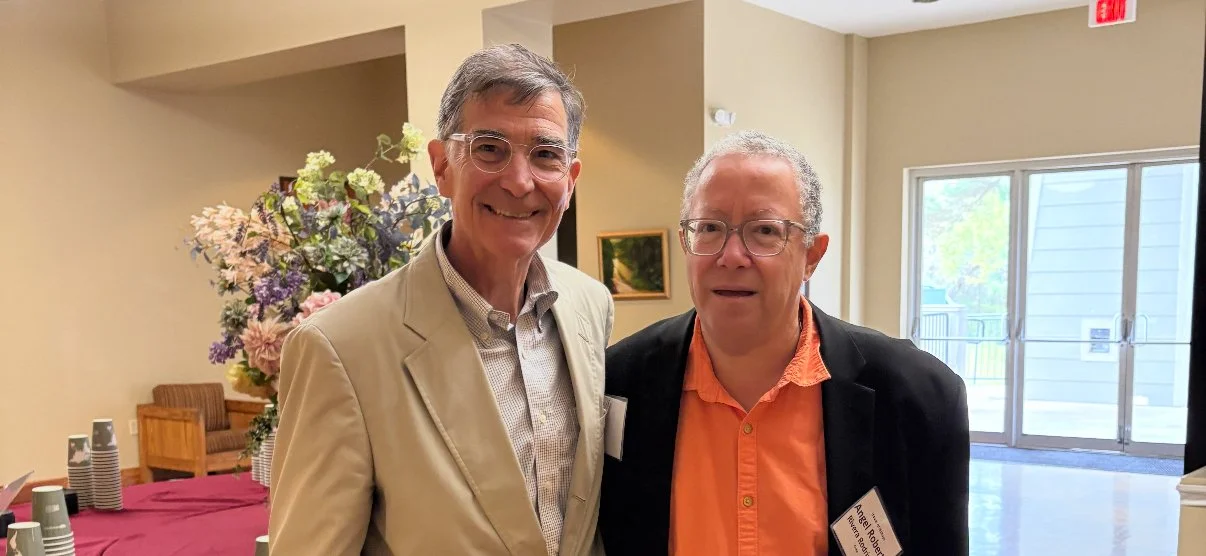
Bishop Rob and Bishop Angel, of Cuba, spend time together.
Report from Bishop Rob - House of Bishops Spring Meeting - March 17-25, 2026
It was a privilege for me to attend the spring gathering of the House of Bishops at Camp Allen in the Diocese of Texas. Though I always hate to leave my beloved Diocese of New Hampshire, I find the time enriching to be with my colleague bishops from the whole Episcopal Church, including from the dioceses in Latin America, Europe, and Taiwan.
By now a Word to the Church has been issued. Its intent is to offer a message of hope, unfailing in the Good News of Jesus Christ, even in times of crisis and discouragement. The new war in Iran—extending to the whole Middle East—the ongoing conflicts in Ukraine, Sudan, and other parts of the world weigh heavily on all of our hearts. Such suffering is a call for us all to pray, fervently, for efforts for a just and lasting peace. I am humbled by the work of my fellow bishops and their churches as they strain to hold together community in Christian fellowship even as forces of inhumanity toward immigrants are rampant and political rages foam.
We always come together in prayer. I have been part of a small but growing number of bishops who devote daily time on contemplation. We do this because as our world experiences such chaos, disorientation, and division, and even war, it is essential that Christians, especially Christian leaders, stay rooted in the awareness of God’s enduring, loving, and life-giving presence in the Incarnate, Crucified and Risen Jesus. Any word or action that is not rooted in prayer is, as Paul says, like a noisy gong to a clanging cymbal. I believe that the tenor of our discussions during the more business-oriented sessions of the House has been more open to deep listening and respect because of the critical mass of bishops who practice contemplative prayer, even those who consider themselves more activist on certain issues.
We spent much of our time discussing the state of theological education, particularly for the raising up of priests in our Church. The landscape of traditional seminary training has shifted significantly in the past 15-20 years. Our denomination has gone from relying on eleven 3-year residential and very expensive seminaries to something like seven, and each of those offering paths that are more accessible to postulants for Holy Orders in local settings, such as rural New England. Much of the changes in education have been driven by economic and demographic forces. The bishops’ discussion of these trends was much overdue. It was so confirming to me to see how our establishment of the School for Ministry, for laity, deacons and priests is something that is becoming more and more accepted and even normative in the wider church. As I spoke with bishops from Ecuador, Columbia, Puerto Rico, the Dominican Republic, Cuba, Massachusetts and Pittsburgh, I was heartened to learn how we are all facing similar challenges in the urgent need to raise up new ministers of the gospel. New Hampshire’s hybrid model is something looked to and admired by such different settings in the Episcopal Church.
We also heard of Presiding Bishop Sean Rowe’s diligent efforts to reform and reshape the organizational structure of the Episcopal Church in a way that supports evangelism, church planting, and redevelopment. There are significant and overdue changes being contemplated, about which we will hear in the coming months. This support for church renewal is of keen interest to us in New Hampshire as we initiate new missions in Manchester, Claremont, Portsmouth, and more in the coming years. This is so important to consider and welcome as demographic models predict a movement northward of the U.S. population in the coming decades. We have been praying for young adults and families for years. I pray that the spiritual and organization work we have done in our Diocese in recent years has helped us prepare for the growth that, God willing, is coming our way.
We discussed proposals in the wider Anglican communion that seek to deepen and further relationships with other provinces of the Church where relationships have been strained and in disrepair for a variety of reasons. The Nairobi-Cairo Proposals are fascinating to read because they imagine a church that is seeking ways to be in communion, and defining what communion means, in an era when the long-term trend for churches, religions, indeed almost every institution in society is toward greater splintering. Though the bishops are, in my view, rightly cautious about the proposals, it is encouraging to think of the many who continue to do the hard and sacred work of true reconciliation across serious differences of practice.
I was so grateful to hear a fulsome presentation from Bishop Ann Ritonia, Bishop Suffragan for the Armed Forces and Federal Ministries. Our church’s work to provide pastoral care and accompaniment to chaplains in the military, federal prisons and hospitals is truly essential, especially when so many of these chaplains encounter tremendous moral, spiritual, and physical trauma. I am grateful for Bishop Ann’s witness to both the gospel of Jesus Christ AND the U.S Constitution’s protection against the incursion of governmental establishment of religion of any kind.
Finally, the return home through a Houston airport stressed with dramatically fewer TSA agents and many more ICE agents felt like being in a country that has changed. As I walked through the labyrinth paths to the security check points, along with thousands of others, I thought of the many pilgrims throughout millennia who have walked the Way of the Cross in Jerusalem, recalling the path the Jesus took from his entry into that City, to his actions in the Temple, to his Trial, his Crucifixion, his burial and his Rising.
I hope that wherever your journey and observances this coming Holy Week takes you, you may know how Jesus Christ walks alongside you, sharing your hopes, your joys, and the depths of your sorrows.
He will raise us all in peace and glory.
Yours in the Risen Christ,
+Rob
Convention Address 2014
Restore us, O God of hosts; *
show the light of your countenance, and we shall be saved.
Turn now, O God of hosts, look down from heaven;
behold and tend this vine; *
preserve what your right hand has planted.
We have work to do. We have work to do. And it’s the sweetest work anyone can be called to. We get to tend the Vine that is the mission of God in the world. We get to join the work of God whose delight it is to bring fruitfulness to what God has planted.
Let’s face it, for many of us, the work we have felt called to perform has been thankless, onerous, bearing meagre fruit. In some of our churches, we keep having to do more with less. For many of us, our buildings, though in the past were centers of community gathering, learning, and hospitality, are now more often sources of stress and fatigue. We wonder where the youth are. We wonder where the people are. We wonder why things are not quite like they used to be.
When you leave this convention tomorrow, and your neighbor will ask you what did you do this weekend, what will you say? Perhaps you’ll say, “We went to Concord. We heard the bishop talk. We voted on a budget, on what clergy should be reasonably paid. We voted on the status of a struggling congregation in the middle of the state. We voted on a position on capital punishment. We sang some songs. We heard about the work of the diocese.” The diocese.
And your neighbors might ask, “what’s a diocese?” Or they may ask, “So how’s the diocese in New Hampshire doing? Growing anywhere? Any more youth or children in church? What does a diocese do anyway?” And then maybe your friends and family members will shake their heads with a mixture of sympathy or befuddlement.
But what if, when they asked you what you did this weekend, you said, “You know what?, I re- joined a movement. I showed up for a cause, the most important in my life. I decided to join the Mission of God to restore a fallen world full of injustice, cruelty, anger, decay, damage. I heard again, but as though for the first time, that I am connected to a cause that is greater than my own self-interest. I found that instead of just another pledging unit, I am nourishing a web of relationship and concern that I need to live and that needs me to live. Instead of being counted as another who makes up the ASA the Average Sunday Attendance, I am essential because every encounter I have, from Monday to Saturday, adds to the number of Average Weekly Encounters with God we have in the world. So more than just ASA (average Sunday attendance) my life increases the Average Weekly Encounters--AWE.”
We got work to do, but it’s sweet and awesome work because it’s the work that brings joy to God’s heart.
Here’s the sweet and awe-filled work that I see we have to do in this part of the Vineyard that we know as the Episcopal Church in New Hampshire. Yes, I’m calling it the Church of New Hampshire, and not the diocese. This is because we are all called into this fellowship of love, of abiding together, of tending the vine together. I’ve only been bishop for two years, and I’m already tiring of being linked to a bureaucratic word that divides me and the bishop’s office from the life of the parishes I am coming to love, and the schools, and all the ways we find to worship and serve God.
So how do we tend the vine?
I’ve come to see that there are Five Practices, five activities that are how we share the work of God, the Divine Vinedresser.
First, We show up.
We present ourselves. We make an opening in our lives for God when we stop and say God is here and I want to be present for God, in my own life, in my community, in my family, friends and neighbor, familiar or stranger. You showed up today. You said no to certain things that you could have done today, in order to be changed by encounters beyond your control. We show up when we pray, placing ourselves in the steadfast and surprising Presence of God who is beyond our control, but who loves us. We show up in our ministries in the world. We show up to discover how is God making God’s-self known in this crisis in my town, in my family. The two most frequent words Jesus uses are “listen” and “go.” We show up because as part of a living vine, we are destined for growth, exploration, and fruitfulness
The Church in New Hampshire is being called to show up in some curious ways. We used to think that showing up for youth and children meant having Sunday School rooms full. We relied on families to show up on Sunday, saying no to the cultural machine that says, in effect, unless your child makes the soccer or the hockey team or first seat in the school orchestra or accomplishes, they will not succeed in life. We have effectively lost the competition for Sunday morning. And then we lament that failure. But children feel connected to the Vine when they see adults from their church communities show up for these events, cheering them on, showing healthy curiosity and showing concern. The Church of the Holy Vine in New Hampshire is a church that stretches out beyond itself. Sometimes we resist going out and listening. We are more accustomed to staying and waiting for God to being the people to us, and then we feel a sense of failure and frustration when they do not come. When God asks “whom shall we send to bear witness to God?” we have bright examples in our midst of our churches going out and saying, “Here we are. Send us!” Here’s one example:
Twenty-one years ago, there was an epidemic of teenage suicide in Goffstown. The church there could have easily hunkered down, paying attention to its own membership and buried its head in the sand to the multiple tragedies that brought national attention. Instead the ministers both lay and ordained of St. Matthew’s went out. Actually, to hear Father Bill Exner tell it, he and others in the church had been knocking on their doors for a long time before the crisis reached epidemic proportions. They initiated a practice of monthly conversations with others in the community and created a way to have ongoing conversations with school administrators, educators, parents, children, youth, teachers, to talk about the deepest most pressing concerns facing youth today. Those conversations continue, and the whole community of Goffstown is the stronger for it. They are now considering addressing the concerns not only of middle and high school students, but of the distressed population of young adults in their twenties. That’s showing up. That’s going and listening. I am learning that the most lively churches and the most effective leadership in the Church of New Hampshire is when the ministers, both lay and ordained, see themselves not so much as taking care of St. Matthew’s, or Trinity, or St. Andrew’s, or Good Shepherd, but they say that the church is showing up, in Christ’s name, and for Christ’s sake, for Goffstown, or Colebrook, or New London. We show up.
Second Practice, We Tell the Story.
Stories are the way the seeming chaos of our lives is joined and brought to order within the overarching story of God in Christ. The story of the Vine itself is only one example of a story that stretches back from the Creation where Adam and Eve were tasked to take care of the Garden, to the days of the prophets Isaiah and Micah, to the great parables of Jesus to the carvings and drawings on so many of our vessels from which we eat and drink from the presence of Christ in the Eucharist. When you tell a story, virtually any story, you can find a way to connect it to the stories of God’s people seeking meeting and life and relationship.
We are people of a story. The story of “our creation, preservation, and all the blessings of this life, and above all of the redemption of the world through our Lord Jesus Christ”, is actually a constellation of countless stories. We are our stories. Stories shape our understanding of reality. The Gospel is simply “the good story” that gathers up all of our stories of failure, loss, success and renewal, hate and love. The failure of the Church to include children and youth in our life is not so much a failure of low numbers in Sunday School, but a failure of all of us to creatively find ways to share our story. As a result children find themselves ill-equipped to face the colossal and threatening forces that take them away from the love of God. Telling the story is about forming Christians for the 21st century. The forming and education of Christians is undergoing a radical and rattling change. Sunday School for many churches does not work anymore as a means to share the story. But every other Wednesday during Family Worship led by Grace Burson, Rector of Holy Spirit, Plymouth, the story is actively shared in the Dining Hall of the Holderness School. And the number of participants in Weld Hall rivals what happens in the Church of the Holy Spirit on Sunday Morning.
I sometimes wonder if we might do better to stop trying explain what the Bible says in our sermons, but just retold the story without explanation. Let the power of the story do its own work. Or if we held open mic opportunities for members of our communities “members or not” to share their own stories of healing, forgiveness, grace, hope and resurrection. The St. Mark’s in the Bowery Poetry project, now at least fifty years old, is one example of the vine reaching out to the outside community of writers, playwrights and poets and being interwoven into the Vine through the Word made flesh. What stories are waiting to be told in our congregations to link us to the world and to God?
Third practice: We splash water.
Jesus’ baptism was not something that excluded him or set him apart. He wasn’t joining an elitist tradition of religious fanatics when he went out to the Jordan. He wasn’t looking to separate himself from the wounded creation or from the full catastrophe of human society. When he entered those waters, Jesus immersed himself into both the infinite possibilities and the infinite tragedies of being human. When we pour water at a baptism, or when we splash water on our faces when entering a church, we remind ourselves that we are joined with Christ in his complete joining of the human race. We also acknowledge that we are part of a wounded creation that needs our care because we cannot live apart from it. When we splash water at our baptism or when we enter a church, we proclaim the cosmic truth expressed by the South African Nguni Bantu word Ubuntu, which means “I am because you are.” My soul, my life, my personhood, my dignity depends on your soul, your personhood, your dignity. And my life, my personhood, my dignity depends on the health and vitality of the creation. Water is what connects all of us, spiritually and as a church, water is how we can ensure the growth and vitality of the Vine.
So, let’s invite anyone who wants to live in the Ubuntu of Jesus to enter those waters. Let’s see some baptisms, for God’s sake. I saw a Parish Register this year whose last baptism was in Bishop Phil Smith’s episcopate. (That was in the 70’s, my friends.) Likely, that was a matter of sloppy record keeping rather than actual practice, but still. In my travels around the Church of New Hampshire, I’ve encountered congregations who would prefer to be isolated and cut off from their neighborhood, preferring instead to just keep to their own. The waters of our baptism, like the waters of the Red Sea, expel us to join the mission of God in the world even if we would sometimes pine for the old days of our bondage. One reminder of that inclusion and expulsion would be to take those ornate and carefully carved lids off the fonts around here, and get some water in those fonts, let’s celebrate that God wakes us up with the water of new life from the nightmare of separateness from the creation and from each other, from other races, classes, other political parties. Here’s another way we can celebrate God’s mission of Ubuntu by splashing water:
Might we be called to show up in a laundry mat, as is being done in other parts of The Episcopal Church. Small teams, maybe of only two apostles (which, remember, simply means person who is sent) offer to pay for and do the laundry of those who use a coin-up laundry. They offer to pray for whatever is on their heart. Before long a community forms. One such a community of “Laundry Love” gained enough strength that Bishop Jon Bruno of Los Angeles actually ordained a deacon to help support it, and the ordination took place in the laundry mat. That’s showing up. That’s tending a vine that has stretched beyond the ivy-covered towers. Vines need watering. Let’s go find some ways to splash it around.
Fourth, We share the food.
Tomorrow we will approach a table, just as you we all do every Sunday morning and at other times during with week. We will share a time of divine invasion into the work of our Convention as our prayers will call the Holy Spirit to transform our gifts of bread and wine into the very presence of the Risen Christ. We will share this most holy food, we can do no other. And when we do that, we will become once again what we receive, the hands and feet and heart and eyes of Jesus Christ. We will become what the world so hungers and thirsts for us to become, fellow servants of God for a broken world.
Because we can share it in a convention center as well as we can share it in the most meticulously cared for, and venerated, gothic arched chancel, we can be bearers of God’s death-defying forgiveness, peace, and justice in the world. When the world sees us, with all of our conflicts and complaints, in all of our glamour and our poverty, gathering reconciled at the eucharistic Altar, the world rightfully comes to expect that we extend that same thanksgiving meal in prisons, from the ChIPs program to Death Row, in feeding programs, at our workplaces, on the streets, the laundry mats, behind the ballot curtains, in the marbled halls where just laws are being fashioned in the State House.
And when the world sees us not caring, not exhibiting the same compassion that Jesus had for the hungry crowd who seems to him helpless and harassed, like sheep without a shepherd, the world will quite understandably dismiss us as self-absorbed with our own survival. The place where youth and young adults seem most to connect with our aging denomination is when we, unabashedly in the name of Jesus, go out into the highways and byways, the shelters, the tent cities here in Concord, in the wounded earth, and among the dispossessed, and show leadership by service. Will Pendleton, of Christ Church, Exeter, is our first representative in the Young Adult Service Corps, having returned from Cuba as a servant leader. The Young Adult Service Corps, and the Episcopal Service Corps, are like an Episcopal Peace Corps, offering opportunities for young adults in their twenties to serve those in need, both locally and abroad, and to experience the mission of God in the world. We hope in the coming year or two to establish such a mission here in New Hampshire, to serve the communities among us that are finding themselves off-the-grid of the economic recovery. Places like Tilton and Franklin, Coos and Sullivan counties are places where we might plant new vines where God can give the growth in ways we can only imagine.
The connection between how we share the holy food of the altar, and how we establish justice was made crystal clear to us in the words of Jesus: The words “when you do it the least of these, you do it to me” are St. Matthew’s version of saying, “All are meant to be connected in the vine. See your selves and others as separate from the vine only at your spiritual and economic peril. “ Episcopalians, of every political party. President Dwight D. Eisenhower, Episcopalian, Republican spoke some shimmering words that I recently discovered framed and hung on the walls of Edgerton House, our center for chaplaincy at Dartmouth College. “Every gun that is made, every warship launched, every rocket fired signifies in the final sense a theft from those who hunger and are not fed, those who are cold and are not clothed.”
Ike got it. He tended the Vine. How are we sharing the food to tend the vine of a peaceful society? Where are we being called to share the food, in the coming year?
The Last Practice is not something we do, but something we watch for: God Surprises
It’s God’s life breaking through into the life of our Church, into the life of the world. There are many ways God surprises, and as sure as I am standing here, I know that each of us can list at least several surprises of the past year. Surprises of how God brought delight to us when we saw persons in our church, people who had been at enmity with each other, find a way to reconcile. That is always a surprise, even when we spend our days striving and praying for it. In a world marked by the need for retribution and violence, a world addicted to holding grudges, to angry rhetoric and partisanship, in a world of such coarseness as ours, never, never take reconciliation and forgiveness for granted.
But, let me list a few other godly surprises that I’ve seen over the past year.
When I asked at St. John’s, Walpole during a baptism of a child if anybody else wanted to wade in the water and a father and his teenage son nudged themselves through the pews and got themselves pretty drenched and something stirred among the whole congregation. God surprised us all then.
When Hannah Anderson convened a group of souls at St. Andrew’s, Manchester to be trained in Servant Leadership fifteen persons showed up, more than 9 congregations were represented and are on fire for bringing Gospel servanthood into our communities. That is a God Surprise.
I was surprised by the openness by which the good and faithful people at Trinity, Tilton chose to live into the hope of the resurrection, even as they face the strong likelihood of their closing. The parish church, one expression of God’s community, sometimes may need to so radically transform itself, so fundamentally alter how it is faithful to the Spirit, that it needs, like a grain of wheat, to die. The conversations continue, though with sadness and grief, into the unknown. But surprisingly, new people that God has brought to that church will continue to gather among themselves, or in the nearby congregation, to wait in prayer and silence, a wilderness of some kind, without jumping into an easy remedy too hastily. Though the conversations have been stressful and painful and direct, we can be surprised by the sense that God is showing up in some new way that asks us to show up. If this decision feels like a pruning, a cutting off, it’s important to remind ourselves that what is being pruned is a building and a way of being that has brought more suffering and pain in recent years than life. It is not people who are being pruned, they are being loved into a new way of being and worship and service that is full of the light and joy rather than anxiety and burden of an institution.
God surprised me when Tim Breen, the Head of School, and the Trustees, of the White Mountain School chose to reaffirm and reclaim its roots by including this sentence in its new mission statement: “Grounded in our Episcopal heritage, we prepare and inspire students to lead lives of curiosity, courage and compassion.” The trustees are looking at architectural rendering of a new chapel. The Head and Trustees of the Holderness School are also looking at plans for an enlargement and refurbishment of its Chapel of the Holy Cross and having open conversations about how to strengthen its spiritual life program for its students. What surprises me is the movement toward being what Bishop Andy Doyle calls “unabashedly Episcopalian.” We may hear ourselves saying to a skeptical world, “As an Episcopalian I am a Christian but I’m not closed hearted, rigid in my thinking, or fearful of those who act and believe differently than I. Instead, I am beginning to hear schools like the White Mountain and Holderness say, “It is Because we are Episcopalian, that we are curious, compassionate and courageous when facing the unknown and the challenges of world.” Do you hear the difference? That’s God surprising us in a place we wouldn't have expected.
I was surprised by the presence of members and leaders of the Lutheran, Roman Catholic, United Church of Christ, and other denominations in the state house and state senate on Maundy Thursday, as we bore witness against the death penalty on the eve Good Friday. Marti Hunt of St. Andrew’s, Hopkinton and Father Dan Ferry of Grace Church, Manchester, and many others, urged us to show up and stand up to say that because of the execution and resurrection of God in Jesus the violence of the death penalty, has no place in God’s kingdom of mercy and justice. God surprised me by the leadership of those who will continue that work and witness, work and witness which we are invited to continue tomorrow afternoon when we come to our resolutions.
As I was writing this address a surprise arrived in the mail in the form of an approval of a grant from the United Thank Offering to help fund our observance next summer of the 50th anniversary of the martyrdom of Jonathan Daniels. Next year, we will be invited to hear some powerful preaching at blessed Jonathan’s home parish in Keene, and at other places in New Hampshire, and to participate in a civil rights pilgrimage in the south that ultimately leads to the site of Jonathan’s witness to God’s justice for all God’s children. When you become aware of God’s surprises and you begin to give thanks for them, the more they seem to land in our laps. The Vine wants to grow. It’s what vines do.
When I gathered the clergy a few times over the course of the past year, and despite vast, differences in circumstances, part-time, full-time, rural, or urban, suburban, some of their churches burgeoning with growth, others just hanging on, all of them facing seismic changes in how we are the Body of Christ in a society that world, I do not take for granted the depth of respect, mutual concern, and prayerfulness among them. It is a deep honor to serve them and the all people of this Church, this part of the vineyard. Even as we find old unfruitful ways of serving God are being trained to grow in new ways, and even pruned, may we continue to abide with each other and in Jesus who is doing some new and powerful things among us. God surprises because that is the nature of a God who is ultimately beyond our knowing, but who loves us deeper than we can love and care for ourselves.
So, come, let us tend the vine, together with God.
Turn now, O God of hosts, look down from heaven; behold and tend this vine; *
And let us help, for in aiding you we will find our life restored, refreshed, and renewed. Here we are, O, Lord, send us!