Youth Pilgrimage: Walking in the Footsteps of Jonathan Daniels - Sept. 2026
By Barbara MacLeod
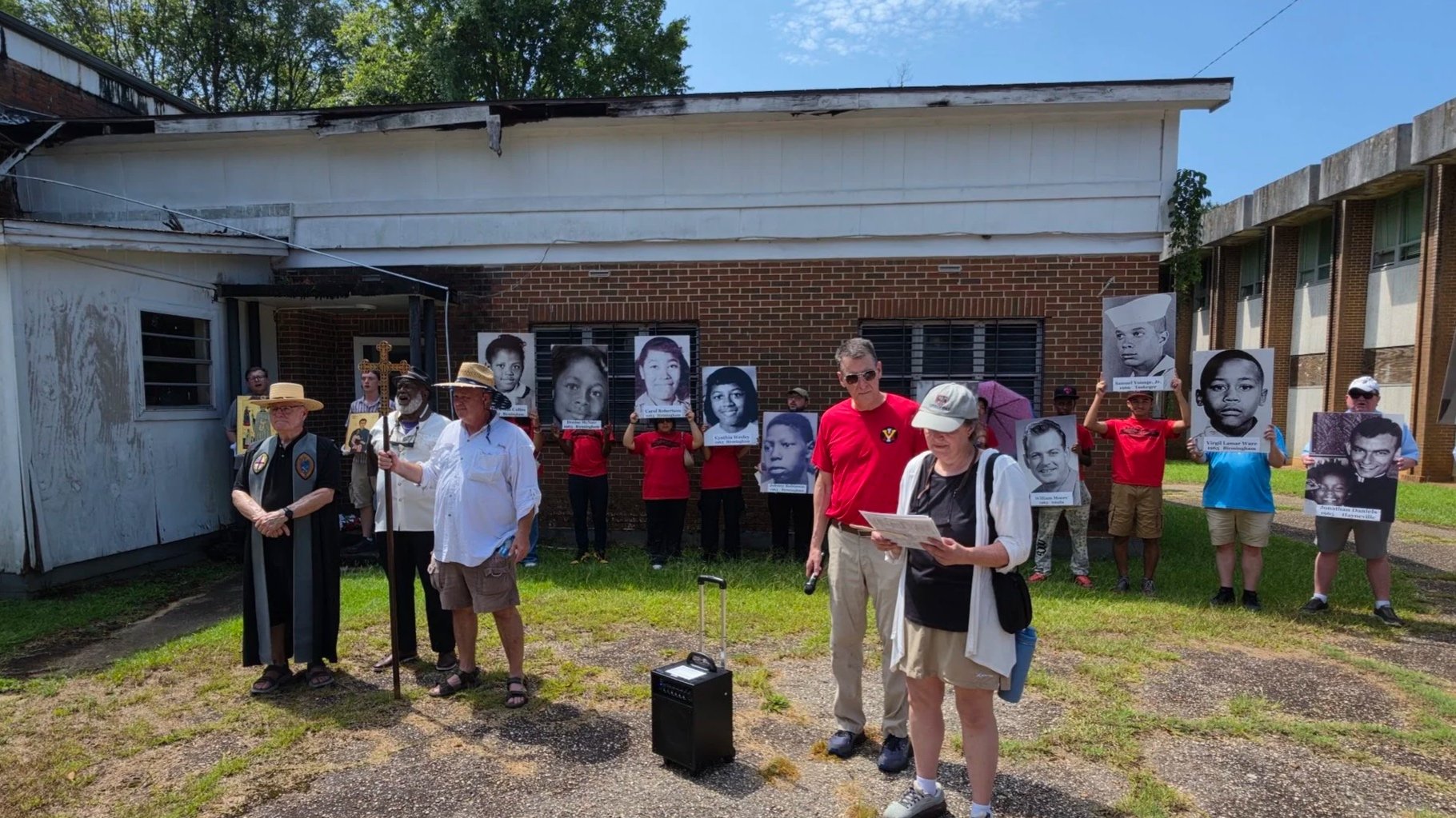
A group of Episcopal teenagers from across the state traveled to Alabama in August for a pilgrimage that brought them face to face with some of the most difficult chapters of American history. It also challenged them to consider what their faith asks of them today. The impetus of the four-day trip was to follow in the footsteps of Keene seminarian Jonathan Daniels, who was murdered in Alabama in 1965, saving a young Black activist from a bullet.
Seventeen-year-old Ava Tennett of Goffstown says the experience revealed how much of civil rights history she did not know. “I was personally impacted by how much I learned that schools simply do not teach,” she said. “We visited museums and landmarks and spoke with people who dedicate their lives to making sure this history and truth are remembered.”
The five young people were accompanied by four adult chaperones. Their journey included visits to significant historic sites before culminating in the annual Jonathan Daniels and the Martyrs of Alabama Pilgrimage in Hayneville.
The idea for the trip began a year earlier, when the Rev. Kelly Sundberg Seaman traveled to Alabama for the 60th-anniversary pilgrimage honoring Daniels. She realized what a meaningful experience it could be for young people to learn about history in the places where it actually happened.
The Rev. George Swenson, who oversees youth ministry for the diocese, says an important aspect of the pilgrimage was helping the teenagers understand the broader history surrounding Daniels' decision to come to Alabama and the role faith communities played in the Civil Rights Movement.
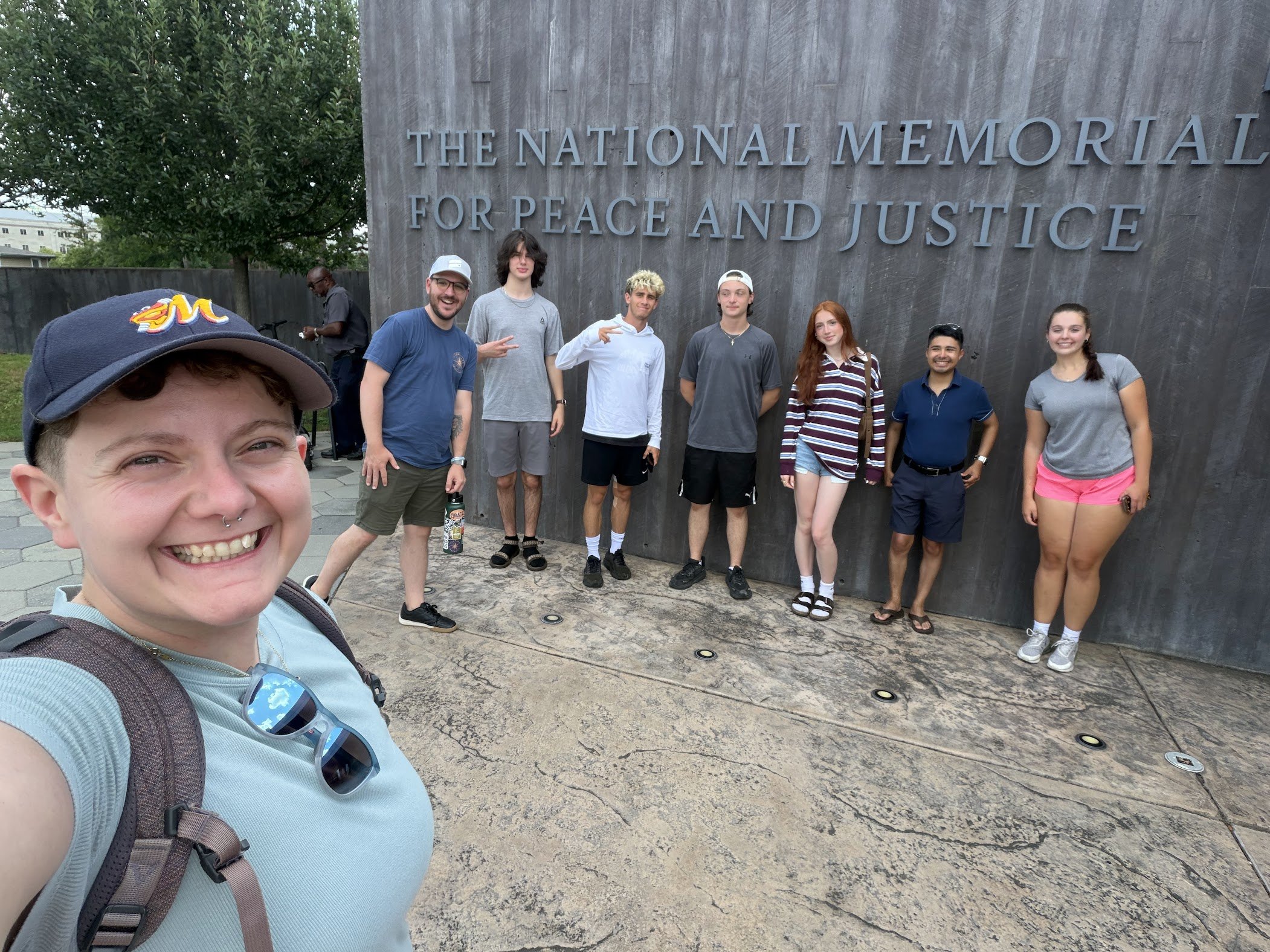
At the National Memorial for Peace and Justice in Montgomery, the group came face to face with the history of racial terror and lynching in America. Ava (pictured above, far right) recounted how surprised she was by the scope of the violence.
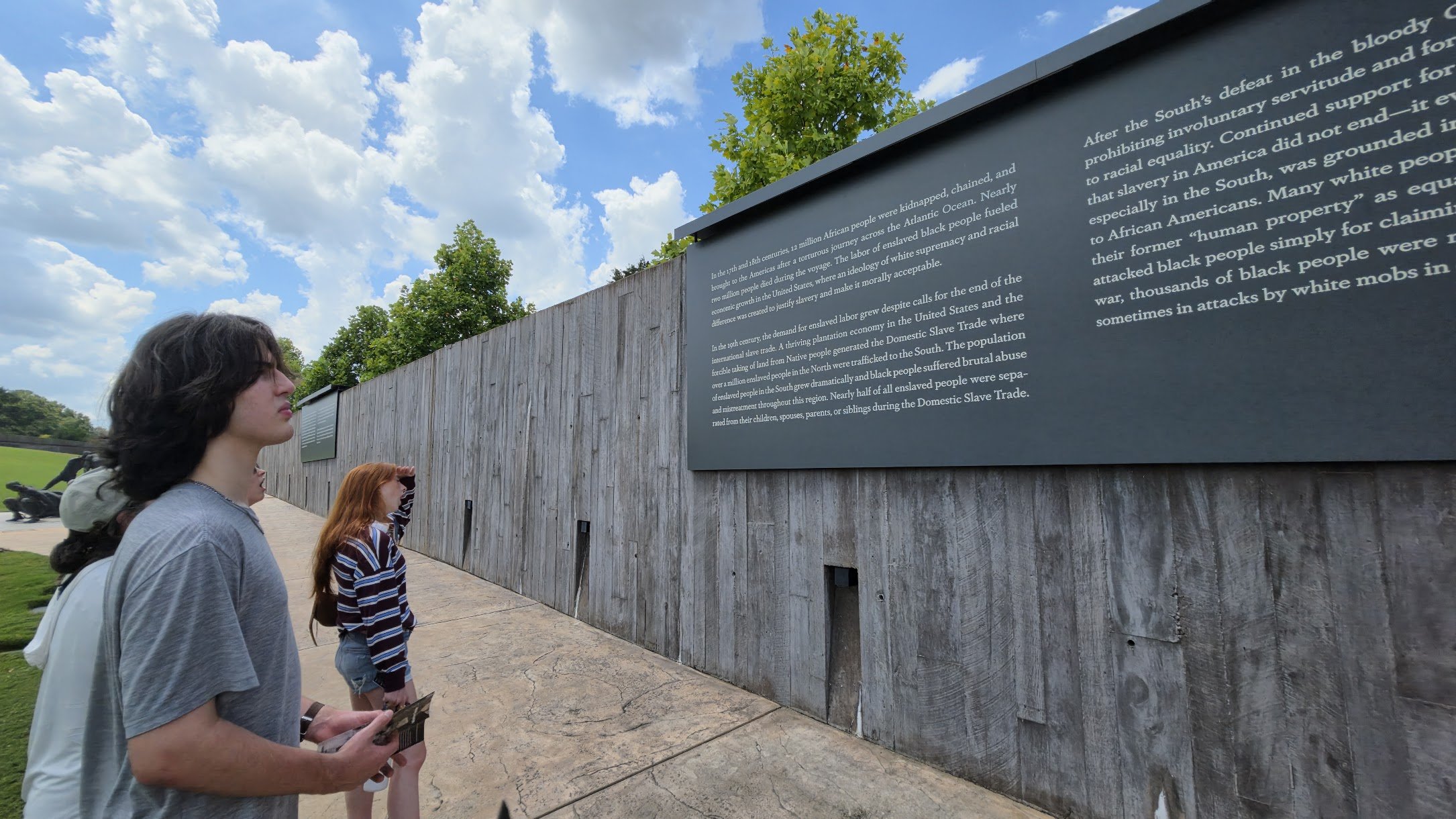
“I was shocked to see how many people were killed by lynching. I do not think I fully understood how long this had been happening or the severity of it until I was surrounded by the names of the victims.” Ava went on to say, “The experience made me realize how important it is to seek out history beyond what is taught in a classroom and to make sure these stories are remembered and shared.”
The Rev. George was similarly moved.
“Some monuments contained so many names that the lettering had to become smaller to accommodate them,” he says. On others, multiple victims shared the same last name – evidence of entire families affected by racial violence.”
At the end, the group sat quietly together; “We were all just sitting there in this deep contemplative silence letting it all soak in,” Rev. George recalled.
The Legacy of Jonathan Daniels
For Episcopalians from New Hampshire, the history of the Civil Rights Movement has an especially powerful connection through Jonathan Daniels.
Daniels grew up in Keene and graduated from the Virginia Military Institute before eventually entering Episcopal Theological School in Cambridge, Massachusetts. In March 1965, he heard the Rev. Dr. Martin Luther King Jr.'s call for clergy and others to come to Alabama following the violence against voting-rights marchers in Selma.
Daniels went.
While many who responded to King's call eventually returned home, Daniels remained in Alabama, working alongside Black residents and civil rights activists.
In August 1965, Daniels and other demonstrators were arrested and taken to the county jail in Hayneville. After being held for several days, they were unexpectedly released. Daniels and three companions walked to a nearby store. There they were confronted by a white man carrying a shotgun. When the gun was aimed at 17-year-old Ruby Sales, Daniels pushed her out of the way and was struck by the blast. He died instantly. He was 26 years old.
For the New Hampshire group on this pilgrimage, Daniels was no longer simply a historical figure from their home state. They stood in the places where the final days of his life unfolded.
The journey also explored a dimension of the Civil Rights Movement that the Rev. George believes is often missing from what students learn in school: the central role of churches. “We asked the students: What does faith require when people encounter injustice? We talked a lot about courage.”
According to Rev. George, some of the most important conversations didn't happen inside a museum or at a historic site. He says the five teens arrived from different communities and brought different personalities and perspectives to what they were experiencing.
“Hearing their thoughts and experiences challenged me to think about what I was learning in new ways,” Ava said.
There were lots of conversations about history and faith, but the pilgrimage wasn't all somber. The teenagers laughed, explored a different part of the country and got to know one another. “I left Alabama with four new friends,” Ava said. “We talked about history and faith, but we also got to know each other and create memories together. The trip was incredibly powerful and moving, but it was also a lot of fun.”
Ava’s advice to another teenager considering the pilgrimage is simple: “Go. This is truly a trip of a lifetime.”
For the Rev. George Swenson and the other adults who made the journey possible, that experience was part of the goal: to give young Episcopalians an opportunity to encounter difficult history, consider the Church's place within it, and reflect on what courage and faith might require in their own lives.
The diocese hopes the Alabama pilgrimage will become a signature experience for its growing youth ministry program and would like to offer it again.

A New Chapter Begins at Christ Church in Portsmouth
On a beautiful sunny day in Portsmouth, more than 150 people gathered on the grounds of Christ Church, where God’s presence seemed to be felt all around — in the warmth of the morning, in the prayers offered, in the memories held in the land, and in the hope of what is yet to come.
With shovels in hand and gratitude in abundance, leaders from the Episcopal Church of New Hampshire, Christ Church Portsmouth, Portsmouth Housing Authority, HAVEN, and the Black Heritage Trail of New Hampshire broke ground on a project that will transform the Christ Church property at 1035 Lafayette Road into a place of housing, healing, worship, historic stewardship, and long-term community care.
The project is made possible through a no-cost 98-year lease of church land by the Episcopal Church of New Hampshire; a remarkable commitment that will make this land available for public good for nearly a century. What has long been sacred ground for worship and community life will now be reimagined to meet some of the most urgent needs of the wider Portsmouth community.
When complete, the site will include 44 permanently affordable workforce housing units, a new headquarters and transitional housing for HAVEN (a nonprofit that serves survivors of domestic and sexual violence), a potential center for early childhood education, a more sustainable worship space for Christ Episcopal Church, and continued care for the African Burying Ground at Langdon Farm.
For Bishop Rob, the day marked not only the beginning of construction, but the beginning of a new chapter in the life of the land, the congregation, and the wider community. “Through this extraordinary collaboration, this property is being reimagined in a way that reflects the church's mission to use its land and resources in service to others. At a time when communities everywhere are struggling with housing affordability, safety, belonging, and the future of faith-owned spaces, this partnership offers something rare and hopeful: a concrete example of land being used not simply for one institution’s needs, but for the common good,” he said.
The day was filled with signs of both reverence and renewal. There was joy in the gathering, but also a deep awareness of the history held by the land. The site includes the African Burying Ground at Langdon Farm, a sacred place that will be protected during construction and stewarded with care.
JerriAnne Boggis, Executive Director of the Black Heritage Trail of New Hampshire, spoke powerfully about the meaning of that commitment; “For descendants and for all who care about truth, this moment carries particular meaning,” Boggis said. “At a time when there are efforts across our country that seek to diminish, erase, or sanitize the history of slavery, we stand here witnessing a different path. No one has looked away from this history. No one has attempted to build over it or pretend it never happened. Instead, those responsible for this project have chosen to proceed thoughtfully, deliberately, and with care. They have recognized that the people buried here deserve respect, and that the history they represent deserves preservation. That is what responsible stewardship looks like.”
For Christ Church, the groundbreaking was a moment of both letting go and leaning forward in faith. The congregation is allowing its beloved church building to be repurposed for HAVEN’s work, while preparing for a more sustainable, right-sized worship space on the site. The Rev. Steve Falci of Christ Church told the crowd; “For nearly a century and a half, Christ Episcopal Church has stood as part of Portsmouth’s spiritual and civic fabric. Since our founding in the 1880s, we’ve served generations — always striving to be a place of welcome, worship, and compassion.”
Rev. Steve honored the parishioners who founded Christ Church in Portsmouth’s West End to serve working-class families and immigrants; those who rebuilt after a devastating 1963 fire destroyed the original church building; those who stewarded the congregation for the past 60 years on Lafayette Road; and the current members of Christ Church, whom he described as “resilient faithful.” Their willingness to imagine a new future for the property is at the heart of the project now taking shape.
For HAVEN, the day represented the culmination of an eight-year search for a permanent home in Portsmouth, where the organization has been rooted since its founding 46 years ago. HAVEN is the largest violence prevention and support services nonprofit agency in New Hampshire.
Kathy Beebe, Executive Director of HAVEN, said the Diocese’s long-term, no-cost commitment of the property creates a once-in-a-generation opportunity. “We are deeply grateful to the Diocese for this incredible gift; not only because it will provide HAVEN with a forever home, but because it brings together community. For survivors of domestic and sexual violence, community is connection, and connection is healing. That is the premise for what HAVEN is building and what this partnership represents.”
HAVEN’s permanent home will be located in the renovated church space, with an addition that includes seven newly constructed transitional housing units.
For Portsmouth Housing Authority (PHA), the project responds to one of the region’s most pressing challenges: the need for housing that working people can afford. The 44 permanently affordable rental apartments will give preference to local workers and childcare workers, with a focus on people earning 60 percent of the area median income. “I am overflowing with gratitude that this project has become a reality,” PHA Executive Director Craig Welch said. “Portsmouth needs housing that working people can actually afford, and opportunities to create it are rare. The Diocese’s no-cost 98-year lease gives this project the long-term stability needed to create permanently affordable homes while joining with HAVEN and Christ Church in a broader community partnership. It is exactly the kind of creative response the Seacoast needs.”
As the gathering came to a close, there was a sense that something more than ground had been broken. A new way forward had been opened.
This project is more than a redevelopment. It is a witness to what can happen when faith communities, housing leaders, survivor-service organizations and historic stewardship partners come together with imagination, courage, and care. It is a reminder that sacred ground is not only preserved by looking back, but also by asking how it can serve God’s people now.
At 1035 Lafayette Road, a new chapter has begun — one rooted in housing, healing, worship, remembrance, and the common good.
Construction is now underway and is expected to be completed in late summer 2027.
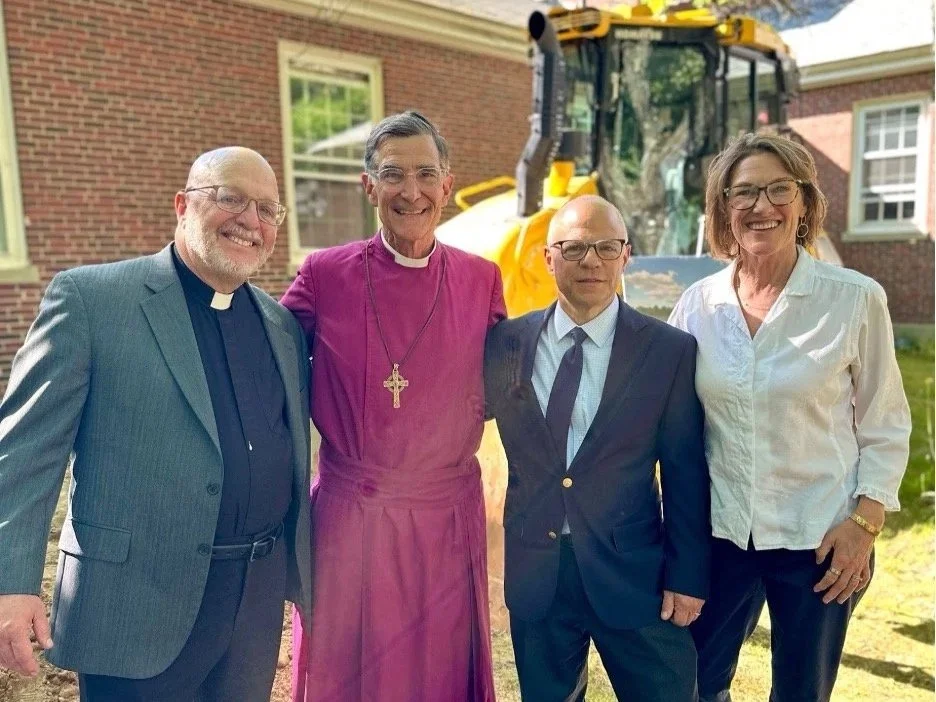
Rev. Steve Falci, Bishop Rob Hirschfeld, Diocese Special Projects Manager Benge Ambrogi, Diocese Communications Consultant Barbara MacLeod at the Portsmouth project groundbreaking.
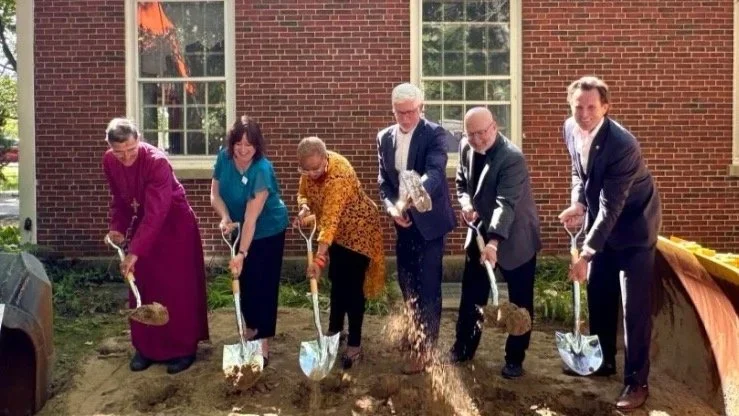
L-R Bishop Rob, HAVEN’s Kathy Beebe, Black Heritage Trail Exec. Dir. JerriAnne Boggis, PHA Exec. Dir. Craig Welch, Rev. Steve Falci, Portsmouth Mayor Deaglan McEachern
Ministry, Marriage, and the Second Half of Life: Joe and Audrey Rose
By Christina C. Gordon
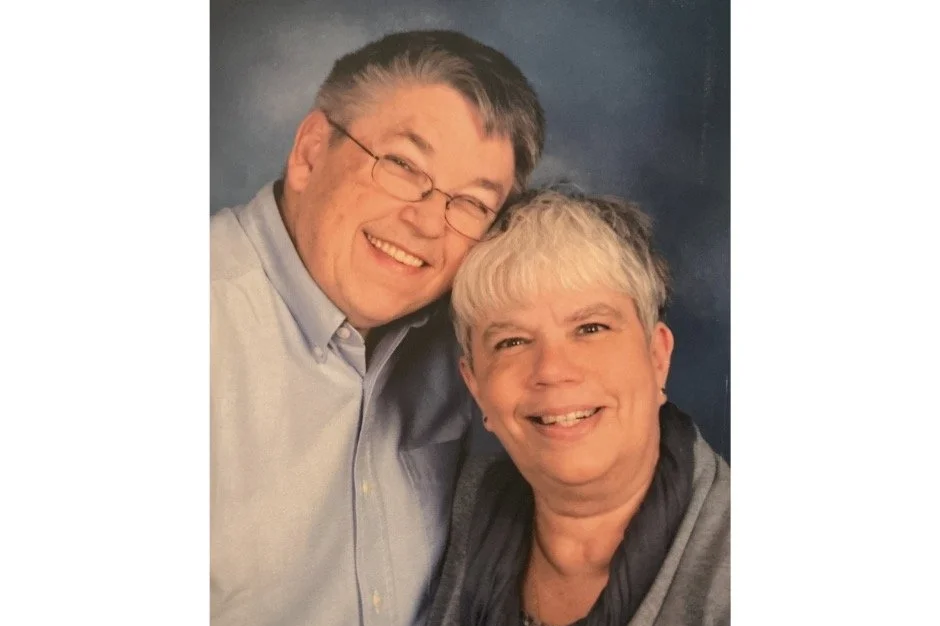
When Joe and Audrey Rose talk about ministry, they begin with stories: stories of surprise, hesitation, and moments when God showed up in ways they never expected.
By most accounts, their story should have been winding down. Joe had retired after a 40-year career in the propane industry. Audrey had spent years in business and doing volunteer work, and for a long stretch, away from church altogether.
Instead, what unfolded was a shared calling that is reshaping small congregations and quietly but dramatically renewing community life.
“I was not going,” Audrey says, laughing as she recalls the Episcopal Revival that changed everything. A friend kept encouraging her to attend. “No, absolutely not,” she insisted. But she went anyway.
There, listening to Bishop Michael Curry, Audrey experienced something she still struggles to describe. “It was probably the first time in my life I totally felt the presence of God.”
That moment changed the course of her life. Later, at a conference in Atlanta, she encountered interactive worship exhibits created by experiential worship curator Lily Lewin. Standing in a quiet ballroom filled with prayer stations and liturgical displays, Audrey felt a clear call: this is what you are meant to do.
“I didn’t have any background,” she says simply. “I just started.”
Audrey did complete her lay preaching certificate through the NH School for Ministry (SFM), a member of the Iona Collaborative network. Today, she preaches regularly in congregations across the region and is known for creating worship experiences that invite participation and connection: prayer trees open to the wider community, large-group puzzles tied to liturgical themes, interactive prayer stations that draw people in rather than asking them to sit passively in the pews.
“It is lighting that little spark and letting it burn into a flame,” Audrey says.
Joe’s call unfolded differently.
For years, he says, he kept putting God off with humor and excuses. Retirement finally changed that. While preparing to begin coursework through SFM, Bishop Rob Hirschfeld called him into his office, slid a business card across the desk, and then handed him a key.
The address belonged to what is now the Episcopal Mission in Franklin, NH: a church building that had sat closed for nearly twenty years.
Joe’s first initiative was a simple weekly meal called “Lunch with Jesus.” Worried nobody would come, he invited two friends to help fill the room. Twelve people showed up.
Soon, others began returning too, including the church’s former organist, who arrived carrying the church’s crucifix she had safeguarded for years. Week by week, more people brought back items they had been keeping safe, waiting, perhaps, for the church to live again.
Today, the Episcopal Mission of Franklin hosts weekly worship and serves as a vibrant part of the community.
Joe later entered a three-year formation program through SFM and was ordained in December 2023. The next day, he began serving as vicar at St. John the Evangelist in Dunbarton, a congregation that had been without clergy for seven years.
Average Sunday attendance hovered around eight people. The church looked closed. When Audrey contacted the town about adding St. John’s to local webpages and social media listings, she was told Dunbarton didn’t have an Episcopal church.
“They were in a liturgical desert,” Joe says.
The work of rebuilding was slow and sometimes difficult. Congregations shaped by years of decline and uncertainty often carry grief, fear, and resistance to change. During a NH Episcopal Diocese workshop hosted by Iona Collaborative's Thriving Congregations program, Joe encountered a framework for understanding congregational transition that helped him name those emotions more clearly.
“It all made sense,” he recalls. “They were angry, fearful, disoriented.”
Back at St. John’s, Joe shared the resource with the congregation and spoke openly about grief, change, and hope.Once the congregation began finding stability internally, Joe encouraged members to look outward.
“I’m not telling you what the mission is,” he told them. “What is in your hearts? How do you want to serve God?”
At a town meeting, Joe heard leaders discuss growing isolation among seniors. Back at church, he looked around: a parish hall, a kitchen, and people with time and a gift for hospitality.
The answer became a monthly senior lunch. Free meals. No pressure. Just a place where people could gather, talk, and feel known. The lunches quickly grew. Community members with no connection to the church began showing up, not only to eat, but to volunteer. Flowers appeared on tables. Donations exceeded costs. Relationships formed.
“You can just see the Holy Spirit at work,” Audrey says.
The congregation itself began to change as well.
On Easter Sunday, 27 people filled the pews. A young man in his twenties sat at the church’s historic pump organ, keeping the pedals moving just as his grandfather once had.
“A couple weeks ago, someone asked, ‘What else can we do?’” Audrey recalls.
Joe smiles. “You can just see the church coming alive.”
The Future
That movement – from maintenance to mission – is at the center of Joe and Audrey’s shared ministry.
Audrey now leads Bible studies, preaches regularly, and hosts online evening prayer four nights a week. What began during the COVID-19 pandemic has grown into an online ministry reaching people from Texas to California to France.
“I think that’s part of the future of the church,” she says.
Together, Joe and Audrey embody a model of ministry that feels increasingly important: collaborative, locally rooted, and open to the gifts of both lay and ordained leadership. “Lay leaders can have just as much calling,” Audrey says. “We need to make it easier for them to pursue it.”
For the past two Christmas Eves, a neighbor who does not attend St. John’s has quietly arrived before worship to line the church driveway with lanterns.
Nobody asked him to do it.
He simply comes, and the light is there when the congregation arrives.
That is the kind of ministry Joe and Audrey Rose are building: not ownership, but stewardship. Not a finished picture, but something still unfolding.
And that something can serve as inspiration and a blueprint for the broader Episcopal community in New Hampshire and beyond.
Theology for All - Expands Learning Across the Diocese
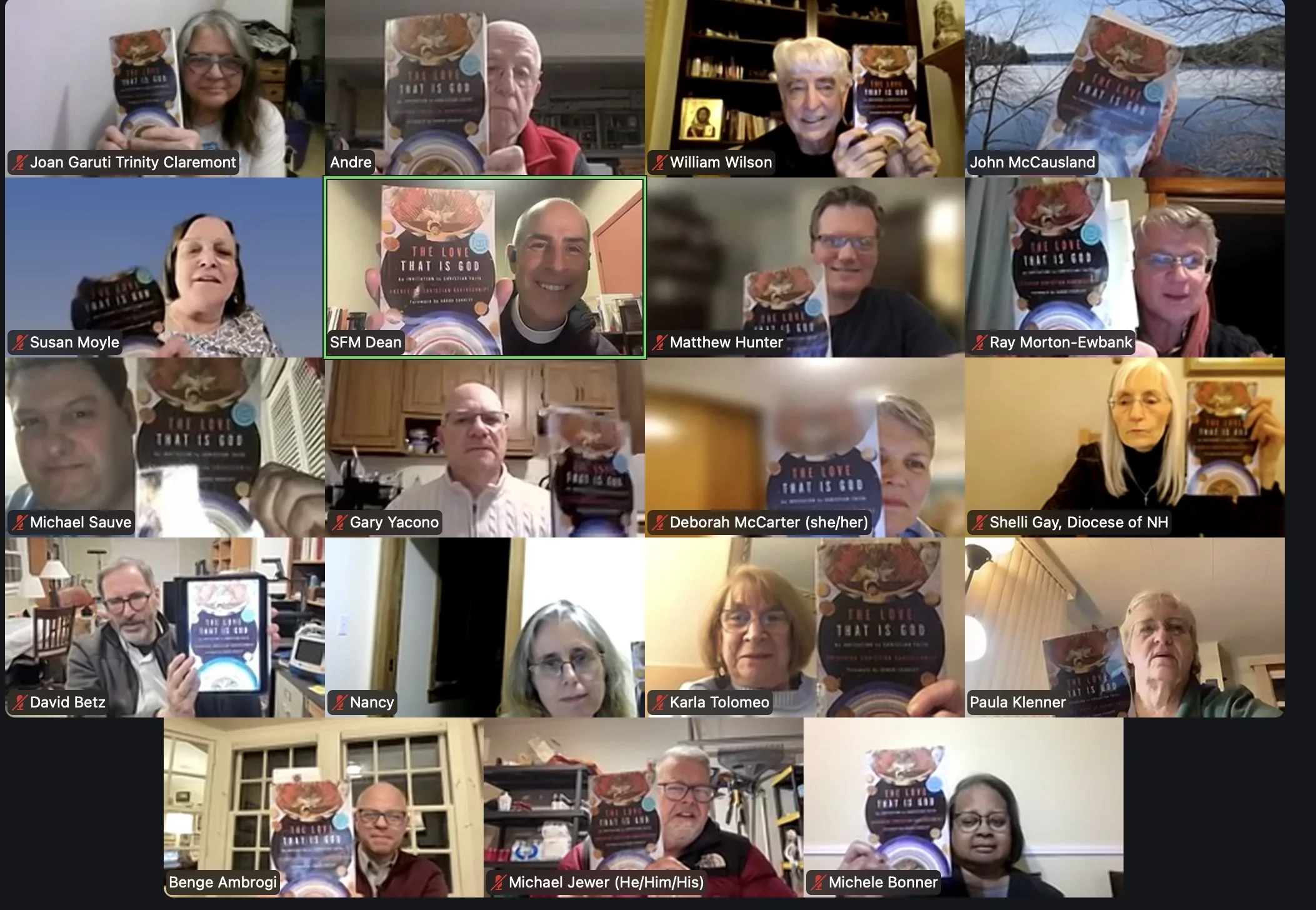
It’s a Thursday night, and twenty people have gathered on Zoom to discuss theology and ethics. Participants – mostly lay people – join from across New Hampshire. The conversation is lively, thoughtful, and often punctuated by laughter.
This is the Seminar in Theology and Ethics, part of a new initiative from the Diocese of New Hampshire’s School for Ministry (SFM): Theology for All – a series of courses open to anyone seeking a deeper understanding of Christian faith and practice.
Led by the Rev. Joe Pagano, one of the Deans of the School for Ministry, the 10-week course reflects an intentional broadening of the SFM’s mission. For the past five years, the School has focused primarily on training those preparing for ordination or lay preaching certification. Theology for All expands that work – creating space for anyone in the Diocese who is curious, engaged, and eager to grow.
Participants say the experience is already making a meaningful impact.
“As a result of the class, I’ve found myself looking at familiar things in a different way,” said Karla Tolomeo of Church of the Good Shepherd. “It’s enriching how I understand both Christian ethics and my role in the church community.”
Others note how the course is shaping their experience of worship.
“Last Sunday’s Eucharistic prayer took on extra meaning,” said Ray Morton-Ewbank of Church of the Transfiguration in Derry, “recalling our recent discussion and seeing how it connects to our shared spiritual story.”
For some, the course offers a chance to re-engage with theological study after many years.
“The class has been enormously stimulating,” said the Rev. John McCausland, a retired priest who worships with St. Andrew’s in Hopkinton. “It’s been hard to keep up with academic theology since seminary, and this fills a real gap. The readings and discussion are just what I need.”
Participants are even joining from beyond the Diocese.
“I’m grateful to be part of this learning adventure,” said Gary Yacono, a deacon in formation from the Diocese of Newark. “It’s been informative, engaging, and a pleasure to connect with people from New Hampshire.”
For Dr. Pagano, the course affirms something important: that serious theological engagement is not limited to specialists.
“We are reading works by two of today’s leading theologians,” he said, “and our experience shows that we can read serious theology, seriously. It’s not just for ‘experts,’ and it doesn’t need to be simplified. People can learn together and grow together.”
That spirit of shared learning is at the heart of Theology for All – and it’s just beginning.
In the words of Karla Tolomeo, “Since the class, I have found myself looking at familiar things in a different way, enriching how I view both Christian ethics and my role in the church community. Joe is an extremely knowledgeable and organized facilitator who presents thoughtful questions for discussion based on the readings.”
For those who have taken part so far, the impact is clear: deeper understanding, renewed engagement, and a stronger connection to faith, worship, and one another. The next Theology For All course, What on Earth Should I Do? Useful Pastoral Care Techniques for Lay People, begins June 1. Find out more here.
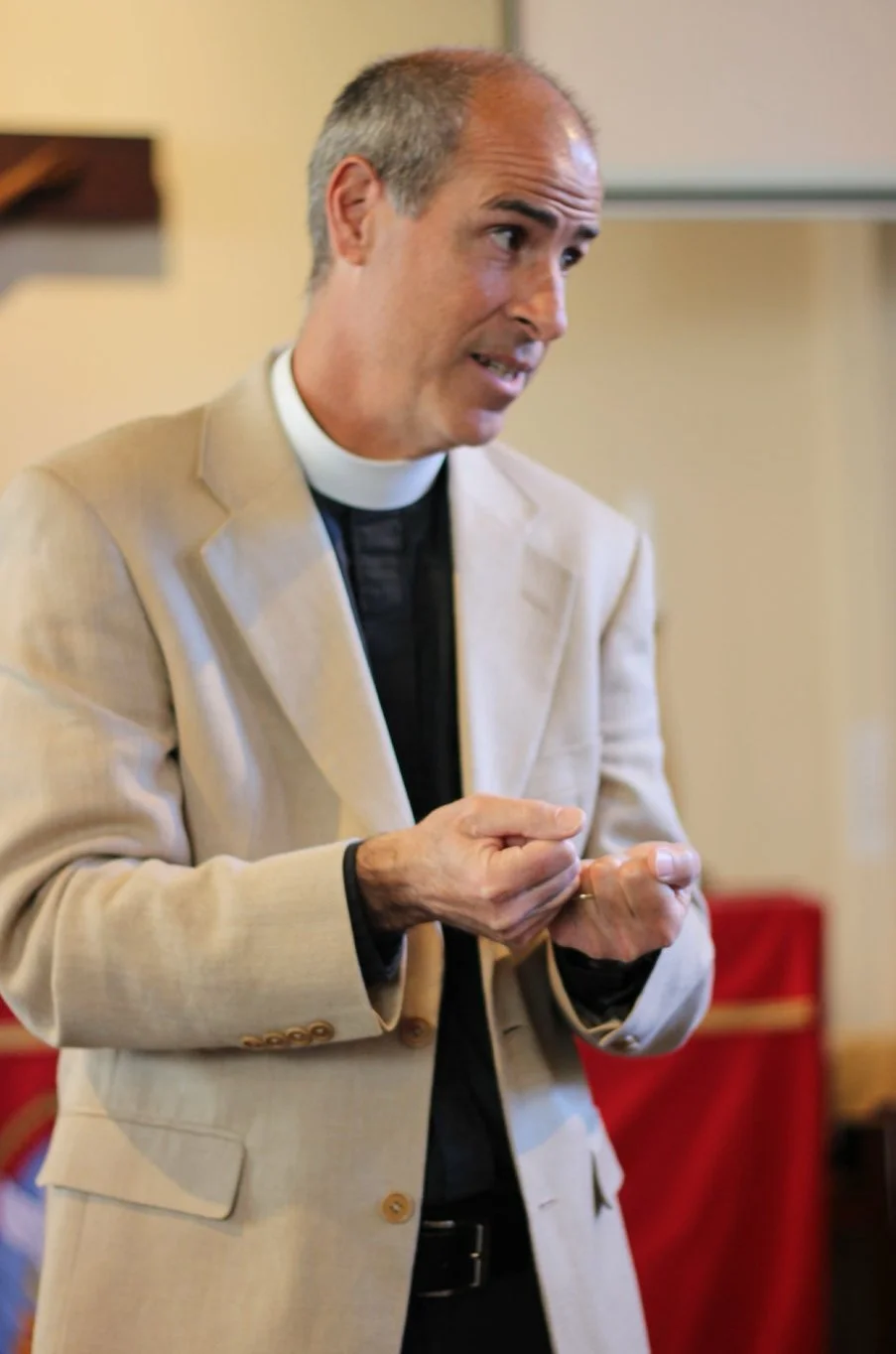
Photo: the Rev. Joe Pagano teaching.
Micah 6 Commission: A Year of Building Relationships for Local Justice
When the Most Reverend Michael Curry, 27th Presiding Bishop of the Episcopal Church, travelled to Portsmouth, New Hampshire last February to speak along with Bishop Rob at the Black Heritage Trail of NH’s celebrated “Tea Talk,” it was a perfect example of the power of the Micah 6 initiative and how it brings people and organizations together in the name of social justice. The event was held in a synagogue, was open to all, and drew a large audience who were thirsty for wisdom and encouragement. The Bishops didn’t disappoint. Their vastly different experiences growing up, their bond of friendship, and their shared faith made for interesting conversation, storytelling and ways to further racial justice. The crowd was mesmerized. This is one example of how the Micah 6 Commission – just one year into its existence – is shaping how the Episcopal Church of NH is taking action with partner organizations.
Now just one year since its formation in April 2025, the Micah 6 Commission is making strides. The Commission was formed as a way to streamline and empower parishes to take action against racism, economic inequity, and environmental degradation. The work is guided by the principles of Micah 6:8, which emphasizes the importance of doing justice, being kind, and walking humbly with God.
“Micah 6 is a guiding call for how we live our faith and baptismal covenant,” says Commission Chair Derek Scalia. “Our world is hurting, and people are yearning for points of light and relief. Through this work, we seek to embody the call to do justice.”
Created to combine our local efforts around reconciliation, earth care, educational equity, and reparations, Micah 6 has found a sibling in the Global Missions Committee, which focuses on international social justice work, while Micah 6 focuses on New Hampshire organizations already doing critical justice work.Rather than creating new programs, Micah 6 focuses on building relationships with these current initiatives. These partnerships reflect shared learning, mutual respect, and a commitment to long-term impact. Among its early collaborations:
Supporting Black Heritage Trail of NH “Tea Talks,” fostering dialogue on race and history
Partnering with the NH Fair Funding Project to advocate for equitable education
Advancing environmental stewardship through the New England Episcopal Path to Creation Justice initiative
John Rowntree, parish treasurer at Good Shepherd Church in Nashua, urges Episcopalians to consider joining churches in Claremont, Keene and Londonderry that are currently participating in the New England Episcopal Path to Creation Justice , a program which provides support and tools to parishes committed to addressing the climate crisis. Rowntree says the Micah 6 Commission contributed a three-year grant to support them. Says Rowntree, “We have done multiple projects to reduce our 148-year-old church’s carbon footprint, including insulation, improving our historic church windows, changing lightbulbs and implementing 35 solar panels. It feels really good to make a difference and helps us be strong financial stewards because we have reduced our energy costs.”
The Commission is made up of 12 members in addition to Bishop Rob. The Commission meets monthly and has held two major planning sessions over the last year.
It has also helped distribute $85,000 in Coit House funds, administered through the New Hampshire Charitable Foundation, to support a wide range of community organizations – from childcare centers and summer camps to youth programs and family services.
At its core, the Micah 6 Commission is grounded in the belief that justice work begins in relationships.
“We are not here to solve every problem,” Commission leaders note. “We are here to listen, to accompany, and to support the work already unfolding in our communities.”
This relational approach is already strengthening parish life across the Diocese. By sharing stories, connecting congregations to opportunities, and deepening engagement, the Commission is helping Episcopalians live out their call to justice in tangible ways.
As the Commission enters its second year, it is building a more intentional structure to sustain and grow this work: strengthening communication, aligning resources, and supporting parishioners in integrating justice, mercy, and humility into every aspect of ministry.
Ultimately, the Micah 6 Commission is an invitation: to listen more deeply, to partner more intentionally, and to participate more fully in the work of healing and justice across New Hampshire. Commission members believe that justice takes root most fully when nurtured in parish communities that pray, learn, and serve together. They are committed to ensuring that the wisdom gained becomes a resource for congregations seeking to deepen their own ministries of justice. These faithful committee members believe that sharing stories and opportunities strengthens parish life and inspires local action rooted in the Gospel.
To share your stories of social justice work at your church or to find out more about Micah 6 please email Derek Scalia at dnascalia@gmail.com.
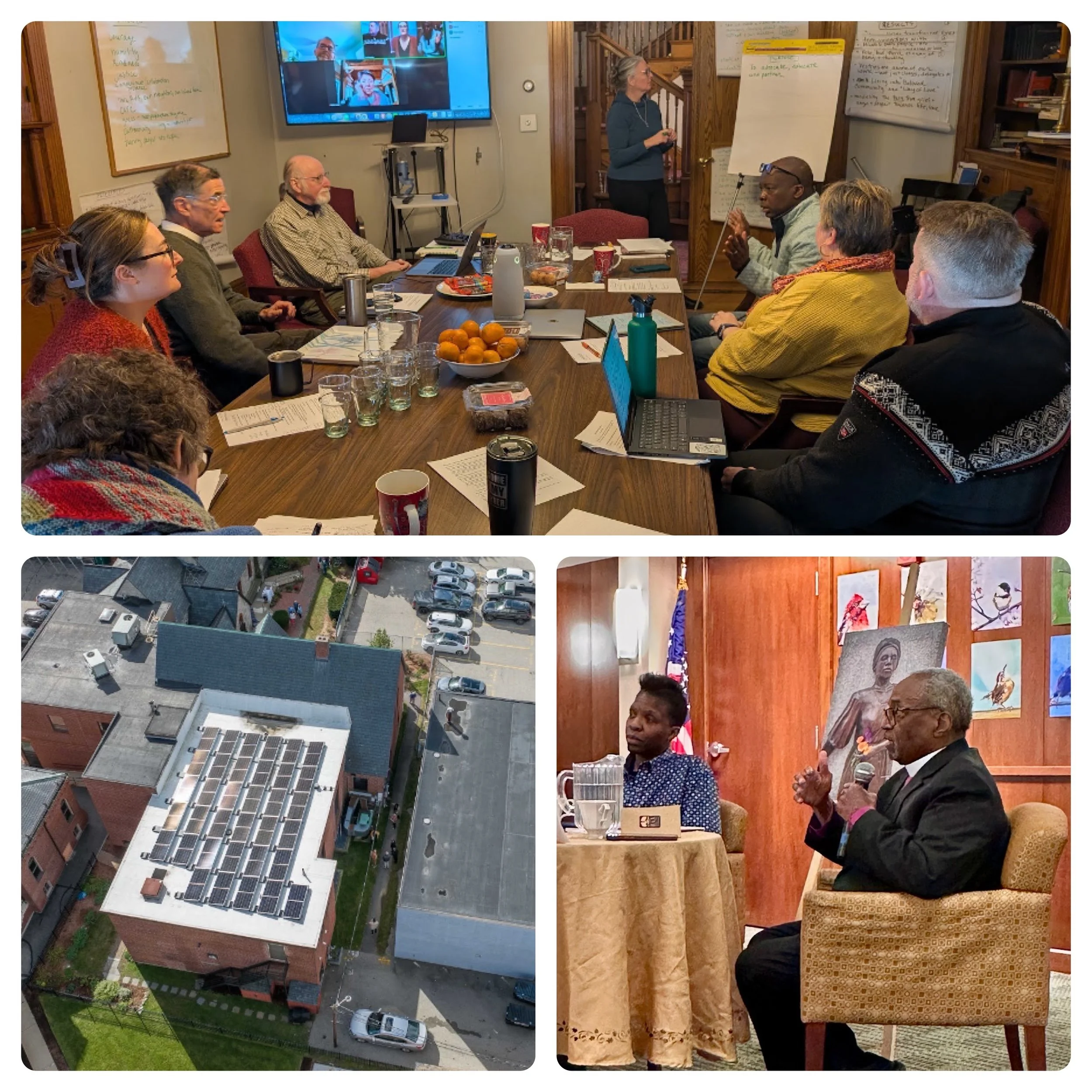
Top - Micah 6 Committee members at a planning meeting; bottom left - solar panels on the roof of the Good Shepherd complex in Nashua; bottom right - Tea Talk with Most Rev. Michael Curry, in Portsmouth.
Episcopal Church of New Hampshire Launches New School for Ministry
Recognizing the changing needs of the state's congregations and evolving trends in vocations for ministry, the Episcopal Church of New Hampshire has announced it is creating a School for Ministry. Its curriculum and educational design will focus on the local and regional formation of priests and licensed lay ministers.

Recognizing the changing needs of the state's congregations and evolving trends in vocations for ministry, the Episcopal Church of New Hampshire has announced it is creating a School for Ministry. Its curriculum and educational design will focus on the local and regional formation of priests and licensed lay ministers. The School for Ministry's teaching model will combine online, internet-based learning with monthly, weekend in-person classes and student meetings. The in-person portion of the program will be held at Trinity Episcopal Church in Tilton, NH.
The Rev. Kelly Sundberg Seaman, of Rumney, NH, has been appointed the School's Dean by Bishop A. Robert Hirschfeld. She began her duties December 1 and will lead in the development and launch of the School. Classes will begin in 2020.
The School for Ministry grows out of new realities for the church, the priesthood, and spiritual leadership. "Churches are increasingly moving to a 'bi-vocational' model for ministry," said Tina Pickering, Canon for Ministry Development in the Episcopal Church of New Hampshire. "This model involves the entire congregation, and even the larger community, in ministry rather than the traditional top-down approach of ministry exclusively through a full-time priest."

"In a bi-vocational setting the priest typically has a paid job and professional career outside the church. In addition, the bi-vocational model calls for lay leaders to play a larger role in leadership, service, and pastoral care within the congregation."
Life circumstances for local and bi-vocational candidates for the priesthood, as well as people called to become licensed lay ministers, often make it unrealistic to attend an out-of-state seminary or school of theology on a full time basis. "We saw that creating a New Hampshire-based school to meet the need in Northern New England was critical," added Pickering.
The Rev. Kelly Sundberg Seaman was ordained to the priesthood in December of 2015 and currently serves at Holy Spirit Episcopal Church in Plymouth, NH and St. Mark's Episcopal Church in Ashland, NH - roles she will continue to maintain. She also served as Episcopal Chaplain to Plymouth State University.
A university teacher and public affairs officer prior to answering the call to the priesthood, the Rev. Sundberg Seaman said, "Every strand of who I've been over the years is coming together as Dean of the School for Ministry. The bi-vocational trend is important for the Church to recognize. It's also important to realize that sometimes it's impossible for someone to put their life on hold and attend a distant seminary or theological school full-time. The School for Ministry will address a vital need."
"The enthusiastic response to the proposal that we create a School for Ministry in New Hampshire to train ordained and lay leaders has confirmed for me that this is a moment for the Holy Spirit," said Bishop A. Robert Hirschfeld. "Likewise, I am certain that the Rev. Kelly Sundberg Seaman is just the right choice as we establish the School. Her many gifts, including teaching, vigilance, leadership, and her pastor's heart, will help create a School for the Church of the present, and for the Church of the future."
The School for Ministry will deliver its classes using a low residency, flipped-classroom framework. Students will meet face-to-face one weekend per month at Trinity Episcopal Church in Tilton, NH. In between, students read, view videos, follow online study guides, and complete assignments on their own - and based on their individual schedules. The Rev. Sundberg Seaman also attended a low-residency program to prepare for the priesthood - offered by the Church Divinity School of the Pacific in Berkley, CA.
Much of the content of the curriculum will be available to the School for Ministry through the Diocese of New Hampshire's partnership with the Iona Collaborative, a ministry of the Seminary of the Southwest that includes 24 dioceses throughout the Episcopal Church. The Collaborative is dedicated to providing theological education for individuals who cannot, or chose not to, attend a conventional residential seminary.
"As part of the Iona Collaborative network, the School for Ministry will offer tremendous opportunities for learning, worship, experimentation, and development, added Sundberg Seaman. "From the start, we're building the School with locally and regionally-based and bi-vocational callings in mind. I'm very excited because the low-residency model is a great way to educate and train priests."
The Rev. Sundberg Seaman's initial priorities include preparing Trinity Episcopal Church's space for monthly in-person student learning, working with the Episcopal Church's various discernment processes to develop enrollment, and creating plans for the long-term financial sustainability of the School.
The School's curriculum will offer three general areas of study - Bible, church history, and theology and ethics - and will be flexible to meet student needs. According to Sundberg Seaman, in spring of 2020 the School for Ministry is planning to offer a "taster course" or two - a sample of what's to come with special, tuition-free class offerings. A full launch of the School of Ministry is planned for fall of 2020.
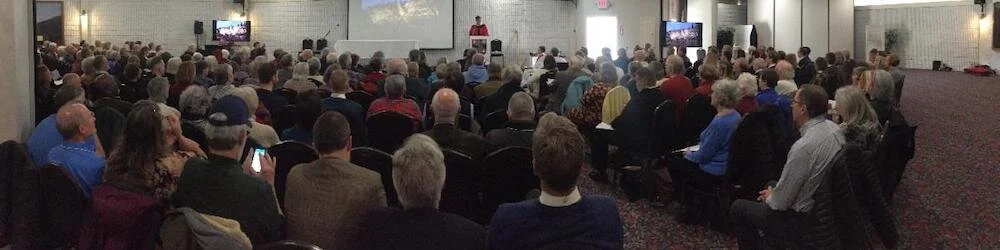
Bishop Rob's Address to Annual Diocesan Convention
With beautiful snowy vistas as a backdrop, attendees at the 217th annual convention worshipped together, passed innovative and impactful resolutions, commissioned lay leaders for congregations without a full-time priest, and held elections for committee positions and General Convention delegates. Click HERE to watch the moving address Bishop Rob gave during the worship service.

With beautiful snowy vistas as a backdrop, attendees at the 217th annual convention worshipped together, passed innovative and impactful resolutions, commissioned lay leaders for congregations without a full-time priest, and held elections for committee positions and General Convention delegates. Click HERE to watch the moving address Bishop Rob gave during the worship service.
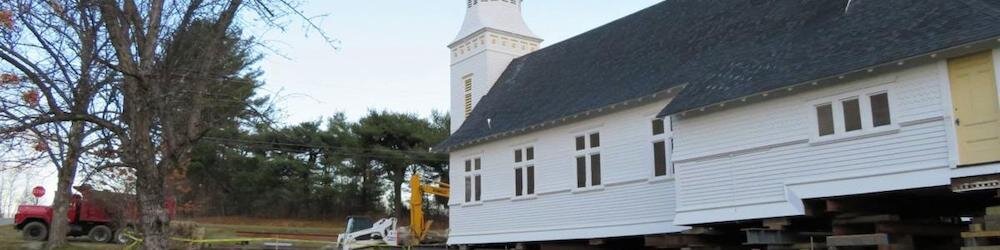
In the News: "Preserving Saint Matthew’s Chapel: Community comes together to preserve a chapel filled with memories"
As reported in the Union Leader: If you’ve ever driven Route 117 up and over and through Sugar Hill — to see the lupines in June, perhaps, or the bright colors of fall — you’ve passed St. Matthew’s Chapel…

As reported in the Union Leader: If you’ve ever driven Route 117 up and over and through Sugar Hill — to see the lupines in June, perhaps, or the bright colors of fall — you’ve passed St. Matthew’s Chapel. Maybe you pulled to the side of the road to snap a picture of the lovely white chapel with the yellow door and pretty stained glass windows, the mountains rising in the distant background…
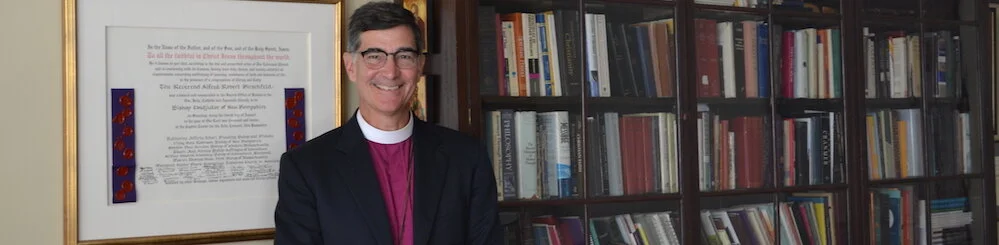
Bishop Rob's Fall 2019 Letter
For this I thank God daily. Rather, I am a theologian and a pastor. My job, the one I took a vow to perform when I became your bishop, is to guide our conversations about what it means to follow Jesus. Who and what is God calling us to be and do, and how is God equipping us as citizens of God’s Realm in times such as these?

I am not a politician. For this I thank God daily. Rather, I am a theologian and a pastor. My job, the one I took a vow to perform when I became your bishop, is to guide our conversations about what it means to follow Jesus. Who and what is God calling us to be and do, and how is God equipping us as citizens of God’s Realm in times such as these?
Clearly, we are in a political crisis in our nation. Some of the most basic, indeed founding, statements of what it means to be a citizen are questioned. Do we hold self-evident that all men, all persons, are created equal, endowed with certain inalienable rights: life, liberty, and the pursuit of happiness?
When Thomas Jefferson wrote the Declaration of Independence, that lofty claim extended only to white males, excluding women, peoples who lived for millennia on these shores, and blacks who had been forced into slavery, first arriving in the ironically named Point Comfort, in the colony of Virginia on August 20, 1619. The written noble aspirations of our Founders and the inconsistency of the society they actually formed and benefited from (and by extension many of us, including me) has provided the fuel for our struggles for justice, freedom, and dignity ever since. The term used to define that perennial struggle is “politics.” And everywhere I go, every parish coffee hour I share, I hear the lament of how painfully fraught and hateful, and even violent, our politics are at present.
I believe we are in as much a religious and spiritual crisis as we are a political one. We are facing a stark spiritual choice. Do we believe in a God whose power is manifest in anger, revenge, retribution, force, control, and violence? In other words, do we believe our God to be no different than the Greco-Roman gods like Zeus (known to the Romans as Jupiter), who required absolute obedience or else destruction would follow? To read Homer’s Iliad or Odyssey is to be introduced to the fickle and emotional insecurity of such gods, who considered human beings almost as children’s dolls. That’s one pattern for “godly” living.
I believe Christianity holds a radically different shape of faithful living. The God who Jesus embodies is proclaimed in a hymn that St. Paul quotes in this letter to the church in Philippi. To share “the mind of Christ” is to pattern one’s life on a God
who, though he was in the form of God,
did not regard equality with God
as something to be exploited,
but emptied himself,
taking the form of a slave,
being born in human likeness.
And being found in human form,
he humbled himself
and became obedient to the point of death—
even death on a cross. (Philippians 2:3-8)
For the ordinary Roman citizen, to hear that God would be willing to die rather than get his own way, or even to protect himself against evil, sounded not only utterly absurd but offensive. And yet, that’s precisely the God who the early Church proclaimed, preached, and practiced. More than weapons and crusades, or the alluring attraction of its basilicas, cathedrals and chapels, when the church follows the self-emptying way of love, it spreads and grows like a healthy life-bearing vine. Even, perhaps especially, when it is pruned or persecuted.
So, I am called to ask the Church and all who claim to walk in the way of the Cross, who is the Lord that we seek to follow? If it’s Jesus, the one who risked and lost everything so that he, and all humanity, can share the resurrected life right now, then how might that change the way we talk about the great “political” issues of our day? How might taking on the mind of this self-emptying God change the tenor of how we talk about immigration, guns, the health of our planet, and the inequitable state of our public schools?
Yours in the crucified and risen Savior Jesus,
Bishop Rob
The Rt. Rev. Robert Hirschfeld
In the News: "God Knows We’re Messy, and That’s OK"
As reported by The Living Church: Something extraordinary is happening at Epiphany Episcopal Church in Newport, N.H. (pop. 6,500). Once a month like clockwork, since early this year, worship attendance jumps from 20 to nearly 40.

As reported by The Living Church: Something extraordinary is happening at Epiphany Episcopal Church in Newport, N.H. (pop. 6,500). Once a month like clockwork, since early this year, worship attendance jumps from 20 to nearly 40. Swelling the crowd are people who have no church background. They sidle up next to folks who quit going to church long ago. Approximately half of these once-a-month worshippers are children.

Bishop Rob: My Prayer for America
“America, love it or leave it.” — seen on a church sign in New Hampshire. Some six centuries before the birth of Jesus, a prophet burst on the scene in Jerusalem. Jeremiah was disgusted with the state of his nation which he saw was threatened, not so much by outside empires poised to invade and conquer, but by the loss of its soul.

“America, love it or leave it.” — seen on a church sign in New Hampshire.
Some six centuries before the birth of Jesus, a prophet burst on the scene in Jerusalem. Jeremiah was disgusted with the state of his nation which he saw was threatened, not so much by outside empires poised to invade and conquer, but by the loss of its soul. Even more repulsive to this lonely and passionate spokesperson for God was how the people of Judah, from its priests to its king, engaged in religious language to defend immorality, injustice, and cruelty.
The mistreatment of immigrants, refugees, and strangers, the neglect of orphans and widows, and pledging fidelity to material idols were rampant in Jeremiah’s day. He saw the injustice and brutality of his time as a betrayal of God. He paid dearly to be a prophet in his time, suffering all sorts of humiliation. He went into exile and was likely killed at the hands of his exasperated fellow Judeans who had escaped the catastrophe in Judah by becoming refugees themselves in Egypt.
Jeremiah loved his country, though its betrayal of the Great Commandment to love God and neighbor caused a burning within him that would not allow him to be silent. Kings, priests, and people all urged him to shut up. They claimed that God would never abandon them or leave them vulnerable to societal and national collapse. And to them he cried:
Do not trust in these deceptive words: “This is the temple of the Lord, the temple of the Lord, the temple of the Lord.” (Jeremiah 7) as though the temple or national pride will save you from a disaster which is coming.
Jeremiah would have had a special word of rebuke to any church that felt its loyalty to our nation was more important that to God’s Realm, and a special word of criticism to the words and chants, “send them back.”
We have heard, and will no doubt hear more in the coming months leading up to the 2020 elections, of the “Greatness of America.” If the witness of Jeremiah has relevance for us today — and I am convinced it certainly does now — then we recognize that the greatness of any society lies not in its material gross domestic product, or the performance of its stock markets, or even in the might of its military. Greatness lies in a nation’s soul: that resilient self-understanding that it has been placed here to extend justice, compassion, prosperity, and opportunity for all, and that all humankind, in all of its rich diversity, is made in God’s image.
A great nation is one that blends its courage with ample humility to admit its imperfections, that its greatness lies in its striving to become more perfect. Racist speech that dehumanizes persons of other races and that perpetuates the empty and cowardly ideology of white supremacy violates and damages the moral core of any nation. Prophets from Amos to Zechariah — and yes, even the prophet Jesus of Nazareth — tell us unequivocally that when a nation loses its soul, that nation risks God’s judgment. And that judgment may be catastrophic. The Bible tells me so.
Am I saying we need open borders? Am I saying we need to impeach or censor the president for his reckless and hate-filled speech? Please don’t put words in my mouth. What I am saying is that if we believe in a God of justice and peace, the current brutal and callous state of affairs in this nation must be grievous unto us, its burden intolerable. For God’s sake, this is a time for collective confession and repentance. As my colleagues at the Washington National Cathedral so powerfully stated, “the question is less about the president’s sense of decency [than] of ours.”
Last summer, it may have felt to us good and righteous when scores of us shouted, “Te vemos!” — “We see you!” — to the detained mothers who were separated from their children in a Texas “family residential center” at the southern border. To be honest, I could not imagine that those mothers would still be wondering where their young children are a year later. So now, this summer, I wonder about how God sees us, this torn, angry nation, and its soul that longs to be restored. This is why my prayer these days is not so much “God bless America,” but “May God have mercy on us, and show us anew the paths of justice, peace, and righteousness.”
A.Robert Hirschfeld

Bearing Witness at the Border in El Paso
Less than one week before the August 3 killing spree at Walmart in El Paso, I participated in a “Moral Monday” vigil at the border, coordinated by Rev. Dr. William Barber and several local organizations. I arrived in El Paso on Sunday, July 28, answering a clarion call to witness at the border.

By The Rev. Canon Gail Avery, Canon for Transition and Community Engagement
THREE MASS SHOOTINGS IN A WEEK — Gilroy California, El Paso Texas, and Dayton Ohio. In our culture of hate and violence, how does one follow Jesus?
Less than one week before the August 3 killing spree at Walmart in El Paso, I participated in a “Moral Monday” vigil at the border, coordinated by Rev. Dr. William Barber and several local organizations.
I arrived in El Paso on Sunday, July 28, answering a clarion call to witness at the border. My sense of urgency to visit the border between the US and Mexico had been growing since being waved through a Border Patrol checkpoint in North Woodstock, NH two years ago. A white woman driving alone, I was literally waved through the checkpoint, with no stopping. I couldn’t help but wonder, what if I had been traveling with my daughter-in-law (who is Salvadoran) or my two beautiful biracial grandchildren? I suspect that if I had been, we would have been noticed. We would have been stopped and asked to answer many questions.
VIGIL AT THE BORDER
At a mass gathering the night before the vigil, we heard from a number of faith leaders. The message of Inman Omar Sulelman was particularly powerful. He said we need to be listening to our holy texts. The Quran says “We are called to welcome those who migrate to us.” In the Hebrew Bible there are 36 passages that speak of welcoming the alien in our midst. “Our faiths are on trial,” he said. “So is our nation and our humanity.”
Who do we want to be as a country? And how can we get there, together? Inman Sulelman concluded by saying that we need to SHOW UP, STAND UP, and VOTE UP.
Monday morning, over 500 people from across the United States, including Steve Ekerberg, a parishioner of St. Steven’s Pittsfield and Candidate for Holy Orders to the Diaconate, and I took part in the vigil.
Approaching a US detention center and speaking through a small call box, clergy asked permission to enter the detention center to offer pastoral care to our people. Clergy’s request to visit with those detained was denied. Anticipating this, the organizers of the vigil had crossed the border into Juarez, Mexico earlier to visit migrant families living in a nearby refugee camp. What they saw and heard was horrific as well as illuminating.
In our US detention centers, children as young as four years old are cutting themselves (often understood as a coping mechanism for people under extreme emotional distress) and shoe laces are being removed from people’s sneakers to prevent strangulation. Men in the El Paso detention center are participating in a hunger strike to protest human rights violations and the poor living conditions.
A congressman later told me that while conditions aren’t great in Mexico, they are far better than what’s being provided in the United States. When asked why the difference, a Mexican authority said, ‘In your country you fear immigrants. We don’t. We’re happy to have them.” I also learned that the US Government is not providing any aid or support. We are depositing the people we’re deporting into Mexico and expecting Mexico to care for them. Independent shelters and faith communities are an integral part of that care since immigrants in Mexico are not looked upon as criminals.
Ready to do my part, I also attended a non-violent civil disobedience training offered by the vigil organizers. I was willing to show up and stand up — not necessarily to be arrested, but to arrest the injustices that our nation is committing. Arm bands were handed out — green for those who chose to witness and yellow for those prepared to participate in civil disobedience. Using a black sharpie, I even wrote the number for jail support on my arm.
At the last moment, before embarking on our vigil, we were instructed to take off our armbands. The shooting in Gilroy had happened the night before and there were concerns about counter-protestors. Fear was even building that our civil disobedience would be looked upon as possible treason, carrying a 5-year minimum jail sentence.
But in taking off the armband, I could feel something change in the room…it felt like we were unified — truly and finally one. One against the injustice and inhumane treatment of God’s creation. This is not a question of political right or left, but of following Jesus on the path of right versus wrong.
MURDER IN EL PASO
I returned safely to New Hampshire four days before the mass shooting. The Custom Border Patrol detention center where Steve Ekerberg and I gathered with hundreds of others was just 2.3 miles from the Walmart where Patrick Crusius, a 21-year-old white male, had openly fired upon “Hispanics,” citing genocide as a pathway to sustainability. Our hotel was only 2.2 miles away.
After the President’s speech declaring that hatred has no place in America, I noticed words cascading down the right side of my computer screen. The black ribbons of words were chats coming from the YouTube feed I was watching. I was appalled and saddened by the hate that the chats were spewing. Most were blaming the “democRats” for the violence and hate in our country.
The vitriolic rhetoric was uncannily similar to the anti-immigrant manifesto that the mass-shooter in El Paso had posted minutes before firing into the crowds at a Walmart, killing 22 people and wounding 26 others. The 4-page document said that politicians from both parties were to blame for the United States “rotting from the inside out” and that “the heavy Hispanic population will make us a democratic strong hold.” He concluded, “If we can get rid of enough people [the Hispanics] then our way of life can be more sustainable.”
Clearly, this attack was a response to what the shooter called “The Hispanic Invasion of Texas.” If carried out fully, my son, his wife, and their two biracial children — an Air Force family stationed in San Antonio, two hours away from the shooter’s home — would have been targeted. My daughter-in-law’s entire family lives in Houston, fleeing El Salvador in the 1980s after being targeted there. They are now US citizens, but would have been a target as well — again. Today, if they approached our border seeking political asylum, our nation would tell them — GO HOME.
BACK HOME: PRAYER AND ACTION
A week later, back home, I attended another vigil: the Interfaith Prayer Vigil and Jericho Walk for Immigrant Justice.
This is a regular vigil that occurs bi-monthly at the Immigration and Customs Enforcement (ICE) office located at the Norris Cotton Building in Manchester. We gather on days that immigration cases are being heard. We begin in prayer and song, and then walk seven times around the building praying for the walls of injustice to come tumbling down.
That day, the vigil was attended by more people than usual. I believe each of us is seeking hope and justice — hope and justice that I’m convinced more than ever can only be found together, which our closing song expresses so well:
Rise as One
by Aaron Fowler
We will march as one
We will stand as one
We will rise as one (repeat)
REFRAIN
We will rise as one. We will rise as one
Working hand in hand, we will rise as one.
We will dance…sing…, REFRAIN
We will laugh….cry…., REFRAIN
We will fight…..win…, REFRAIN
May our country find inner strength to be one, and work hand-in-hand in taking care of each other, including those who migrate to us.
In the News: “New Hampshire prison softball league connects Episcopalians and inmates in ministry of presence”
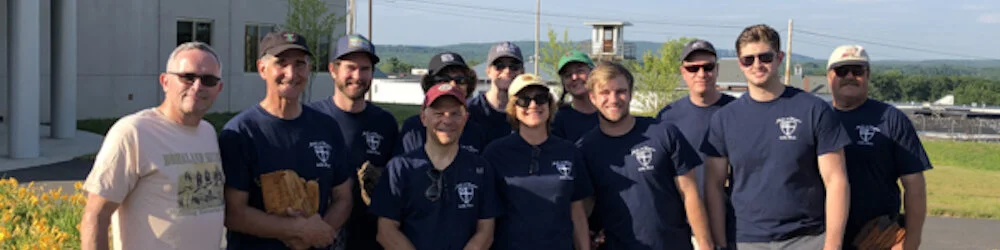
As reported by the Episcopal News Service: Episcopalians may be familiar with Jesus’ assurance that “where two or three are gathered in my name, I am there among them.” Members of St. Matthew’s Episcopal Church in Goffstown, New Hampshire, also know this: Two or three, however devout, are not enough to field a softball team.

As reported by the Episcopal News Service: Episcopalians may be familiar with Jesus’ assurance that “where two or three are gathered in my name, I am there among them.” Members of St. Matthew’s Episcopal Church in Goffstown, New Hampshire, also know this: Two or three, however devout, are not enough to field a softball team. Whether they bring two, three or a full squad of nine or more players, the Episcopal softball team led by St. Matthew’s parishioner Benge Ambrogi gathers several times each summer in Jesus’ name to play against inmates at the state’s prison for women in Concord.
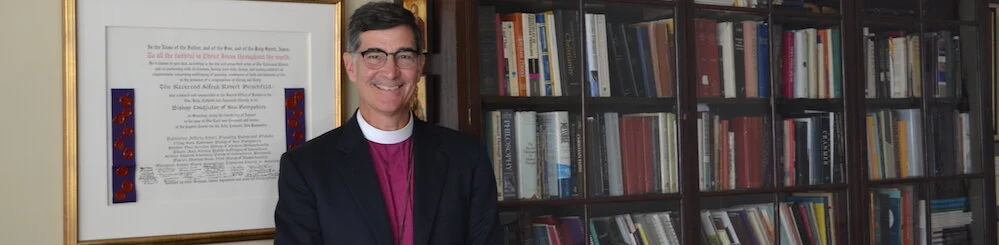
Bishop Rob's Summer 2019 Letter: "...Things Which Were Cast Down are Being Raised Up..."
“...let the whole world see and know that things which were cast down are being raised up, and things which have grown old are being made new...” Someone once told me that faith is simply a way of seeing. Arguably, persons of faith... any faith... are generally those constantly looking for a deeper or more compelling truth — truth that may not be obvious at first glance.

“...let the whole world see and know that things which were cast down are being raised up, and things which have grown old are being made new...”
Someone once told me that faith is simply a way of seeing. Arguably, persons of faith... any faith... are generally those constantly looking for a deeper or more compelling truth — truth that may not be obvious at first glance. The eyes of faith are trained to see the hand of God, the movement of the Spirit, and the face of Jesus in circumstances that may otherwise tell us that what we initially perceive is all there is.
For many years now, we in mainline Christian denominations have been persuaded to see things through a lens of decline — that our Church is dying, crucified on the crosses of our society’s rise in materialism, secularism, political extremism,and growing mistrust, often warranted, in institutions of any kind. We’ve all seen these trends. They can easily lead us to despair.
I also see things that are equally true and heralds of resurrection. Today, for instance, a church in Franklin that has been shuttered for 17 years has now opened its doors for prayer. Mr. Joe Rose of Grace Church, East Concord, took up my invitation to “just go up there and pray with folk and see what happens.” Within a month a small congregation has formed, the local paper showed up with a reporter and photographer, and suddenly, what was cast down seems to be rising.
Living with a strict budget and limited clergy support, St. Stephen’s in Pittsfield is exploring lay worship leadership and sharing the Real Presence of Christ in a new provision I am exploring called “Communion by Extension.”
In another sign of God’s mission of renewal, we are enjoying the benefit of welcoming a number of priests and deacons in their 20s and 30s — young people asking wonderfully disruptive and energizing questions. “Things which have grown old are being made new.” Many churches are actually growing in attendance, maybe not on Sunday morning, but during the week as we adapt to the economic reality that over one third of the our workforce now works on weekends. Despite that, souls still search for signs of new life, holy purpose, Jesus Community. We enjoyed two vibrant and successful events recently: Revival: Reimagined and Spring Renewal. These events look to the eyes of my faith as signs of just that — revival, renewal, even resurrection. As we prepare for our annual Convention in November, you will see bold new initiatives that build on the work the Holy Spirit seems to be already doing. A new school for mission leadership. A network of new clergy to serve as “curates,” to learn from seasoned pastors and multiply area Christian communities. A system of coaching to support newly assigned priests. All these things you will hear about as we seek to strengthen the church as it pursues God’s mission of loving, liberating, and giving life to all God’s people.
If we are truly the Body of Jesus Christ, we will always be giving up ourselves to the death of the cross. It’s what Jesus said would happen. But the eyes of faith always look beyond, to the glory of Resurrection. I pray you see signs of that renewal wherever you are. Look for them. They are there, just as surely as the Risen Jesus is walking with us along the Way.
Bishop Rob
The Rt. Rev. Robert Hirschfeld
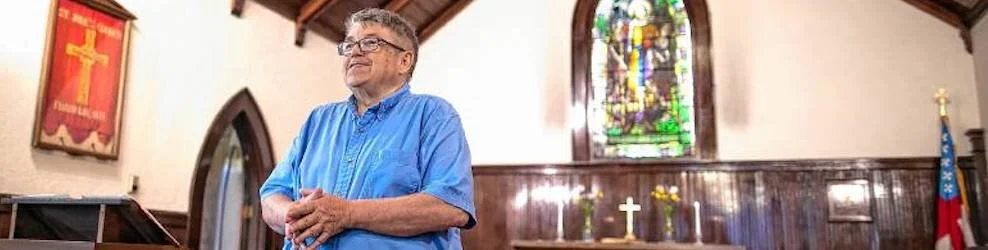
In the News: “Closed for 17 years, St. Jude’s in Franklin opens for prayer”
As reported in the Concord Monitor: When Barbara Burns plays the organ at St. Jude’s Church in Franklin, she thinks about her mother singing with the church’s choir 60 years ago.

As reported in the Concord Monitor: When Barbara Burns plays the organ at St. Jude’s Church in Franklin, she thinks about her mother singing with the church’s choir 60 years ago.
“You can almost see your family up here, in the choir, teaching Sunday school,” said Burns, 81, sitting near the pulpit on her familiar cushioned seat at the organ during a recent Thursday service.
Bishop Rob Speaks at NHCF: The Weavers Among Us
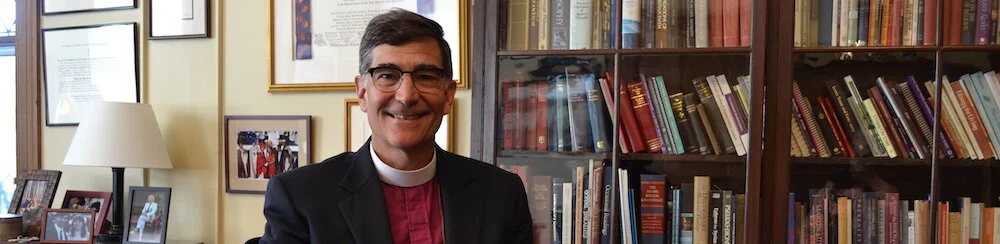
Bishop Rob delivered an inspiring address at the New Hampshire Charitable Foundation's recent annual meeting. Carrying forward his message of spiritual weaving in our community, he set the tone for a moving and uplifting evening.

Bishop Rob delivered an inspiring address at the New Hampshire Charitable Foundation's recent annual meeting. Carrying forward his message of spiritual weaving in our community, he set the tone for a moving and uplifting evening. Please watch, reflect, and share Bishop Rob's words. https://youtu.be/icuCcMfLvv8

In the News: The Rev. Stephen Blackmer and Church of the Woods
Please check out these wonderful articles featuring the Rev. Stephen Blackmer and Church of the Woods. The Dartmouth cover story details Steve's spiritual journey and the creation of the Church of the Woods and Kairos Earth

Please check out these wonderful articles featuring the Rev. Stephen Blackmer and Church of the Woods. The Dartmouth cover story details Steve's spiritual journey and the creation of the Church of the Woods and Kairos Earth. In addition, Steve has also written a marvelous, thoughtful piece in Yale Divinity School's Reflections Magazine: "A Sacred Assembly of Pines, Plants, and People Too."
"Every time we interact
with the creation
is a sacred act.”

200+ Attend Inspiring and Informative Spring Renewal Event
Over 200 people from across the Episcopal Church of New Hampshire (and beyond) gathered at Manchester Community College for a day filled with personal spiritual growth, ministry development, connecting, and renewal.

Over 200 people from across the Episcopal Church of New Hampshire (and beyond) gathered at Manchester Community College for a day filled with personal spiritual growth, ministry development, connecting, and renewal.
“It always renews my faith and strength in the Lord to be around people who are there for the same reasons,” said one of the attendees. “It is wonderful to think out-of-the-box, and the sessions I attended certainly helped me to do that. I have already been talking to people about ways to involve our mission in our community.”
Bishop Rob led everyone in worship, gave thanks, and rejoiced for a "loving, gracious, renewing, restoring, recreating God to be at work in the Episcopal Church of New Hampshire.” He prayed, "May we find our rising today."
30 presenters conducted a wide-range of workshops throughout the day, and Spring Renewal’s Keynote speaker, the Rev. Jay Sidebotham, Director of RenewalWorks, a ministry of Forward Movement, energized us with insights from his stories about the initial development and subsequent growth of RenewalWorks. He urged everyone to ask themselves “in what areas might you benefit from renewal in your lives and the lives of your congregations.”
“The quality of the offerings was very good” noted an attendee. “The keynote was thought-provoking and humorous.”
Workshops included The Way of Love, Green Guidance for Your Spiritual Home, Supporting Your Marriage and Family Life with the Five Love Languages, Mindfulness-Based Stress Reduction, Holding Courageous Community Conversations Across Difference, Parishes Welcoming Recovery, RenewalWorks, Vital Conversations, Crossing Boundaries as a Way to Encounter Christ, The Upside Down Week: Reclaiming Sabbath, Stories of Humble Chutzpah, Reflections on Spiritual Authority, and more.
“What a great day. I only wish I had been able to attend more of the workshops!”
Feedback about the event has been very positive. ”Overall over 81% of attendees said they were “very satisfied” with Spring Renewal, and over 93% said they were “very or somewhat satisfied.” When asked how likely they would be to attend Spring Renewal next year and recommend it to friends, 90% said “likely” or “most likely.”
“This was a great opportunity to get together and meet people from other parishes and to do something interesting and informative!” Most agreed that Spring Renewal strengthened their relationships with others in the Diocese, and almost half said that the workshops gave them “a lot” of practical spiritual growth tools they can implement now.
Spring Renewal created a wonderful sense of community and offered insightful tools for transformation. Stay tuned for Spring Renewal 2020!

Revival: Reimagined. Sharing Faith and Fun
“Insightful, playful, a real celebration,” Revival: Reimagined drew over 110 people in early May, 2019, for a day of spiritual exploration, discussion, and worship in a festive, music-filled setting.

“Insightful, playful, a real celebration,” Revival: Reimagined drew over 110 people in early May, 2019, for a day of spiritual exploration, discussion, and worship in a festive, music-filled setting.
Organized by St. Christopher’s in Hampstead and St. Peter’s in Londonderry, Revival: Reimagined featured
a Celebration Eucharist, six different presentations covering a diverse range of spiritual topics... and a jazz band, a bluegrass band, and an ice cream truck!
Presentations included the Intergenerational Church, Experiencing God in the World of Pop Culture, Becoming Beloved Community Through the Way of Love, Losing Faith and Finding It, Where the People are: Unexpected Christian Formation, On the Way of Love, and a conversation with Bishop Rob.
Revival: Reimagined featured special guest, the Rev. Dr. Tricia Lyons. She lives and teaches evangelism at Virginia Theological Seminary, and is finishing her latest book, “What is Evangelism?” (to be published in late 2020). “People raved about our guest speaker,” said the Rev. Colin Chapman, St. Peter’s, Londonderry. “She had an amazing ability to speak uncomfortable truths about sharing faith and evangelism in a way that was straightforward and genuine.”
People had fun and learned a lot about how to share their faith, share their stories, engage their communities, and work to find deeper peace and meaning in their lives. Many attendees commented on learning about the importance of “listening for the voice of God in their lives” and “meeting, talking, and listening to people where they are to establish a true, loving connection.”
Energizing and celebratory music was provided by the WildVine Jazz Sanctuary House Band and the New Revival Bluegrass Band.
Bishop Rob's 2019 Easter Letter: A Community of Weavers
Much has been written about our torn social fabric. So many in our society wake up feeling cut off from any sense of family, community or neighborhood. Belonging is on the wane. Isolation is on the rise.

Much has been written about our torn social fabric. So many in our society wake up feeling cut off from any sense of family, community or neighborhood. Belonging is on the wane. Isolation is on the rise. In such a fragmented culture as ours, it is no wonder that there are nearly 50,000 suicides every year in America and over 70,000 deaths to drug addiction, almost double the number of casualties during the whole of the Vietnam War.
Recently I read a powerfully truthful and hopeful piece by columnist David Brooks who reported on attending a conference called “Weave: The Social Fabric Project.” Its first core idea is “that social isolation is the problem underlying a lot of our other problems. The second core idea is that this problem is being solved by people around the country at the local level who are building community and weaving the social fabric.”
The Church has benefited society because Jesus calls each of us to a holy weaving. Every time we see a person as a bearer of God’s image, we weave. Every time we pigeonhole someone into the isolating labels of gender, ethnicity, nationality, race, sexual orientation, or even political party, we are rippers. To seek to fulfill our Baptismal Vow to “uphold the dignity of every human being” is to weave.
This weaving is done in so many of our churches. When we welcome the homeless into our spaces through Family Promise, volunteer to be mentors or tutors at local public schools or for at-risk children, when we simply have lunch at the local soup kitchen, or visit those in prison or in hospice or the homebound, we are weavers. We weave when we faithfully keep vigil with one who struggles to recover from addiction. We weave when we participate in book groups or discussions across differences of opinion. We weave when we pick up the trash by the side of the road or from our river banks and are cautious about our carbon footprint.
When I say this is holy work, I speak from the depths of our Christian tradition. The theological word that describes the love and adoration that moves among the Three Persons of the Holy Trinity is perichoresis, meaning, an interweaving, a dancing flow, among three distinct identities. More simply, God is a weaver. God’s love is known not in isolation, but in community. As he washes his disciples’ feet, Jesus says, “By this everyone will know that you are my disciples, if you have love for one another.” (John 13:35) Being created in God’s image means sharing in this eternal identity and mission wherever and among whomever we find ourselves.
The torn body of Jesus is mended by God in the Resurrection. May it be so with us in the Risen Body of Christ this Easter!
Bishop Rob
The Rt. Rev. Robert Hirschfeld