Youth Pilgrimage: Walking in the Footsteps of Jonathan Daniels - Sept. 2026
By Barbara MacLeod
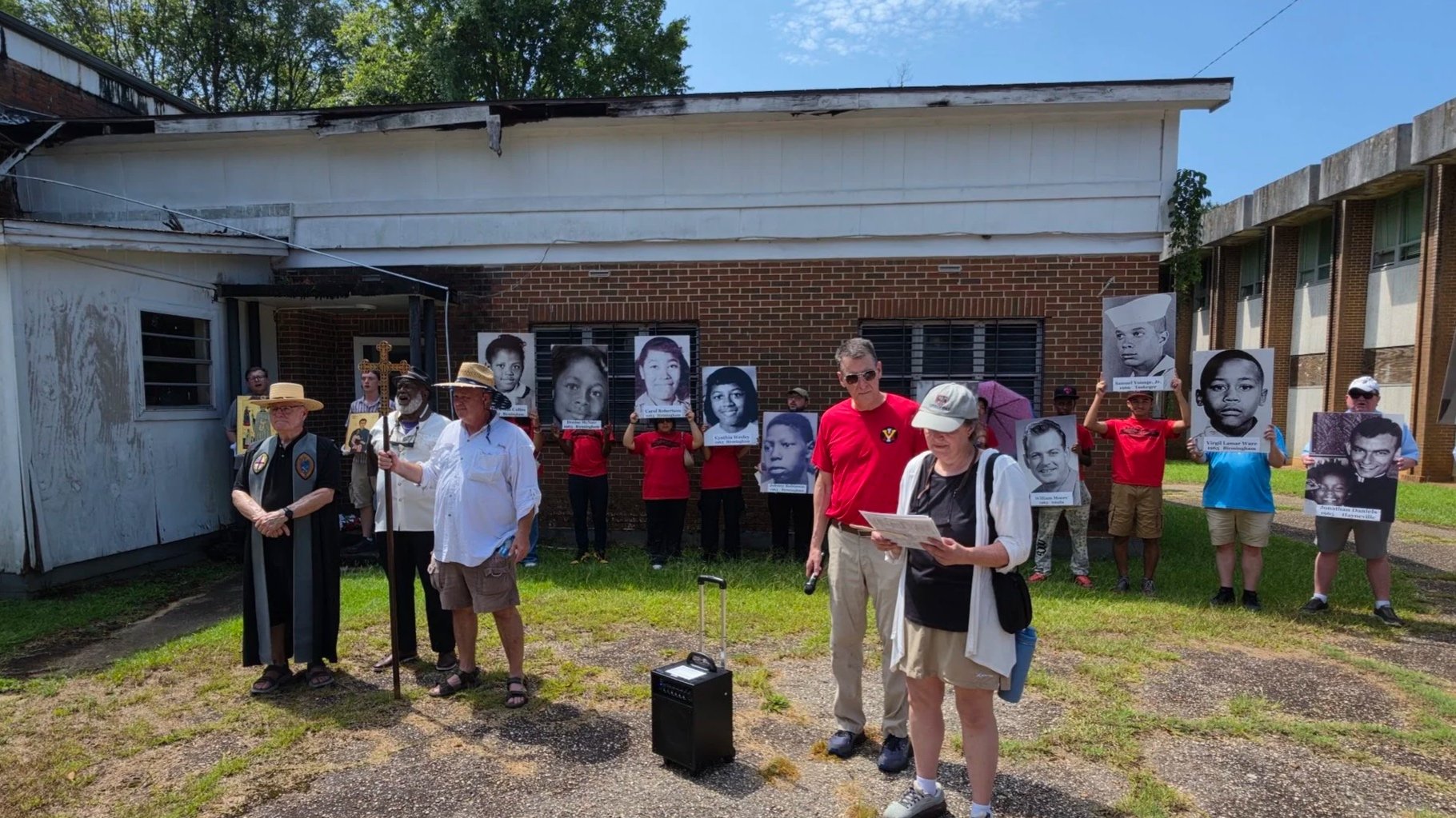
A group of Episcopal teenagers from across the state traveled to Alabama in August for a pilgrimage that brought them face to face with some of the most difficult chapters of American history. It also challenged them to consider what their faith asks of them today. The impetus of the four-day trip was to follow in the footsteps of Keene seminarian Jonathan Daniels, who was murdered in Alabama in 1965, saving a young Black activist from a bullet.
Seventeen-year-old Ava Tennett of Goffstown says the experience revealed how much of civil rights history she did not know. “I was personally impacted by how much I learned that schools simply do not teach,” she said. “We visited museums and landmarks and spoke with people who dedicate their lives to making sure this history and truth are remembered.”
The five young people were accompanied by four adult chaperones. Their journey included visits to significant historic sites before culminating in the annual Jonathan Daniels and the Martyrs of Alabama Pilgrimage in Hayneville.
The idea for the trip began a year earlier, when the Rev. Kelly Sundberg Seaman traveled to Alabama for the 60th-anniversary pilgrimage honoring Daniels. She realized what a meaningful experience it could be for young people to learn about history in the places where it actually happened.
The Rev. George Swenson, who oversees youth ministry for the diocese, says an important aspect of the pilgrimage was helping the teenagers understand the broader history surrounding Daniels' decision to come to Alabama and the role faith communities played in the Civil Rights Movement.
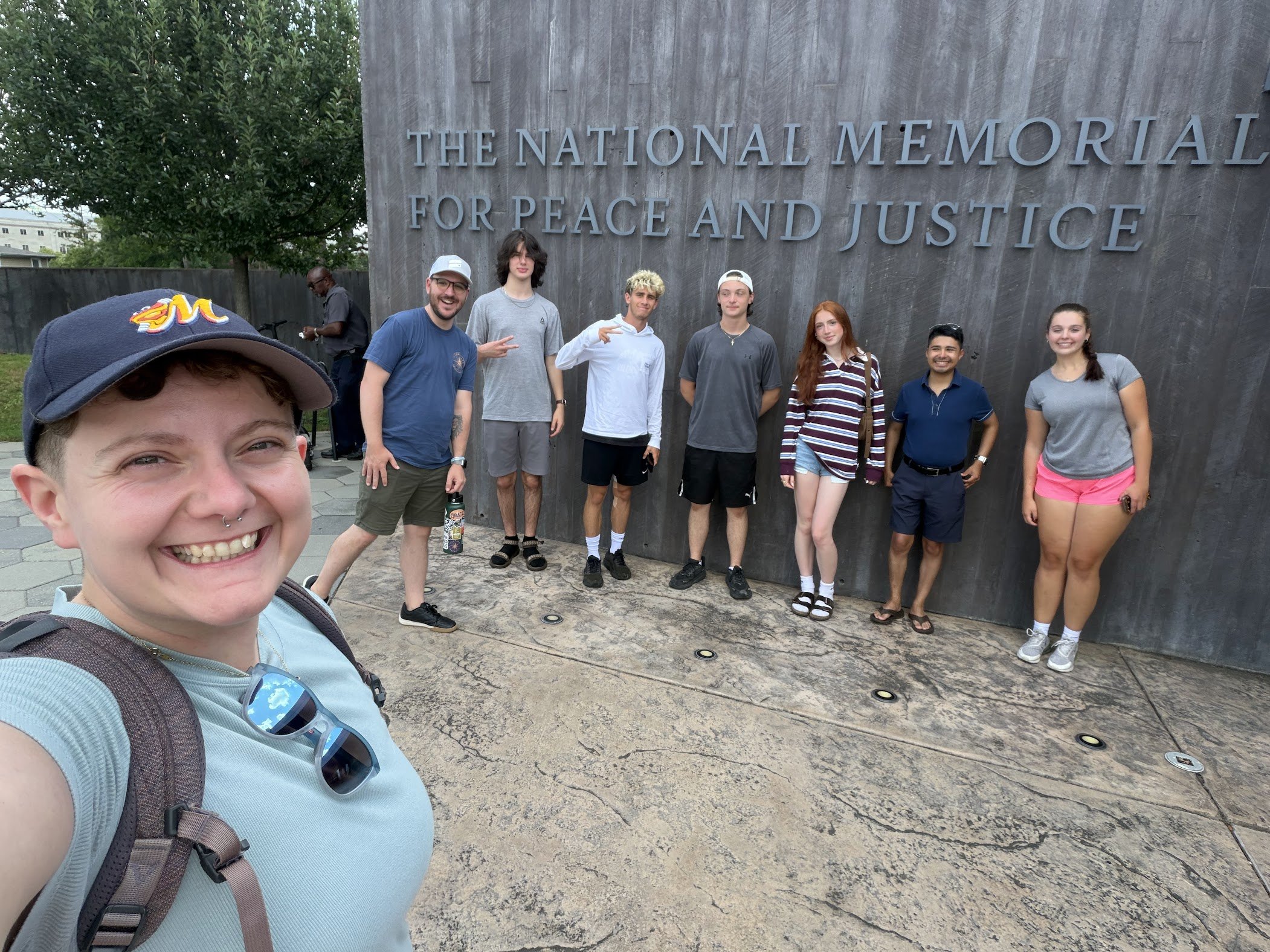
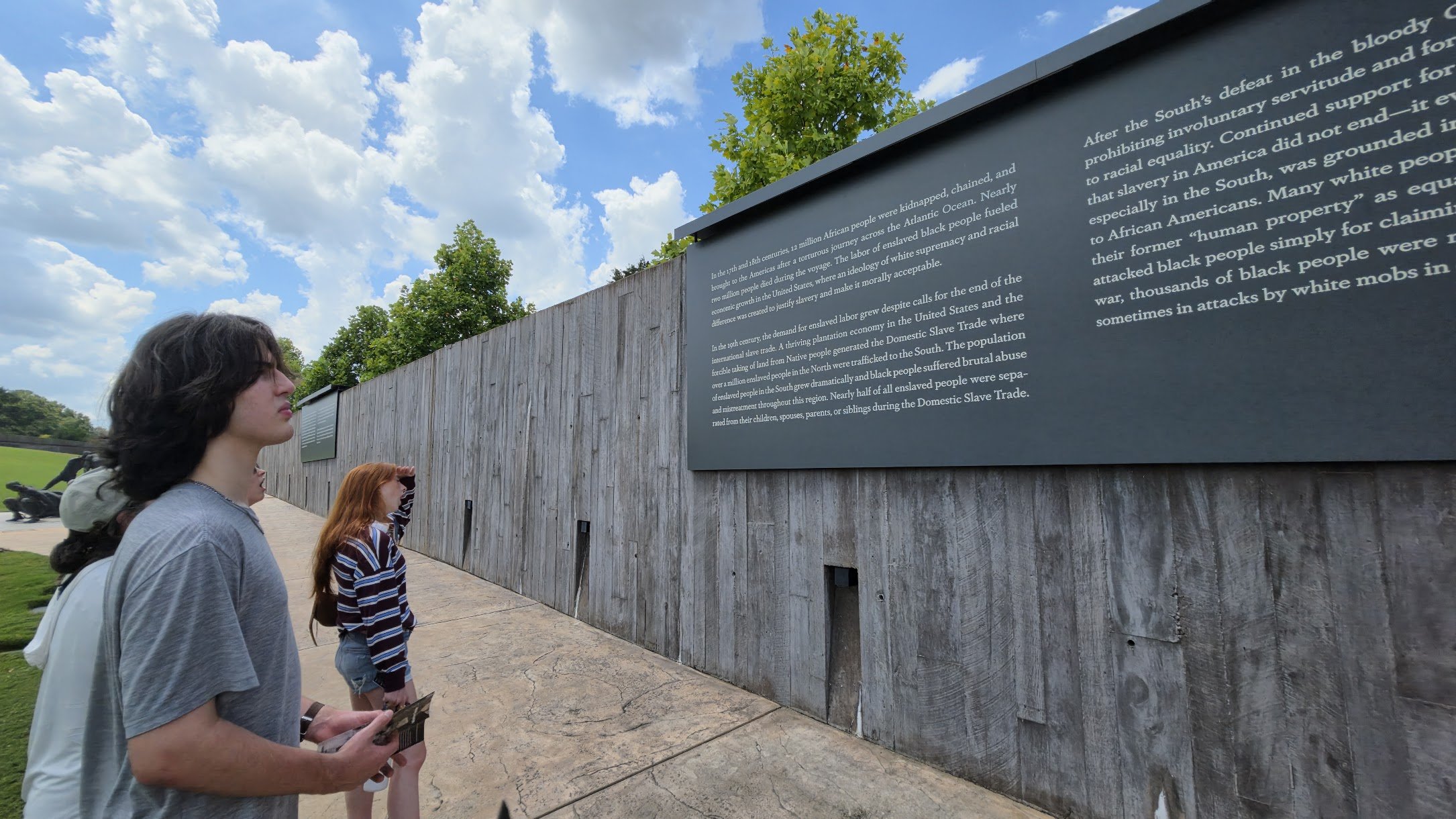
At the National Memorial for Peace and Justice in Montgomery, the group came face to face with the history of racial terror and lynching in America. Ava (pictured above, far right) recounted how surprised she was by the scope of the violence.
“I was shocked to see how many people were killed by lynching. I do not think I fully understood how long this had been happening or the severity of it until I was surrounded by the names of the victims.” Ava went on to say, “The experience made me realize how important it is to seek out history beyond what is taught in a classroom and to make sure these stories are remembered and shared.”
The Rev. George was similarly moved.
“Some monuments contained so many names that the lettering had to become smaller to accommodate them,” he says. On others, multiple victims shared the same last name – evidence of entire families affected by racial violence.”
At the end, the group sat quietly together; “We were all just sitting there in this deep contemplative silence letting it all soak in,” Rev. George recalled.
The Legacy of Jonathan Daniels
For Episcopalians from New Hampshire, the history of the Civil Rights Movement has an especially powerful connection through Jonathan Daniels.
Daniels grew up in Keene and graduated from the Virginia Military Institute before eventually entering Episcopal Theological School in Cambridge, Massachusetts. In March 1965, he heard the Rev. Dr. Martin Luther King Jr.'s call for clergy and others to come to Alabama following the violence against voting-rights marchers in Selma.
Daniels went.
While many who responded to King's call eventually returned home, Daniels remained in Alabama, working alongside Black residents and civil rights activists.
In August 1965, Daniels and other demonstrators were arrested and taken to the county jail in Hayneville. After being held for several days, they were unexpectedly released. Daniels and three companions walked to a nearby store. There they were confronted by a white man carrying a shotgun. When the gun was aimed at 17-year-old Ruby Sales, Daniels pushed her out of the way and was struck by the blast. He died instantly. He was 26 years old.
For the New Hampshire group on this pilgrimage, Daniels was no longer simply a historical figure from their home state. They stood in the places where the final days of his life unfolded.
The journey also explored a dimension of the Civil Rights Movement that the Rev. George believes is often missing from what students learn in school: the central role of churches. “We asked the students: What does faith require when people encounter injustice? We talked a lot about courage.”
According to Rev. George, some of the most important conversations didn't happen inside a museum or at a historic site. He says the five teens arrived from different communities and brought different personalities and perspectives to what they were experiencing.
“Hearing their thoughts and experiences challenged me to think about what I was learning in new ways,” Ava said.
There were lots of conversations about history and faith, but the pilgrimage wasn't all somber. The teenagers laughed, explored a different part of the country and got to know one another. “I left Alabama with four new friends,” Ava said. “We talked about history and faith, but we also got to know each other and create memories together. The trip was incredibly powerful and moving, but it was also a lot of fun.”
Ava’s advice to another teenager considering the pilgrimage is simple: “Go. This is truly a trip of a lifetime.”
For the Rev. George Swenson and the other adults who made the journey possible, that experience was part of the goal: to give young Episcopalians an opportunity to encounter difficult history, consider the Church's place within it, and reflect on what courage and faith might require in their own lives.
The diocese hopes the Alabama pilgrimage will become a signature experience for its growing youth ministry program and would like to offer it again.

A New Chapter Begins at Christ Church in Portsmouth
On a beautiful sunny day in Portsmouth, more than 150 people gathered on the grounds of Christ Church, where God’s presence seemed to be felt all around — in the warmth of the morning, in the prayers offered, in the memories held in the land, and in the hope of what is yet to come.
With shovels in hand and gratitude in abundance, leaders from the Episcopal Church of New Hampshire, Christ Church Portsmouth, Portsmouth Housing Authority, HAVEN, and the Black Heritage Trail of New Hampshire broke ground on a project that will transform the Christ Church property at 1035 Lafayette Road into a place of housing, healing, worship, historic stewardship, and long-term community care.
The project is made possible through a no-cost 98-year lease of church land by the Episcopal Church of New Hampshire; a remarkable commitment that will make this land available for public good for nearly a century. What has long been sacred ground for worship and community life will now be reimagined to meet some of the most urgent needs of the wider Portsmouth community.
When complete, the site will include 44 permanently affordable workforce housing units, a new headquarters and transitional housing for HAVEN (a nonprofit that serves survivors of domestic and sexual violence), a potential center for early childhood education, a more sustainable worship space for Christ Episcopal Church, and continued care for the African Burying Ground at Langdon Farm.
For Bishop Rob, the day marked not only the beginning of construction, but the beginning of a new chapter in the life of the land, the congregation, and the wider community. “Through this extraordinary collaboration, this property is being reimagined in a way that reflects the church's mission to use its land and resources in service to others. At a time when communities everywhere are struggling with housing affordability, safety, belonging, and the future of faith-owned spaces, this partnership offers something rare and hopeful: a concrete example of land being used not simply for one institution’s needs, but for the common good,” he said.
The day was filled with signs of both reverence and renewal. There was joy in the gathering, but also a deep awareness of the history held by the land. The site includes the African Burying Ground at Langdon Farm, a sacred place that will be protected during construction and stewarded with care.
JerriAnne Boggis, Executive Director of the Black Heritage Trail of New Hampshire, spoke powerfully about the meaning of that commitment; “For descendants and for all who care about truth, this moment carries particular meaning,” Boggis said. “At a time when there are efforts across our country that seek to diminish, erase, or sanitize the history of slavery, we stand here witnessing a different path. No one has looked away from this history. No one has attempted to build over it or pretend it never happened. Instead, those responsible for this project have chosen to proceed thoughtfully, deliberately, and with care. They have recognized that the people buried here deserve respect, and that the history they represent deserves preservation. That is what responsible stewardship looks like.”
For Christ Church, the groundbreaking was a moment of both letting go and leaning forward in faith. The congregation is allowing its beloved church building to be repurposed for HAVEN’s work, while preparing for a more sustainable, right-sized worship space on the site. The Rev. Steve Falci of Christ Church told the crowd; “For nearly a century and a half, Christ Episcopal Church has stood as part of Portsmouth’s spiritual and civic fabric. Since our founding in the 1880s, we’ve served generations — always striving to be a place of welcome, worship, and compassion.”
Rev. Steve honored the parishioners who founded Christ Church in Portsmouth’s West End to serve working-class families and immigrants; those who rebuilt after a devastating 1963 fire destroyed the original church building; those who stewarded the congregation for the past 60 years on Lafayette Road; and the current members of Christ Church, whom he described as “resilient faithful.” Their willingness to imagine a new future for the property is at the heart of the project now taking shape.
For HAVEN, the day represented the culmination of an eight-year search for a permanent home in Portsmouth, where the organization has been rooted since its founding 46 years ago. HAVEN is the largest violence prevention and support services nonprofit agency in New Hampshire.
Kathy Beebe, Executive Director of HAVEN, said the Diocese’s long-term, no-cost commitment of the property creates a once-in-a-generation opportunity. “We are deeply grateful to the Diocese for this incredible gift; not only because it will provide HAVEN with a forever home, but because it brings together community. For survivors of domestic and sexual violence, community is connection, and connection is healing. That is the premise for what HAVEN is building and what this partnership represents.”
HAVEN’s permanent home will be located in the renovated church space, with an addition that includes seven newly constructed transitional housing units.
For Portsmouth Housing Authority (PHA), the project responds to one of the region’s most pressing challenges: the need for housing that working people can afford. The 44 permanently affordable rental apartments will give preference to local workers and childcare workers, with a focus on people earning 60 percent of the area median income. “I am overflowing with gratitude that this project has become a reality,” PHA Executive Director Craig Welch said. “Portsmouth needs housing that working people can actually afford, and opportunities to create it are rare. The Diocese’s no-cost 98-year lease gives this project the long-term stability needed to create permanently affordable homes while joining with HAVEN and Christ Church in a broader community partnership. It is exactly the kind of creative response the Seacoast needs.”
As the gathering came to a close, there was a sense that something more than ground had been broken. A new way forward had been opened.
This project is more than a redevelopment. It is a witness to what can happen when faith communities, housing leaders, survivor-service organizations and historic stewardship partners come together with imagination, courage, and care. It is a reminder that sacred ground is not only preserved by looking back, but also by asking how it can serve God’s people now.
At 1035 Lafayette Road, a new chapter has begun — one rooted in housing, healing, worship, remembrance, and the common good.
Construction is now underway and is expected to be completed in late summer 2027.
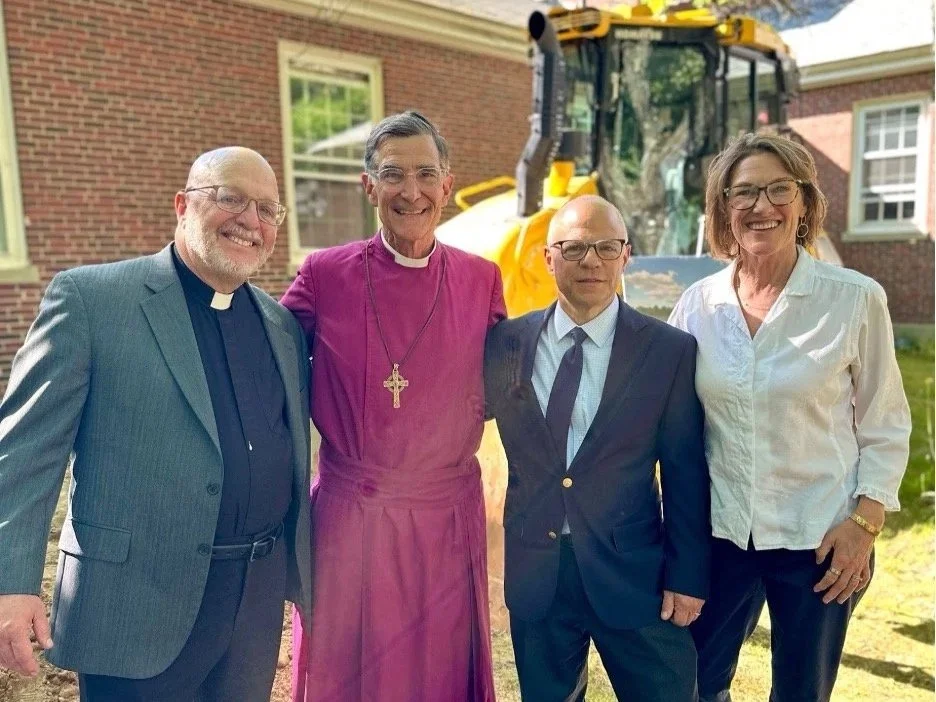
Rev. Steve Falci, Bishop Rob Hirschfeld, Diocese Special Projects Manager Benge Ambrogi, Diocese Communications Consultant Barbara MacLeod at the Portsmouth project groundbreaking.
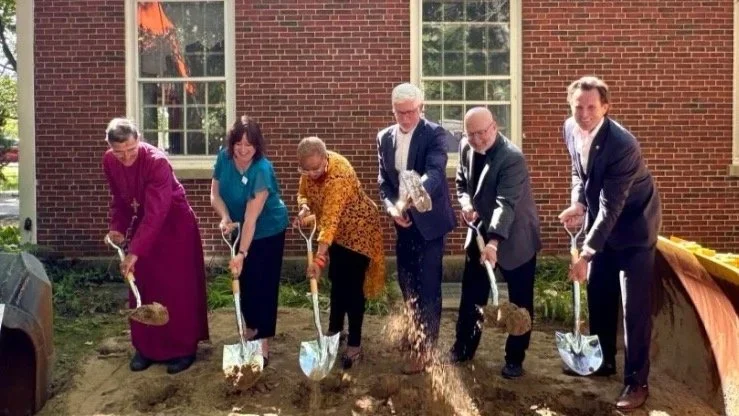
L-R Bishop Rob, HAVEN’s Kathy Beebe, Black Heritage Trail Exec. Dir. JerriAnne Boggis, PHA Exec. Dir. Craig Welch, Rev. Steve Falci, Portsmouth Mayor Deaglan McEachern
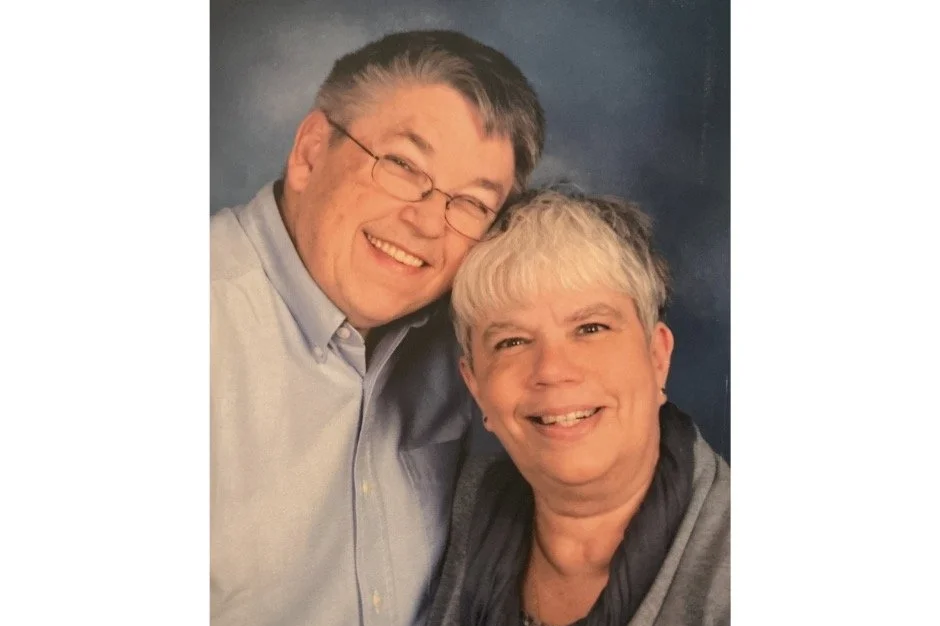
Ministry, Marriage, and the Second Half of Life: Joe and Audrey Rose
By Christina C. Gordon
When Joe and Audrey Rose talk about ministry, they begin with stories: stories of surprise, hesitation, and moments when God showed up in ways they never expected.
By most accounts, their story should have been winding down. Joe had retired after a 40-year career in the propane industry. Audrey had spent years in business and doing volunteer work, and for a long stretch, away from church altogether.
Instead, what unfolded was a shared calling that is reshaping small congregations and quietly but dramatically renewing community life.
“I was not going,” Audrey says, laughing as she recalls the Episcopal Revival that changed everything. A friend kept encouraging her to attend. “No, absolutely not,” she insisted. But she went anyway.
There, listening to Bishop Michael Curry, Audrey experienced something she still struggles to describe. “It was probably the first time in my life I totally felt the presence of God.”
That moment changed the course of her life. Later, at a conference in Atlanta, she encountered interactive worship exhibits created by experiential worship curator Lily Lewin. Standing in a quiet ballroom filled with prayer stations and liturgical displays, Audrey felt a clear call: this is what you are meant to do.
“I didn’t have any background,” she says simply. “I just started.”
Audrey did complete her lay preaching certificate through the NH School for Ministry (SFM), a member of the Iona Collaborative network. Today, she preaches regularly in congregations across the region and is known for creating worship experiences that invite participation and connection: prayer trees open to the wider community, large-group puzzles tied to liturgical themes, interactive prayer stations that draw people in rather than asking them to sit passively in the pews.
“It is lighting that little spark and letting it burn into a flame,” Audrey says.
Joe’s call unfolded differently.
For years, he says, he kept putting God off with humor and excuses. Retirement finally changed that. While preparing to begin coursework through SFM, Bishop Rob Hirschfeld called him into his office, slid a business card across the desk, and then handed him a key.
The address belonged to what is now the Episcopal Mission in Franklin, NH: a church building that had sat closed for nearly twenty years.
Joe’s first initiative was a simple weekly meal called “Lunch with Jesus.” Worried nobody would come, he invited two friends to help fill the room. Twelve people showed up.
Soon, others began returning too, including the church’s former organist, who arrived carrying the church’s crucifix she had safeguarded for years. Week by week, more people brought back items they had been keeping safe, waiting, perhaps, for the church to live again.
Today, the Episcopal Mission of Franklin hosts weekly worship and serves as a vibrant part of the community.
Joe later entered a three-year formation program through SFM and was ordained in December 2023. The next day, he began serving as vicar at St. John the Evangelist in Dunbarton, a congregation that had been without clergy for seven years.
Average Sunday attendance hovered around eight people. The church looked closed. When Audrey contacted the town about adding St. John’s to local webpages and social media listings, she was told Dunbarton didn’t have an Episcopal church.
“They were in a liturgical desert,” Joe says.
The work of rebuilding was slow and sometimes difficult. Congregations shaped by years of decline and uncertainty often carry grief, fear, and resistance to change. During a NH Episcopal Diocese workshop hosted by Iona Collaborative's Thriving Congregations program, Joe encountered a framework for understanding congregational transition that helped him name those emotions more clearly.
“It all made sense,” he recalls. “They were angry, fearful, disoriented.”
Back at St. John’s, Joe shared the resource with the congregation and spoke openly about grief, change, and hope.Once the congregation began finding stability internally, Joe encouraged members to look outward.
“I’m not telling you what the mission is,” he told them. “What is in your hearts? How do you want to serve God?”
At a town meeting, Joe heard leaders discuss growing isolation among seniors. Back at church, he looked around: a parish hall, a kitchen, and people with time and a gift for hospitality.
The answer became a monthly senior lunch. Free meals. No pressure. Just a place where people could gather, talk, and feel known. The lunches quickly grew. Community members with no connection to the church began showing up, not only to eat, but to volunteer. Flowers appeared on tables. Donations exceeded costs. Relationships formed.
“You can just see the Holy Spirit at work,” Audrey says.
The congregation itself began to change as well.
On Easter Sunday, 27 people filled the pews. A young man in his twenties sat at the church’s historic pump organ, keeping the pedals moving just as his grandfather once had.
“A couple weeks ago, someone asked, ‘What else can we do?’” Audrey recalls.
Joe smiles. “You can just see the church coming alive.”
The Future
That movement – from maintenance to mission – is at the center of Joe and Audrey’s shared ministry.
Audrey now leads Bible studies, preaches regularly, and hosts online evening prayer four nights a week. What began during the COVID-19 pandemic has grown into an online ministry reaching people from Texas to California to France.
“I think that’s part of the future of the church,” she says.
Together, Joe and Audrey embody a model of ministry that feels increasingly important: collaborative, locally rooted, and open to the gifts of both lay and ordained leadership. “Lay leaders can have just as much calling,” Audrey says. “We need to make it easier for them to pursue it.”
For the past two Christmas Eves, a neighbor who does not attend St. John’s has quietly arrived before worship to line the church driveway with lanterns.
Nobody asked him to do it.
He simply comes, and the light is there when the congregation arrives.
That is the kind of ministry Joe and Audrey Rose are building: not ownership, but stewardship. Not a finished picture, but something still unfolding.
And that something can serve as inspiration and a blueprint for the broader Episcopal community in New Hampshire and beyond.
Theology for All - Expands Learning Across the Diocese
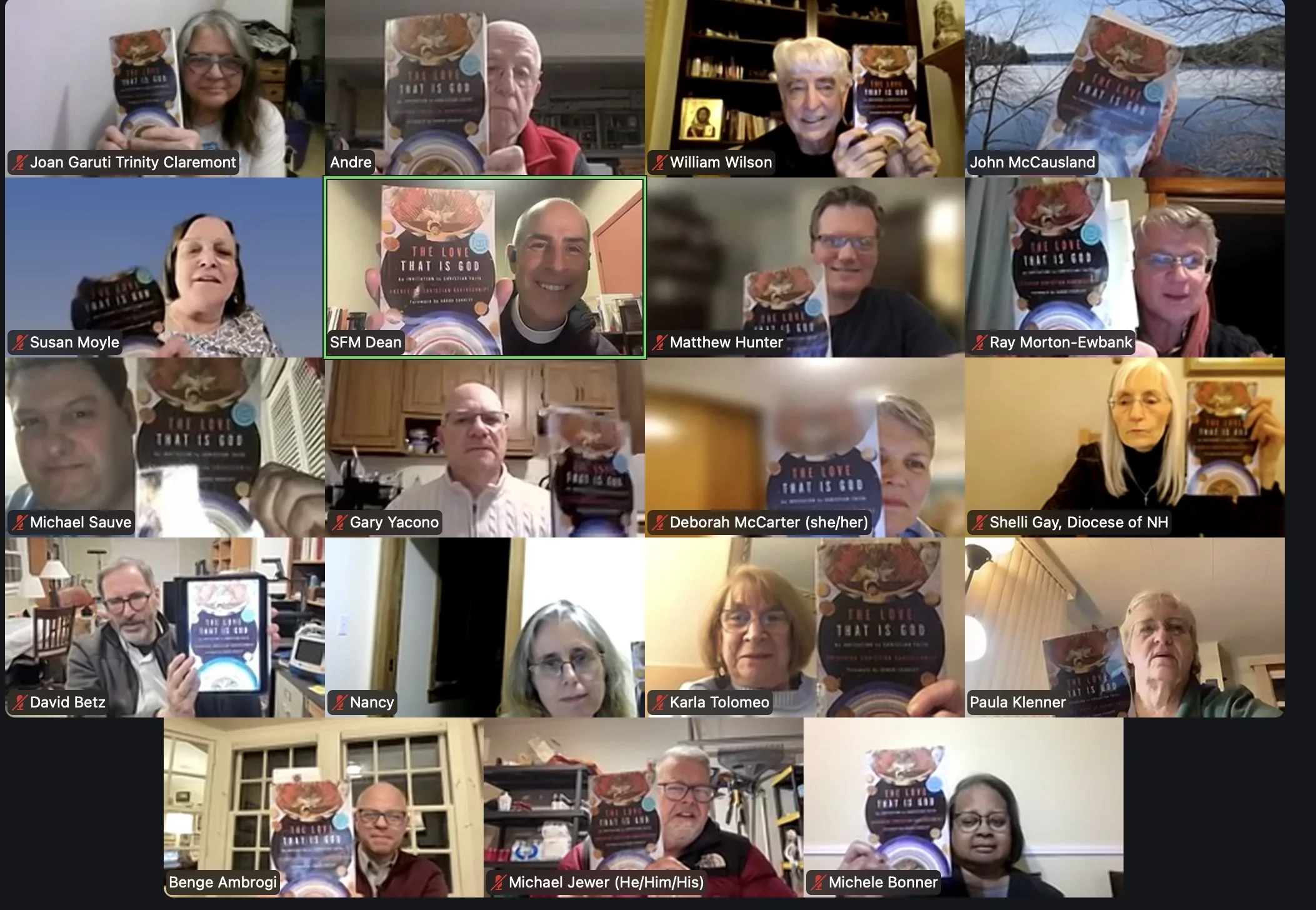
It’s a Thursday night, and twenty people have gathered on Zoom to discuss theology and ethics. Participants – mostly lay people – join from across New Hampshire. The conversation is lively, thoughtful, and often punctuated by laughter.
This is the Seminar in Theology and Ethics, part of a new initiative from the Diocese of New Hampshire’s School for Ministry (SFM): Theology for All – a series of courses open to anyone seeking a deeper understanding of Christian faith and practice.
Led by the Rev. Joe Pagano, one of the Deans of the School for Ministry, the 10-week course reflects an intentional broadening of the SFM’s mission. For the past five years, the School has focused primarily on training those preparing for ordination or lay preaching certification. Theology for All expands that work – creating space for anyone in the Diocese who is curious, engaged, and eager to grow.
Participants say the experience is already making a meaningful impact.
“As a result of the class, I’ve found myself looking at familiar things in a different way,” said Karla Tolomeo of Church of the Good Shepherd. “It’s enriching how I understand both Christian ethics and my role in the church community.”
Others note how the course is shaping their experience of worship.
“Last Sunday’s Eucharistic prayer took on extra meaning,” said Ray Morton-Ewbank of Church of the Transfiguration in Derry, “recalling our recent discussion and seeing how it connects to our shared spiritual story.”
For some, the course offers a chance to re-engage with theological study after many years.
“The class has been enormously stimulating,” said the Rev. John McCausland, a retired priest who worships with St. Andrew’s in Hopkinton. “It’s been hard to keep up with academic theology since seminary, and this fills a real gap. The readings and discussion are just what I need.”
Participants are even joining from beyond the Diocese.
“I’m grateful to be part of this learning adventure,” said Gary Yacono, a deacon in formation from the Diocese of Newark. “It’s been informative, engaging, and a pleasure to connect with people from New Hampshire.”
For Dr. Pagano, the course affirms something important: that serious theological engagement is not limited to specialists.
“We are reading works by two of today’s leading theologians,” he said, “and our experience shows that we can read serious theology, seriously. It’s not just for ‘experts,’ and it doesn’t need to be simplified. People can learn together and grow together.”
That spirit of shared learning is at the heart of Theology for All – and it’s just beginning.
In the words of Karla Tolomeo, “Since the class, I have found myself looking at familiar things in a different way, enriching how I view both Christian ethics and my role in the church community. Joe is an extremely knowledgeable and organized facilitator who presents thoughtful questions for discussion based on the readings.”
For those who have taken part so far, the impact is clear: deeper understanding, renewed engagement, and a stronger connection to faith, worship, and one another. The next Theology For All course, What on Earth Should I Do? Useful Pastoral Care Techniques for Lay People, begins June 1. Find out more here.
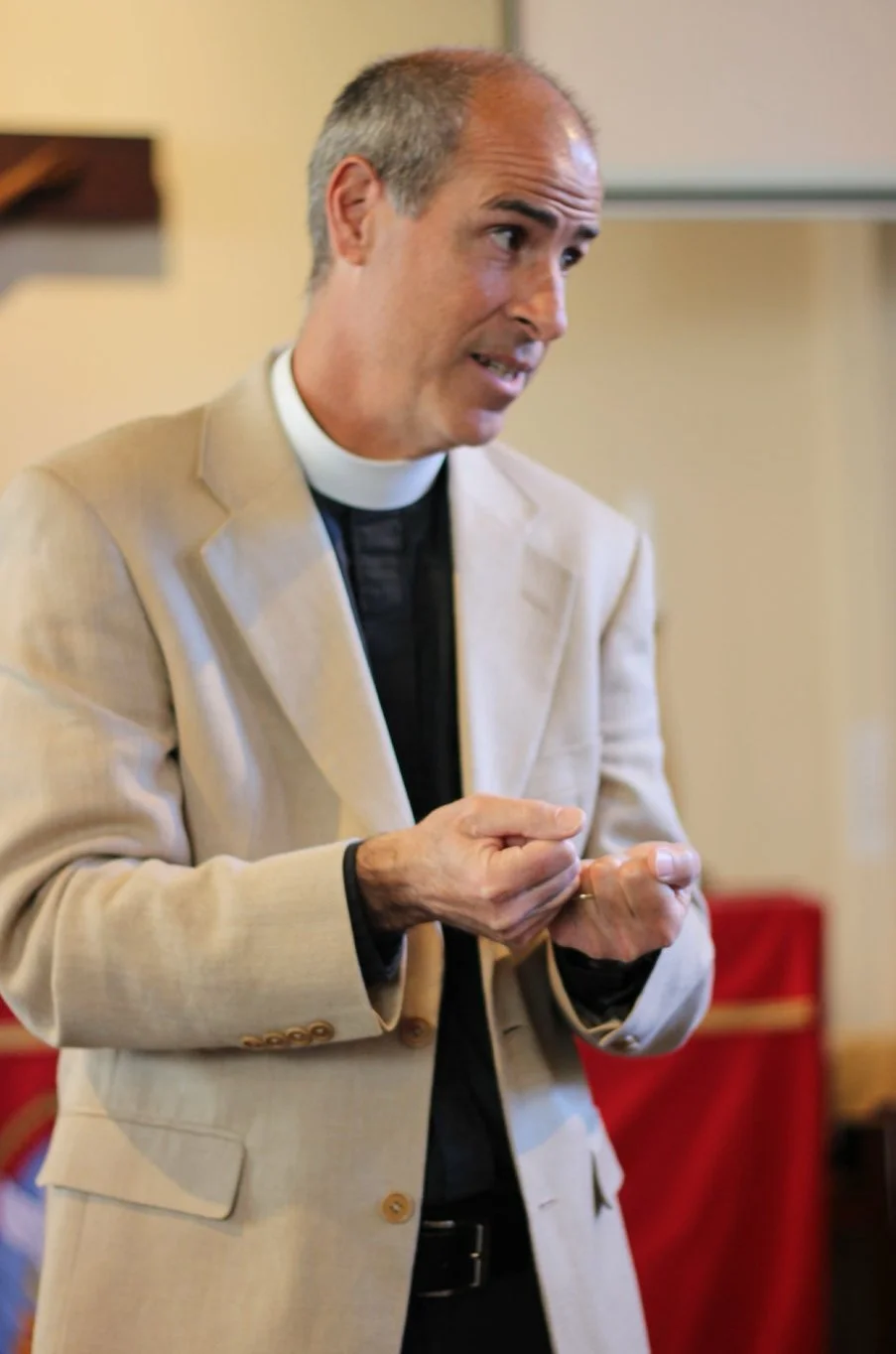
Photo: the Rev. Joe Pagano teaching.
Micah 6 Commission: A Year of Building Relationships for Local Justice
When the Most Reverend Michael Curry, 27th Presiding Bishop of the Episcopal Church, travelled to Portsmouth, New Hampshire last February to speak along with Bishop Rob at the Black Heritage Trail of NH’s celebrated “Tea Talk,” it was a perfect example of the power of the Micah 6 initiative and how it brings people and organizations together in the name of social justice. The event was held in a synagogue, was open to all, and drew a large audience who were thirsty for wisdom and encouragement. The Bishops didn’t disappoint. Their vastly different experiences growing up, their bond of friendship, and their shared faith made for interesting conversation, storytelling and ways to further racial justice. The crowd was mesmerized. This is one example of how the Micah 6 Commission – just one year into its existence – is shaping how the Episcopal Church of NH is taking action with partner organizations.
Now just one year since its formation in April 2025, the Micah 6 Commission is making strides. The Commission was formed as a way to streamline and empower parishes to take action against racism, economic inequity, and environmental degradation. The work is guided by the principles of Micah 6:8, which emphasizes the importance of doing justice, being kind, and walking humbly with God.
“Micah 6 is a guiding call for how we live our faith and baptismal covenant,” says Commission Chair Derek Scalia. “Our world is hurting, and people are yearning for points of light and relief. Through this work, we seek to embody the call to do justice.”
Created to combine our local efforts around reconciliation, earth care, educational equity, and reparations, Micah 6 has found a sibling in the Global Missions Committee, which focuses on international social justice work, while Micah 6 focuses on New Hampshire organizations already doing critical justice work.Rather than creating new programs, Micah 6 focuses on building relationships with these current initiatives. These partnerships reflect shared learning, mutual respect, and a commitment to long-term impact. Among its early collaborations:
Supporting Black Heritage Trail of NH “Tea Talks,” fostering dialogue on race and history
Partnering with the NH Fair Funding Project to advocate for equitable education
Advancing environmental stewardship through the New England Episcopal Path to Creation Justice initiative
John Rowntree, parish treasurer at Good Shepherd Church in Nashua, urges Episcopalians to consider joining churches in Claremont, Keene and Londonderry that are currently participating in the New England Episcopal Path to Creation Justice , a program which provides support and tools to parishes committed to addressing the climate crisis. Rowntree says the Micah 6 Commission contributed a three-year grant to support them. Says Rowntree, “We have done multiple projects to reduce our 148-year-old church’s carbon footprint, including insulation, improving our historic church windows, changing lightbulbs and implementing 35 solar panels. It feels really good to make a difference and helps us be strong financial stewards because we have reduced our energy costs.”
The Commission is made up of 12 members in addition to Bishop Rob. The Commission meets monthly and has held two major planning sessions over the last year.
It has also helped distribute $85,000 in Coit House funds, administered through the New Hampshire Charitable Foundation, to support a wide range of community organizations – from childcare centers and summer camps to youth programs and family services.
At its core, the Micah 6 Commission is grounded in the belief that justice work begins in relationships.
“We are not here to solve every problem,” Commission leaders note. “We are here to listen, to accompany, and to support the work already unfolding in our communities.”
This relational approach is already strengthening parish life across the Diocese. By sharing stories, connecting congregations to opportunities, and deepening engagement, the Commission is helping Episcopalians live out their call to justice in tangible ways.
As the Commission enters its second year, it is building a more intentional structure to sustain and grow this work: strengthening communication, aligning resources, and supporting parishioners in integrating justice, mercy, and humility into every aspect of ministry.
Ultimately, the Micah 6 Commission is an invitation: to listen more deeply, to partner more intentionally, and to participate more fully in the work of healing and justice across New Hampshire. Commission members believe that justice takes root most fully when nurtured in parish communities that pray, learn, and serve together. They are committed to ensuring that the wisdom gained becomes a resource for congregations seeking to deepen their own ministries of justice. These faithful committee members believe that sharing stories and opportunities strengthens parish life and inspires local action rooted in the Gospel.
To share your stories of social justice work at your church or to find out more about Micah 6 please email Derek Scalia at dnascalia@gmail.com.
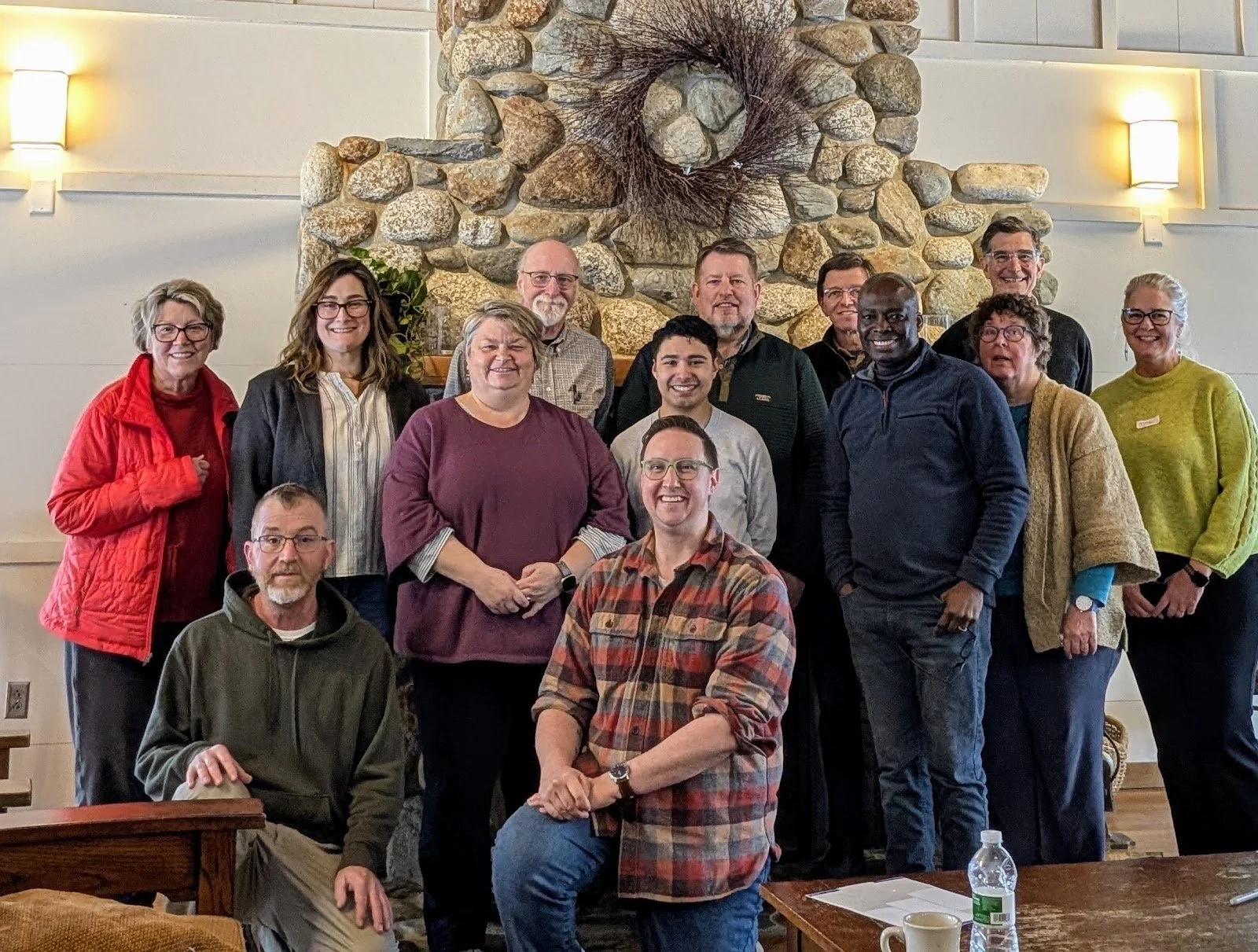
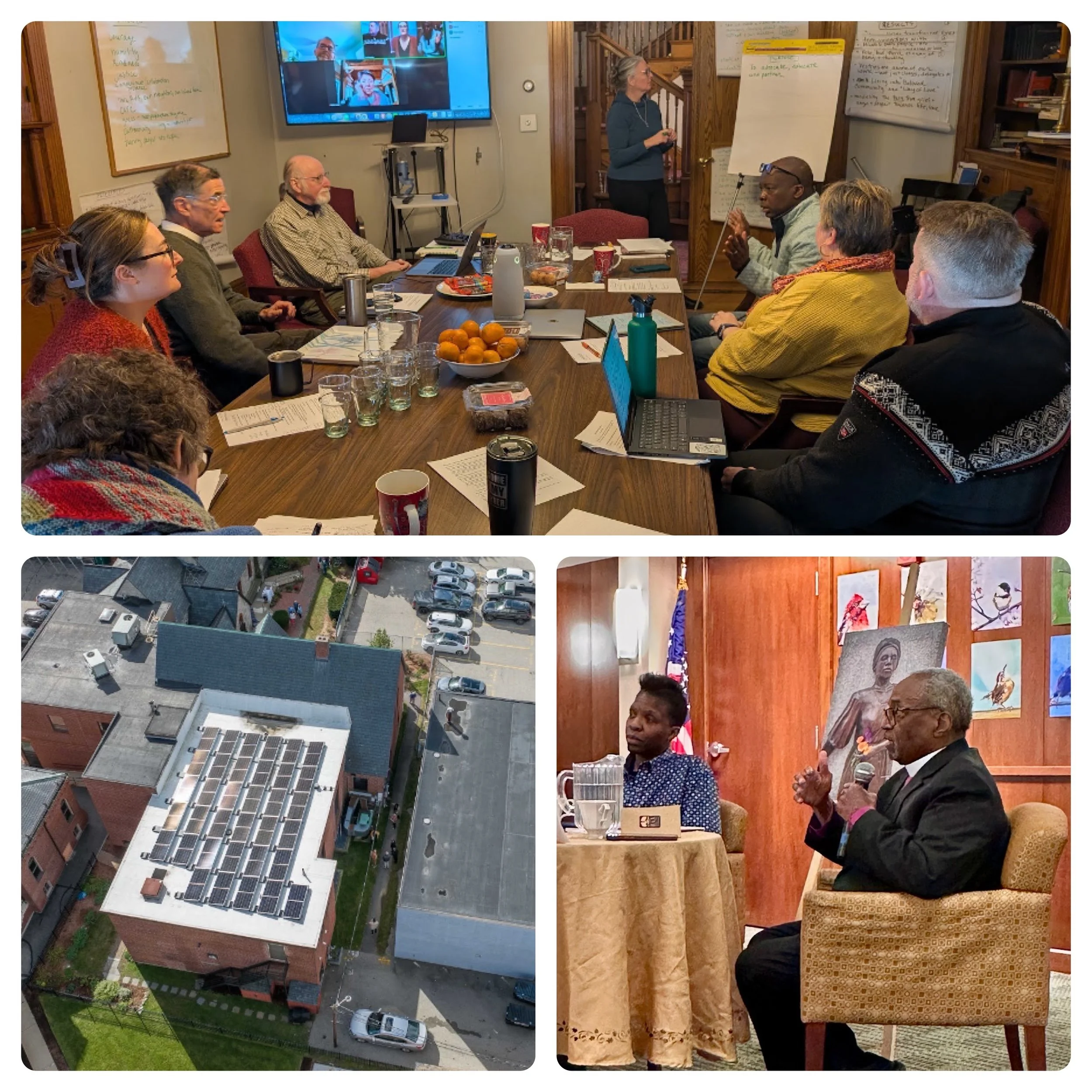
Top - Micah 6 Committee members at a planning meeting; bottom left - solar panels on the roof of the Good Shepherd complex in Nashua; bottom right - Tea Talk with Most Rev. Michael Curry, in Portsmouth.
Global Missions: Diocesan Initiatives from Cuba to Haiti—and Beyond
The medical supplies donated by Christ Church parishioners and community members in Exeter are stacked in careful piles in the basement of the Rev. Mark Pendleton’s home.
“This year’s trip to Cuba is on – God willing,” he says. “Only eight of us will go in March. Because of safety concerns, we’re not able to visit our companion parish, so we’ll stay in Havana on a shortened itinerary. But the supplies we’re bringing will make a real difference as Cuba faces a deepening crisis.”
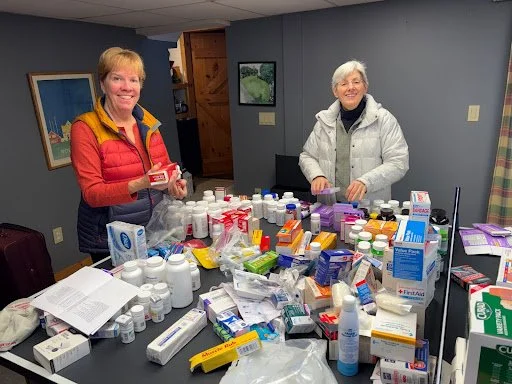
Leslie Pendleton and Dr. Claudia McQueen, Christ Church in Exeter parishioners, sort donated medical supplies for Cuba.
The U.S. embargo and severe oil shortages are hitting the island nation hard. Recent news reports describe a failing electrical grid, prolonged fuel shortages, limited sanitation services, hospital closures, food scarcity, and rising disease. “It’s bad,” Rev. Mark says quietly. “The humanitarian conditions are severe.”
For the past twelve years, Christ Church in Exeter has made pilgrimages to Cuba. Why? Because local and global ministry are inseparable.
More than forty parishioners – including many young people – have traveled to Cuba through this partnership. When high school student Andrew Hodson returned from a youth service mission, he told the congregation:
“It was obvious that God touched everyone in Cuba because of their spirit—and in the end, touched us all. As I entered the homes of the Cuban people, I experienced a feeling of sanctuary unlike anything I have experienced. The only time I’ve ever felt that welcome is in my own home.”
On one trip, the group filled their suitcases with water filtration systems to assemble upon arrival. Teenager Tess Hayes reflected:
“Water is the one thing we all take for granted. I frequently fill up my water glass at the kitchen sink without questioning its cleanliness. Many people in this world do not have access to clean drinking water, or they must travel long distances to get it. Our companion parish in Cuba can now provide free, accessible drinking water to anyone who needs it.”
Rev. Mark sees transformation not only in Cuba, but at home.
“The youth group’s eyes are opened to human need,” he says. “When they return, they look at everything differently. There’s a renewed commitment to ask: What can we do here? And how can we continue supporting our partner parish? The ripple effects of global ministry are vast.”
The Christ Church group departs March 14, 2026. We all pray for safe travel and meaningful connection as parishioners take time away from their own lives to accompany others in crisis.
*
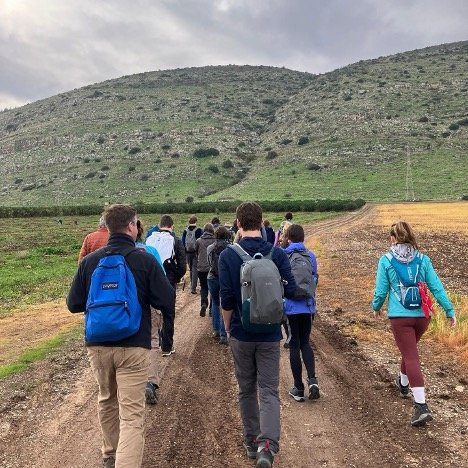
Parishioners from St. Andrews in New London on a pilgrimage to the Holy Land in 2023, where efforts to engage both Palestinians and Israelis leads to a better understanding of the challenges to achieving lasting peace in the Middle East.
A Broader Call to Global Mission
Christ Church’s partnership with Cuba is just one example of how Episcopal churches in New Hampshire are cultivating long-term, reciprocal relationships with parishes across the globe.
The Episcopal Church has long embraced global mission. In fact, its original 1835 name was the Domestic and Foreign Missionary Society. That legacy continues today.
In New Hampshire, the call to global engagement has taken on renewed urgency in light of federal funding reductions to international aid programs. In response, the Episcopal Church of New Hampshire established the Global Missions Committee in 2025 to strengthen and support parish partnerships with international dioceses and ministries.
The Rev. Canon Gail Avery, who chairs the committee, emphasizes a guiding principle:
“We’ve found that even a small amount of money can have far-reaching impact. The key is listening to what our partners want – not imposing what we think they need.”
She continues: “We want to inspire, educate, and encourage Episcopalians to step into this global work. The relationships transform us. We witness deep faith in communities with limited resources, and it’s profoundly moving. But this work requires long-term commitment. Being able to support a community financially – without controlling – allows us to serve Christ in all people. We’re all connected.”
Last year, the committee awarded $21,900 in grants supporting initiatives in Cuba, Angola, and Haiti.
In Angola, where prolonged drought has contributed to acute malnutrition, funds supported nutrition training initiatives. In Cuba, grants have helped provide solar lighting and medical supplies amid widespread infrastructure and political challenges.
In Haiti – one of the world’s most economically fragile nations, facing natural disasters and ongoing violence – donations contributed to the construction of a bathroom at a school for children with physical disabilities and helped increase salaries at another Episcopal school.
The NH Episcopal Church also supports the Diocese of Jerusalem, encouraging parishes to donate through a church-wide Good Friday offering campaign in an effort to find peace and justice for both Palestinians and Israelis. A photo of St. Andrews mission in the Holy Land is pictured above.
At St. Paul’s Episcopal Church in Concord, a 25-year relationship with the people of Chantilly, Jamaica has created a friendship, mutual respect and shared faith. The Rev. John Beniste recently visited Jamaica with three others from St Paul’s to reevaluate the partnership:
“We have learned that mission is not about going to “help” but about walking alongside one another, listening, learning, praying, and recognizing that we are bound together as one body in Christ.”
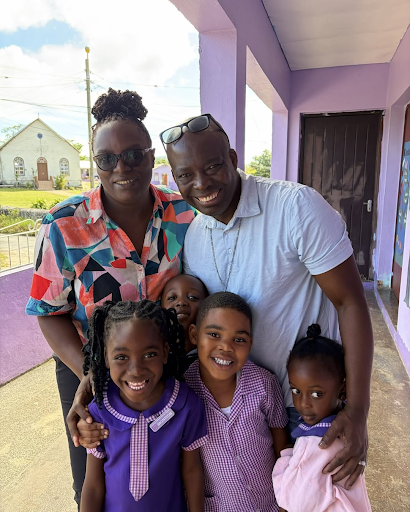
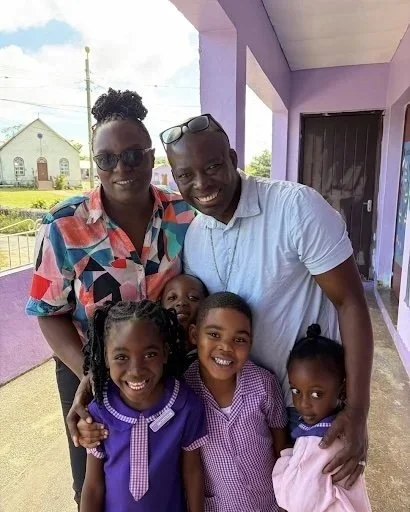
The Rev. Jean Beniste on a recent mission to the Chantilly Primary School in Jamaica.
Bishop Rob, who has accompanied some of the missions during his tenure, reflects:
“While this work is not new, the Global Missions Committee helps us extend our vision beyond our borders and remember that we are woven into a global vine of prayer, love, and concern.”
Are you interested in deepening your faith? The invitation is simple: learn, listen, and consider how you or your parish might participate in this shared, inspiring work.
This spring, members of the Global Missions Committee will hold a diocesan-wide Zoom call to answer questions, share stories, and help congregations explore or deepen global partnerships. Watch for the Zoom sign-up in our future newsletters! In March, the Committee will solicit grant applications.
*
Basic information and a list of Global Mission Committee members can be found here.
*
Which God Are We Following? - By, Bishop Rob - January 29, 2026

In the wake of the killings of Alex Pretti and Renee Good, and just months after the murder of Charlie Kirk, I find myself asking a question that feels unavoidable in this moment of national grief and division: Which God are we following?
Are we following Jesus the Christ or are we following Zeus?
This may sound provocative, but it cuts to the heart of the crisis facing American Christianity today. The God revealed in Jesus is not a god of retribution, domination, or brute force. He is a God who, though all-powerful, chooses vulnerability. A God who refuses coercion. A God who empties himself.
The apostle Paul, writing from prison, described this God plainly: Christ, “though in the form of God, did not regard equality with God as something to be exploited, but emptied himself, taking the form of a servant… becoming obedient to the point of death — even death on a cross.”
That vision is scandalous. It always has been. Christianity, at its core, proclaims that God freely chose the cross — the violent instrument of empire — not as a means of control, but as a revelation of love. Easter does not erase that brutality; it declares that love is stronger than it.
That choice defines Christian prayer, morality, and public life. Or at least it should.
Martyrdom, properly understood, simply means witness; bearing testimony to this God of self-giving love, sometimes at terrible cost. The early Church understood this before Christianity was allied with empire and power. Once the Church was folded into imperial authority under Constantine, that witness became compromised. History has shown us what follows when a faith rooted in love collides with governments that rule through fear and force.
We know this pattern well. In 1965, Jonathan Daniels, a white seminarian from New Hampshire, traveled south to support the Civil Rights Movement. When a shotgun was raised toward a Black teenager, Ruby Sales, Daniels stepped in front of her and was killed. In El Salvador, Maryknoll sisters were raped and murdered for standing with the poor. Archbishop Oscar Romero, after calling on soldiers to lay down their arms, was assassinated at the altar the following Sunday.
These were not extremists. They were witnesses.
Today, there are voices in American Christianity once again preaching a different gospel—one that sanctifies power, excuses brutality, and insists that the world is changed not by love but by force. This is not the faith of the Crucified Christ. It is a faith far closer to Zeus: capricious, violent, enthroning the strong and discarding the weak.
In the days following Renee Good’s death, religious leaders, including myself, have issued statements of grief. We have done so before: after acts of racial violence, in response to the treatment of immigrants, amid wars and unrest. And yet, words alone cannot bridge the chasm we now face.
I grieve Renee Good as a martyr. I also grieve Charlie Kirk, regardless of politics. I take him at his word that he sought peace and prayer. Faith demands that we refuse the temptation to sort the dead into categories of deserving and undeserving. God’s love is not rationed.
What matters now is not only how investigations unfold or how blame is assigned — important as those processes are. What matters is the choice each of us makes as these tragedies accumulate: Will we deepen our fear and retreat further into tribal loyalties? Or will we insist on seeing one another as bearers of the image of God, even when that insistence is costly?
Christian faith does not promise safety. It promises life — abundant life rooted in love stronger than death. To live without fear ultimately means refusing to fear even death itself. That is not a call to recklessness, but to courage.
As a bishop, I have told clergy under my care to have their affairs in order — not because we seek martyrdom, but because discipleship has always carried risk when it stands with the poor, the oppressed, and the discarded. This is not new. It is the ancient calling of the Church.
Some will bear witness with words, as I am doing now. Others will do so with how they spend their lives. I am not suggesting someone step in front of a bullet, but a few may inevitably and tragically, end up bearing witness with their lives. Whatever form it takes, the choice before us remains the same.
We must decide whether we follow the God of abiding love and the teachings of Jesus — or the gods of control and fear.
Bishop Rob's Reflection from the Renee Good Vigil in Concord, NH - January 9, 2026
Following is a transcript of Bishop Rob’s remarks:
Good evening. I am in such awe of what I just heard, as you no doubt are, and of the statements that have preceded my coming up. The statements that call for justice, that are statements of deep sorrow and grief, and that it's met with resolve and commitment to build a new world.
I'm also coming to an awareness that the times of statements and the times of our eloquent words have reached a kind of limit, sadly.
As someone who is a man of profound historical privilege, as one who has made statements that, I have to say, have been really good and eloquent, but have not moved the needle one bit.
I want to speak briefly—primarily to the Christians among us.
We are now engaged in a horrible battle that is eternal, that has gone on for millennia. As soon as the Christian church became linked to the empire by Constantine in the year 325 or so, the church immediately became corrupt. And the message of Jesus's love, compassion, and commitment to the poor, the outcast, was immediately compromised. And we have lost that voice, and we are now, I believe, entering a time, a new era of martyrdom.
Renee Good being the last of note of those martyrs.
New Hampshire's own Jonathan Daniels, a man also of white privilege, stood in front of the blast of a sheriff in Haynesville, Alabama, to protect a young black teenager from a shotgun blast. He died and was martyred.
We know of the women, the Maryknoll sisters, who stood alongside the poor and the oppressed in El Salvador and were brutally raped and murdered in the name of Jesus.
Oscar Romero, in a mass called upon the death squads of El Salvador to lay down their arms or risk excommunication, was martyred the next Sunday at the altar.
I have told the clergy of the Episcopal Diocese of New Hampshire that we may be entering into that same witness. And I've asked them to get their affairs in order—to make sure they have their wills written, because it may be that now is no longer the time for statements, but for us with our bodies to stand between the powers of this world and the most vulnerable.
And it may mean that we are going to have to act in a new way that we have never seen perhaps in our lifetime, except for these remote stories that I've just cited, to put our faith in the God of life, of resurrection, of a love that is stronger than death itself.
There are those who call themselves Christians now who are very close to the seat of the highest echelons of power in this country. Who tell us that the way the world works is by force. We've heard it this week from Stephen Miller. That disparity could not be more stark. St. Paul in his letter to the Philippians said, “Let this mind be, let the same mind that was in Christ Jesus be in you.” Who though had every force in the world and could just lay assault to the whole universe, chose instead to enter our humanity, to empty himself, and to take the posture of weakness, of vulnerability, to enter even death, even death on the cross.
I'm speaking here to the Christians.
That's what we are to model. Because life, the life that God wants for us is stronger than what we see, the cruelty, the injustice, the horror that we saw unleashed in Minneapolis. And we've seen it so many other times. Also in Minneapolis, lest we forget, George Floyd: say his name.
So that is my prayer.
Those of us who are ready to build a new world, we also have to be prepared. If we truly want to live without fear, we cannot fear even death itself, my friends.
And that is the stark truth of my faith. If I want to live and live with the fullness that God intends, I have to trust that God will always protect me and raise me as God I believe is bringing Renee Good to glory right now. And I see that face of that glory among all of us who are here on this cold dark night.
So I'll leave with a prayer: “Live without fear. You have been created holy in the image of the divine. Whatever race, whatever gender, whatever orientation—straight, queer, trans, you have been made in the image of the divine. God has always and will always protect you no matter what happens. So live in that without fear. God supports you, protects you and loves you with a power and a presence that is stronger than death. That is how we live free or die.”
And may the Creator, the Anointed, and the Holy Spirit uphold, give you courage and strength and compassion to live these days. There is a new day ahead. It is coming. We can see smell it. It is on its way.
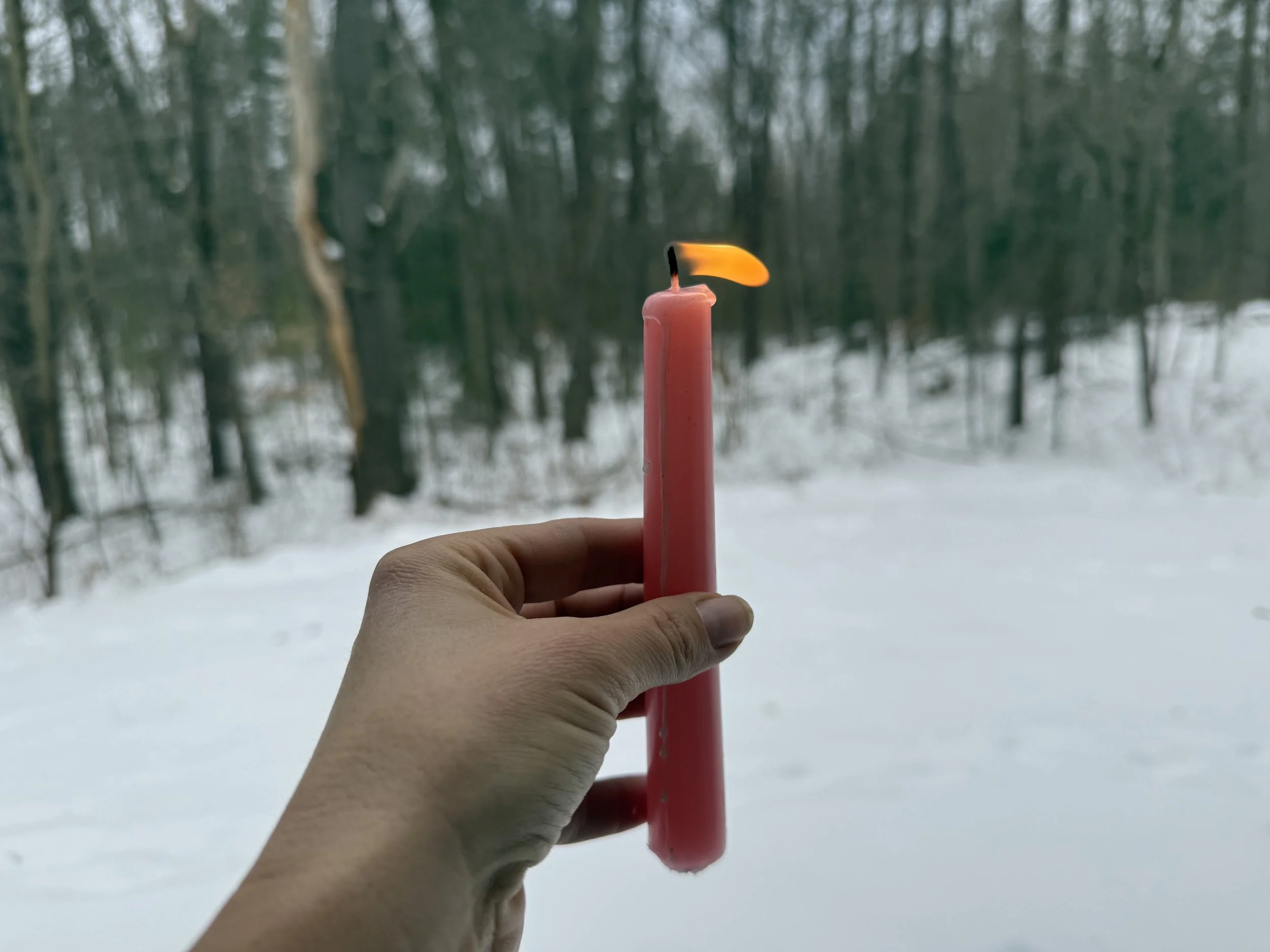
Let this light shine. The darkness, the shadows of our lives will not overcome it. Amen.
*
View the full video below.
Statement from Episcopal and Lutheran Bishops in New England: Our Commitment to Peace and Justice in a Broken World
Beloved of God,
In the midst of an Advent full of joyful preparation, this past weekend delivered a stark reminder that our Lord Jesus Christ was and continues to be born into a broken world full of danger and sin. As Episcopal and Lutheran bishops in New England, we ask you all to hold the people of Providence, and particularly Brown University, in your prayers as they contend with the trauma of gun violence in their community. We pray especially for the repose of the two young people who have died and all who loved them. We pray also for all who are still in the grip of fear and uncertainty.
We also commend your prayers for the people of Sydney, Australia and particularly the Jewish community there and worldwide. Yet another attack on a Jewish religious gathering points to the continued evil of anti-Semitism across the globe. Please join us in standing with our Jewish siblings, while we continue to pray for peace and an end to religious violence of all kinds.
On Sunday we prayed the wonderful collect of Gaudete Sunday, called by some “Stir It Up” Sunday. It reads: “Stir up your power, O Lord, and with great might come among us; and, because we are sorely hindered by our sins, let your bountiful grace and mercy speedily help and deliver us; through Jesus Christ our Lord, to whom, with you and the Holy Spirit, be honor and glory, now and forever."
The collect resonates more than ever this week. May God’s power, grace, and mercy be abundantly revealed in our world. We pray also that God will stir up our own resolve to deepen our commitment to peace and justice. May our way and the way of all the lands be Peace.
Blessings upon your last week of Advent. May this time be one of renewed prayer and reflection as we await the entrance of Light into our despairing world.
Faithfully,
The Right Reverend Julia E. Whitworth
Bishop Diocesan
Diocese of Massachusetts
The Right Reverend Laura J. Ahrens
Bishop Suffragan
The Episcopal Church in Connecticut
The Right Reverend Thomas J. Brown
Bishop Diocesan
Diocese of Maine
The Right Reverend Douglas J. Fisher
Bishop Diocesan
Diocese of Western Massachusetts
The Right Reverend A. Robert Hirschfeld
Bishop Diocesan
Diocese of New Hampshire
The Right Reverend W. Nicholas Knisely
Bishop Diocesan
Bishop of Rhode Island
The Right Reverend Shannon MacVean-Brown
Bishop Diocesan
Bishop of Vermont
The Right Reverend Jeffrey W. Mello
Bishop Diocesan
The Episcopal Church in Connecticut
The Reverend Nathan D. Pipho, Bishop
New England Synod
Evangelical Lutheran Church in America
A Prayer adapted from Bishops United Against Gun Violence:
Almighty and merciful God, whose only Son came
to preach peace to the nations: Hear us, we beseech you, and comfort those in
Providence and Sydney with your steady Hand, as we come before you in the wake
of unspeakable violence. Help those who mourn, those in pain, and those
grieving to feel your healing presence and abiding love. In a world that seems
hopeless, help us all to remember that our hope rests always in you, and in the
resurrection of your Son our Lord Jesus Christ. Amen.
For more liturgical resources, click here.
The Importance of NOW: Convention 2025
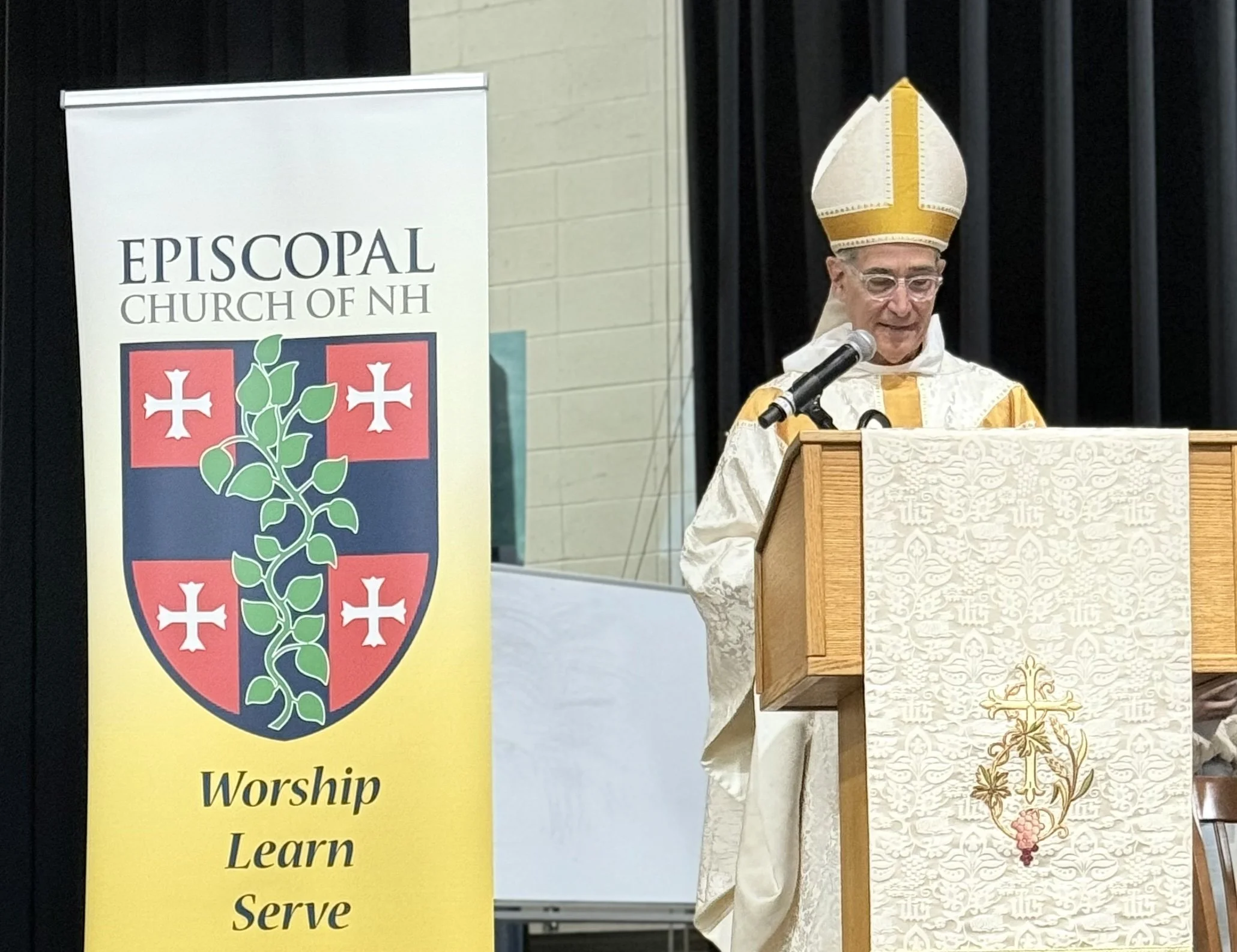
Bishop Rob gives his address at Convention.
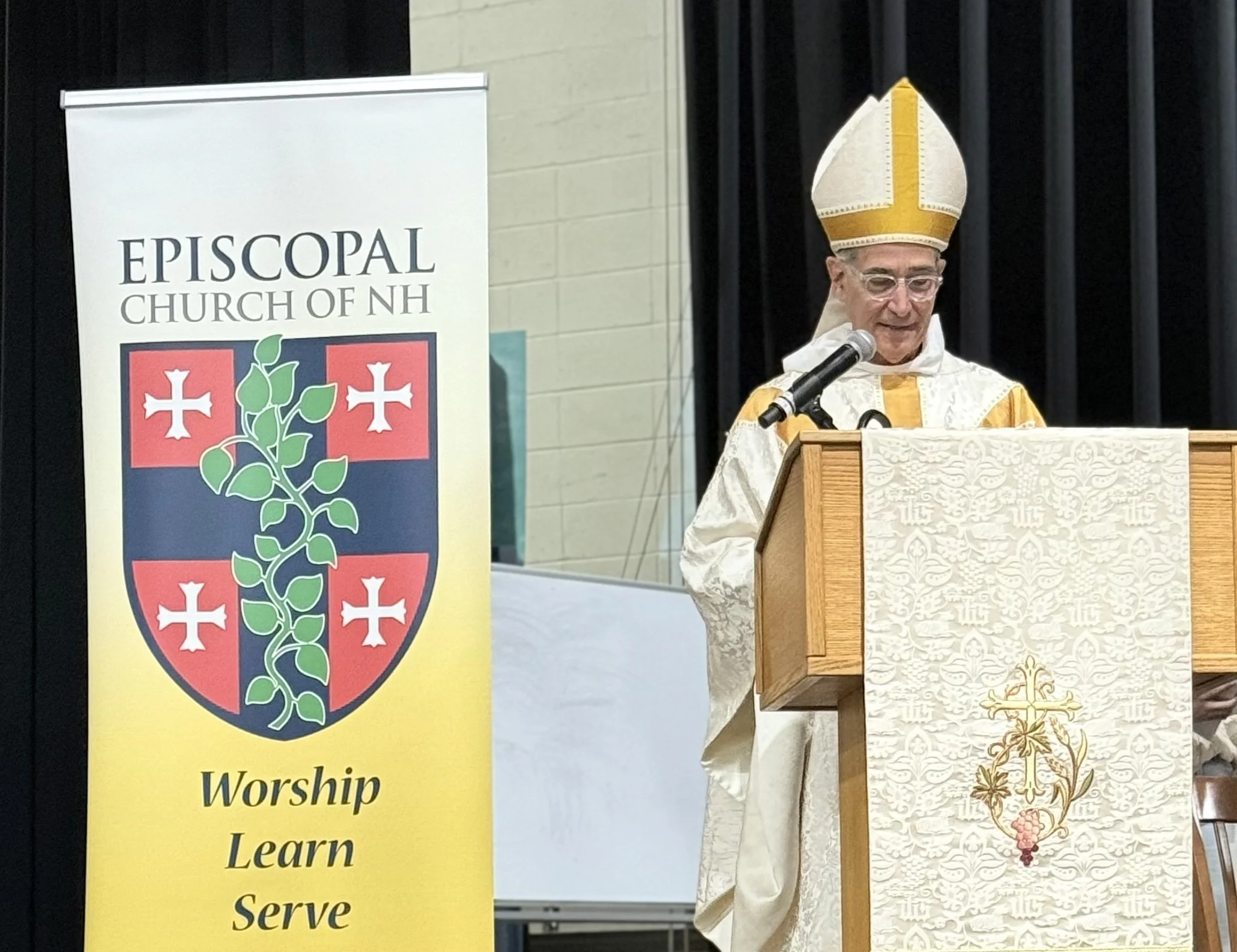
On November 1, approximately 250 Episcopal clergy, lay leaders, and Northern Convocation parishioners gathered in Whitefield, NH, next to a panorama of snow-tipped White Mountains for the 223rd Diocesan Convention. Inside the high school auditorium, registrants gathered for the Bishop’s address, worship, and business.
“Convention,” as it is called among church leaders, is the primary representative governing body of the diocese. Its primary mission is to conduct diocesan business, including the election of officers, approval of a budget for the upcoming year, setting mission strategy, and establishing diocesan policy and procedure by considering and voting on resolutions and approving changes to the diocesan constitution and canons. It is also an occasion for fellowship, community building and common prayer, as well as the celebration of the Holy Eucharist as a community.
This year’s Convention theme was NOW, calling our attention to the importance of the present. Bishop Rob delivered his address about how Jesus calls us to live in this cultural and spiritual moment in time (which, he says, is not that different from divided first century Palestine. Read the transcript HERE). He encouraged church leaders to have congregations of “resilient vitality, hope, truthfulness, generosity…to be communities that the wider world sees and says, I want what they have.”
Participants celebrated Communion to the strum of Portsmouth-based Chapel Street Band, whose bluegrass harmonies filled the quiet spaces. Both joy and reverence filled the room.
*
Throughout the day, we learned what our five committees have accomplished this past year:
1. GLOBAL MISSIONS UPDATE
Five meaningful projects were the focus of The Global Missions Committee this year. A total of $22k in grants supported initiatives in Cuba, Angola, and Haiti. The awards support the Episcopal Church’s effort to alleviate poverty and foster growth. From nutrition training in Angola, where drought has led to acute malnutrition, to purchasing solar lights for the Episcopal Church of Cuba, to Haiti - one of the poorest nations hit hard by natural disasters and gang violence - where donations led to the construction of a new bathroom at a school for kids with physical disabilities and increased salaries at a separate school.

2. THE MICAH 6 COMMISSION
This effort that started at the beginning of 2025 is already making an impact as the commission delves into how we can bring Christ’s love to a world in need. From political upheaval to ecological justice and beyond, Micah 6 awarded 20k to the Black Heritage Trail NH, Northwoods Eco Region/Creation Justice, and the NH Food Bank to support families impacted by food insecurity. An additional 85k in grants was given to a wide array of community groups. In the words of Micah 6:8 - And what does the Lord require of you? To act justly, to love mercy, and to walk humbly with your God.
3. YOUTH MINISTRY
Our Youth Ministry efforts are centered on connecting parish Youth Ministers and volunteers to each other to share ideas and resources. In addition, collaborating with partners within the Diocese and with outside groups like Barbara C. Harris Camp and Conference Center are priorities. The Youth Ministry is also working on facilitating events involving young people to provide formation opportunities and a chance to connect with other youth, including a retreat with the Diocese of Maine, a Faith In Action retreat at the Barbara C Harris camp, and a group hike. Lots more coming up in 2026!
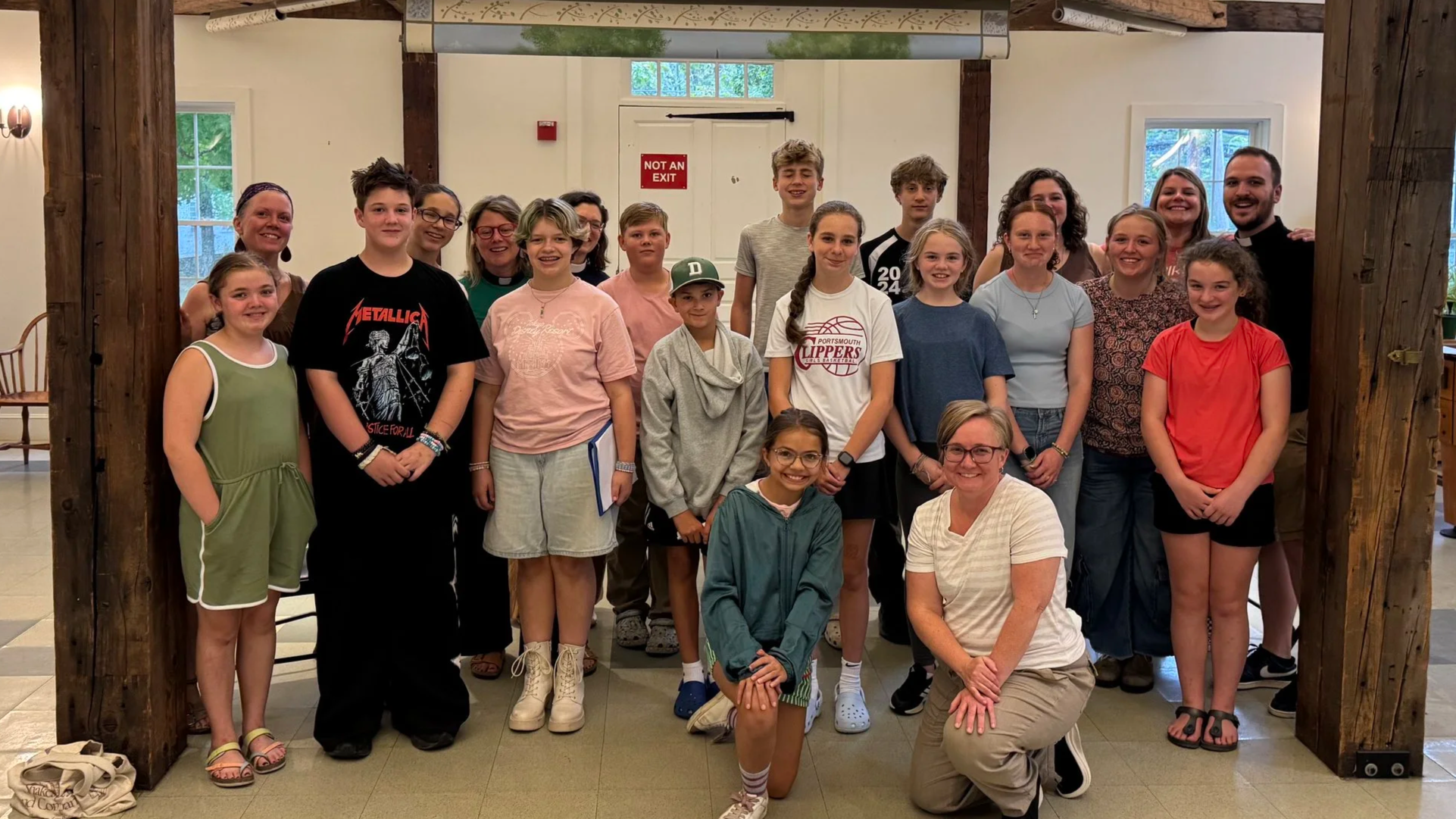
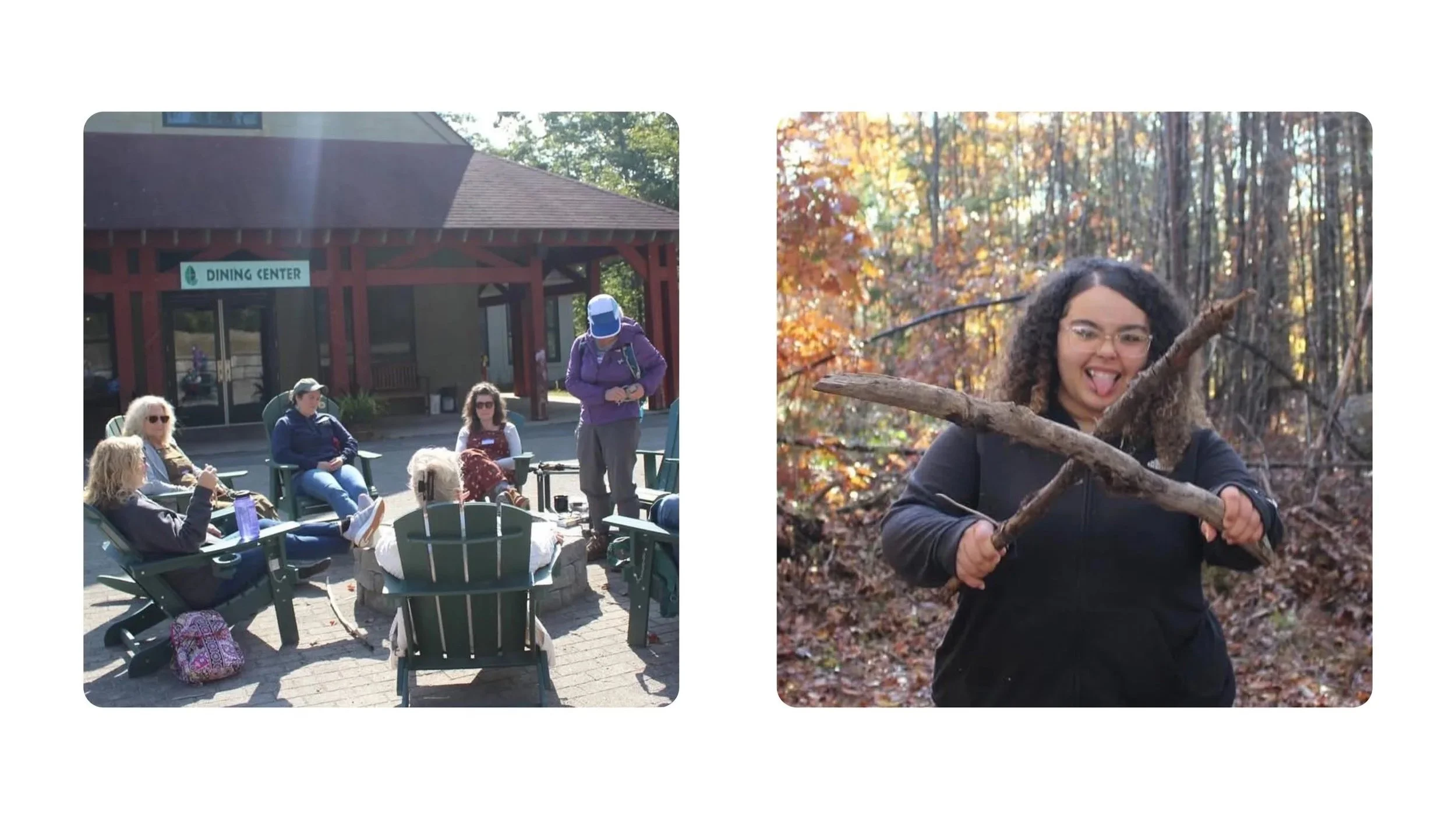
4. BARBARA C. HARRIS CAMP & CONFERENCE CENTER
Located on Otter Lake with 325 beautiful wooded acres in Greenfield, New Hampshire, for 22 years BCH Camp/Center has offered year round programs, retreats and a youth summer camp that explores nature, spirituality and relationship building. The center boasts a variety of meeting spaces, overnight lodging, and countless arts and recreation opportunities, including swimming, boating, basketball and volleyball courts, athletic fields, a ropes course, climbing wall and more. We are so fortunate to have such a premier place/organization that provides incredible opportunities for our community and likeminded nonprofit organizations. This past fall’s Becoming an Episcopal Outdoorswoman was well attended and we hope to offer it again next year!
5. CONTEMPLATIVE ACTION NETWORK (CAN)
The Contemplative Action Network (CAN) is a movement that seeks to focus on ministry and sharing the gospel as some Episcopal and Lutheran congregations are struggling. CAN is an opportunity to rethink how church property and personnel can best serve those in need of connection and a place of belonging. This collaborative in Manchester, involves Gethsemane, St. Andrew’s and Grace. We are pooling our resources and are currently working out of the YWCA. We are engaging with marginalized communities like immigrants/refugees, the unhoused and food insecure, LGBTQ+ young people, and those dealing with addiction and trauma.
RESOLUTIONS:
All resolutions that were up for consideration passed: from re-designating parishes into missions, editing canon language, and approving the budget. Election results, including delegates to the 2027 General Convention, Convention officers, and committee members, were also announced. The results can be found HERE.
*
The Convention concluded with the reminder that next year’s annual gathering will elect the next Bishop of New Hampshire. At the end of his address, Bishop Rob gestured to this transition by blessing our remaining time:
“May God continue to bless us today, in the next year and half we have together, and Always.”
Bishop Rob's Prayer: for the possibility of peace in the Middle East - October 10, 2025
Message from the Bishop: “I invite the congregations and people of the Episcopal Diocese of New Hampshire to pray often and fervently that the emerging possibility of a lasting and just peace in the lands of Israel and Palestine will become a reality. Please let us enter into a spirit of hope, however tender, that hearts and minds that were hardened will be made more supple and open the prospect of a solution where the dignity and flourishing of all human beings are respected and cherished.”
Prayer:
O God of peace, we know that you hear the cry of the people of Israel, Gaza, and the West Bank, and all places torn by violence and hatred. We believe that in Jesus, there is no place where earth sorrows are more deeply felt than in heaven. Hear our cry for peace. Give courage to those who work tirelessly for a cessation of all violence. Give a sense of your abundance to those on each side of this conflict who will be asked to give, surrender and heal. Help them release the impulse of retribution and revenge. We thank you for those who have led your people to this hopeful moment. We hold our breath in anticipation. Send the gentle winds of the Holy Spirit to guide us to what we have not known before; for in Jesus Christ you can make all things new and can dry the tears of those who weep.
Two Retired Priests,
One New Role:
Welcome Our New Deans at the School for Ministry
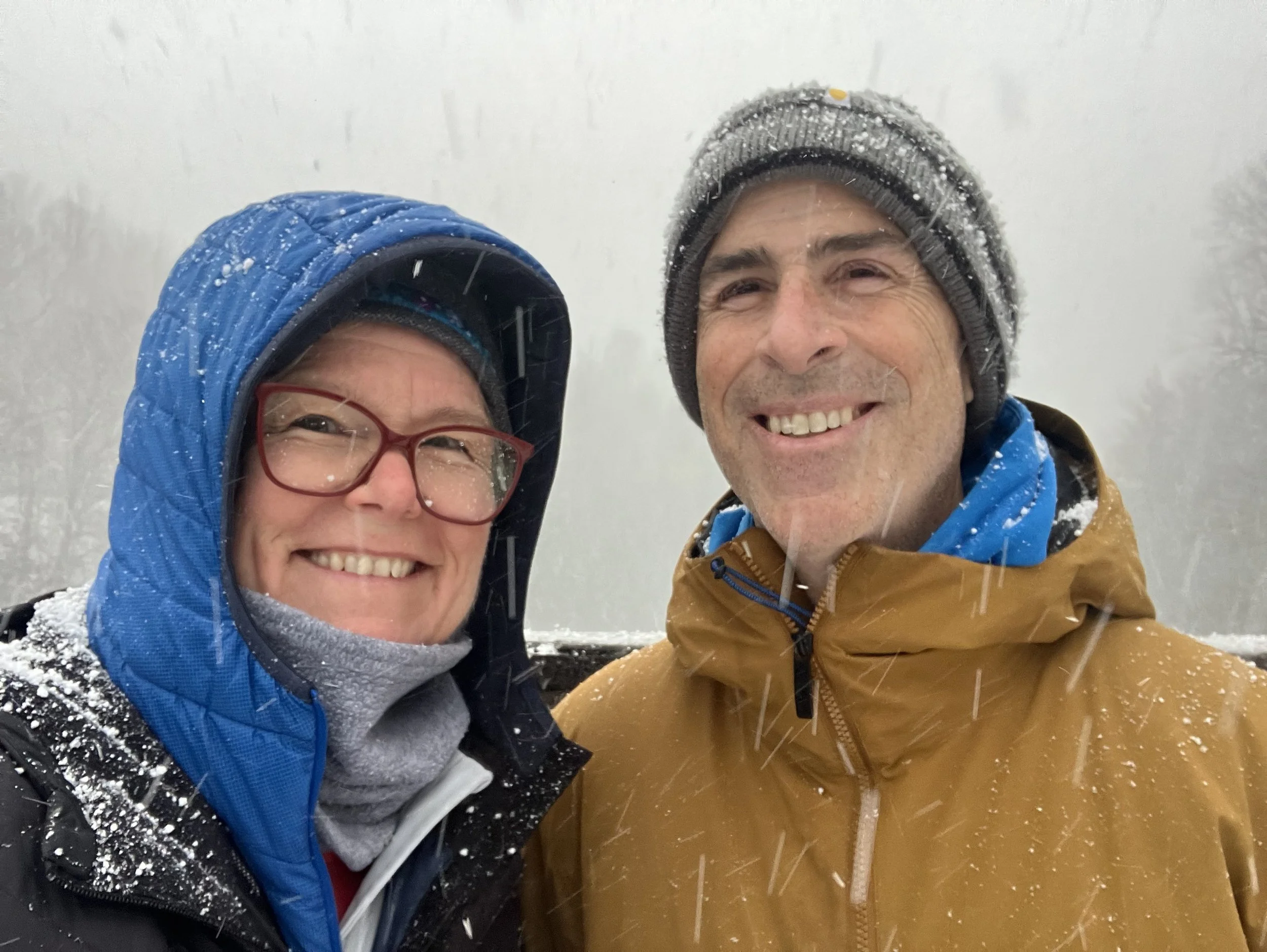
Amy and Joe on the Riviere du Diable, Mont-Tremblant, Quebec, 2023.
The Diocese of New Hampshire’s School for Ministry (SFM) is evolving! The Diocese is excited to grow with our newly hired deans: the Rev. Dr. Amy Richter and the Rev. Dr. Joseph Pagano (who much prefer to be called Amy and Joe). The couple will provide academic leadership and local formation of ordained and lay Episcopal ministers at SFM.
The job search for this position began in July 2025, after the SFM received a grant from the Iona Collaborative at Seminary of the Southwest’s “Locally Grown Leaders” program. Along with 21 Episcopal dioceses, the SFM received funding from Lilly Endowment as part of its Ministry in Rural Areas and Small Towns Initiative. This support will further advance SFM’s mission to form local spiritual leaders. The SFM’s founding dean, Rev. Canon Kelly Sundberg Seaman, will transition to a new role in the Diocese. (More on this soon!)
While the evolution of the SFM was very much planned, the dean job share was not. When the search committee received Amy and Joe’s cover letter asking if the Diocese would be open to splitting the position, the committee let the Spirit move them. “That’s just the kind of creative approach we love in the Diocese of New Hampshire,” Tina Pickering, Canon to the Ordinary, responded.
And so, after recently retiring from parish ministry in Maryland (where they are canonically resident), Amy and Joe submitted their CVs as co-applicants to the dean position.
Working together is not new for Amy and Joe, however. They have fifteen years of experience working in tandem—in both parish clergy leadership and academic ministry settings. They served three parishes together, ranging from a small, rural setting (in Western Newfoundland, Canada) to a large, urban setting (in Annapolis, Maryland).
“We’ve gotten positive feedback from people who have seen us work and teach together,” Amy shares. “They’ll say, ‘oh that’s what cooperation and mutual respect can look like.’” It is easy to see their ability, and call, to job share as a blessing when you speak with them. “It can be a gift to see how two people can cooperate in leadership,” Amy adds.
The married couple work very much as a team, even co-authoring books, but they are also aware of their individual talents and complimentary gifts in ministry. “We have always been able to discern between our different gifts,” Joe says. “Amy, for example, was always the rector at the churches where we served, while I did Christian education, outreach, and pastoral care. We worked out those areas easily and faithfully.”
As parish priests, Amy and Joe helped identify and prepare people for ministry as lay leaders and for ordination—a background that equips them for their new role. Part of their intention in early retirement was to engage more fully in ministries of helping to form lay and ordained leaders in the church through teaching and writing.
“We love working together on theological education,” Joe says. “And we have different expertise.” Both hold PhDs in theology—Joe’s is in systematic theology (ethics) and Amy’s in biblical studies/New Testament. They have taught internationally in colleges and theological schools in Makhanda, South Africa and in St. John’s, Newfoundland, and nationally at Stevenson School for Ministry, Mount Mary College (now University), Loyola University Baltimore, and the Ecumenical Institute of St Mary’s University in Baltimore.
Both Amy and Joe are deeply committed to theological teaching. Joe taught all through parish ministry and Amy served as part of the group of academics charged with preparing study materials for bishops and their spouses at the most recent meeting of the Lambeth Conference.
Their retirement has only deepened their energy for education and service. “After I retired, my prayer was, how can I serve faithfully now?” Joe shares.
The answer, as it turns out, was as a dean for the New Hampshire School for Ministry, in its next chapter. Both Joe and Amy are excited to take on their new role and immerse themselves in the
communities where their students are involved. “It’s one role, so we’ll go together,” Joe says, gesturing toward their example of unity in shared leadership.
“We look forward to building on the great work Dean Kelly has done,” Amy says. “It’s a gift to come into a position with such a good foundation, where people are excited and want to be involved.”
As for moving to New Hampshire, they can’t wait. “We love being out in God’s beautiful creation all four seasons,” Joe says. After temporarily residing in Quebec, Canada, they have been looking for a more permanent, beautiful place to live. They hope to move somewhere in the Diocese where they can hike, bicycle, and run while serving the SFM.
The new deans will be at the Clergy Conference in early October. When you see them, be sure not only to welcome them, but to ask about the research projects they’ll continue in the Granite State.
(Oh – and for extra credit, ask Joe for one of the recipes he’s been making with maple syrup!)
Announcement from Bishop Rob Hirschfeld regarding his intent to retire
It is with a full heart that I write to let you know of my intention to retire in March of 2027. Thirteen years ago, this beautiful and vibrant diocese conferred a tremendous honor upon me by asking if I would accept your election as the 10th Bishop of New Hampshire. READ MORE
The Standing Committee will lead the forthcoming diocesan discernment process, timeline, and opportunities for participation; details will be sent out in the coming week.
Almighty and ever gracious God. We thank you for the loving, wise and generous ministry of our Bishop, Rob. We ask your blessing upon him and his family as they move through this time of transition. We ask your blessing on all the clergy and people of the Diocese of New Hampshire as we discern together to call the next Bishop of New Hampshire. Guide us in wisdom, patience and love as we seek your will for us and for the leader you will send to be our shepherd. We ask this in the name of Jesus Christ our Lord. Amen.
A media press release is here. For media inquiries please contact Barbara MacLeod at bmacleod@nhepiscopal.org.
New Global Missions Committee Helps Weave the Vine Across the World
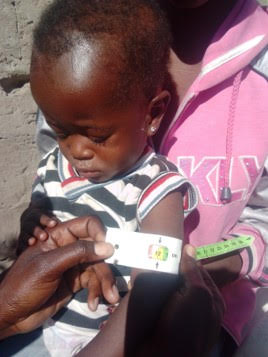
A child has his arm measured in Angola. Measuring arm circumferences is part of the nutrition training center’s determination whether a child is malnourished. Photo: Gail Avery
As nations across the globe are becoming more insular and the effectiveness of international health efforts and aid in question, the Episcopal Church of New Hampshire is making a bold yet necessary move to counter this trend. A new committee has been created—the Global Missions Committee (GMC)—whose goal is to support ministries across the world that our congregations have been participating in and working alongside of for decades. These efforts intentionally make visible our sacramental relationships with our global brothers and sisters who are worthy of dignity and respect as well as our attention and care.
We are experiencing in real time the rippling impact when financial support is withdrawn. The gutting of USAID, an agency providing 40 percent of all aid worldwide, has resulted in the collapse of food aid programs in Africa, refugee resettlement, childhood vaccines, PEPFAR (a US government program providing aid to fight HIV/AIDS in developing countries). Lives are on the line; tens of thousands of people are already in the depth of poverty and starvation due to civil unrest and climate change.
“While the work is not new, the newly established Global Missions Committee helps the Episcopal Church of New Hampshire to extend its vision beyond our own tiny borders and see how we are woven in a global vine of prayer, love, and concern,” said Bishop Rob.
For 18-plus years, the Episcopal Church of New Hampshire has supported a partnership with St. Andre’s Anglican church in Ondjiva Angola, a community ravaged by war and drought. The relationship began in 2006 when a men’s group at Church of our Saviour in Milford began praying for the members of St. Andres, resulting in a mission trip to Angola a year and a half later.
“We arrived with some ideas about what we could do, and suggestions from members of our parish about what we should do, but very quickly it became clear that our job, perhaps our only job, was to listen,” says Elizabeth Rotch. “To listen to the people of St. Andre’s, to listen to the Holy Spirit…and to respond. If we went out with the slightest notion that we were somehow carrying a light to Ondjiva, we soon understood we could only hope to hold up a mirror that might reflect the light that already shone so brightly there.”
What started off as transactional (one community giving and the other receiving) was soon transformed. Prayer and friendships were born—a church built, and a community school reopened, as well as a nutrition training center that combats malnutrition due to dramatic food shortages caused by floods and then drought—all this in partnership with St. Andres parish, the Episcopal Church of New Hampshire and the Holy Spirit.
The Holy Spirit remains on the move. Recently the Mother’s Union nutrition training program has expanded to the village of Namacunde, due in part to our ongoing global partnership with MANNA and ALMA, two Angolan initiatives within the Diocese of London.
The Rev. Canon Gail Avery, who chairs the committee overseeing the work in Angola, has been appointed by Bishop Rob to chair the GMC. She sees the church’s involvement in global ministries as reparatory.

The Rev. Mark Pendleton, rector of Christ Church Exeter, with congregants at Iglesia Episcopal San Francisco de Asís in Cardenas, Cuba, in 2023.
“There’s an intersectionality to the reparation work that churches in our diocese are embarking upon,” says Avery. “The first Africans enslaved landed in Jamestown in 1619 were from Angola, and they were strong and healthy. Our current partnership with the Mother’s Union nutrition program is repairing that breach by effectively nourishing and strengthening Angolan families. We have been participating in Restorative Justice with the parish of St. Andres and the new Diocese of Central South Angola from the beginning. We’ve been doing the work, not just talking about doing the work.”
Avery points out that there are lessons to learn from our global partners. In Africa, the Anglican church in Angola led the way in their fight against HIV/AIDS and malaria and was an active participant in Angola’s peace process at the end of their civil war in 2003. Angola shares a long northern border with the Democratic Republic of Congo (DRC) and in recent years has played a valuable mediation role to end the conflict between DRC and Rwanda. Rather than tightening its borders, Angola is doing its part in alleviating the global refugee crisis, including opening its borders to the Congolese. The small country of Angola exemplifies what it means to welcome the stranger, hosting 57,000 displaced refugees, more than half of the United States’ quota.
Our churches are also ministering to global neighbors closer to home. Christ Church in Exeter has a companion relationship with Iglesia Episcopal San Francisco de Asís (St. Francis of Assisi Episcopal Church) in Cardenas, Cuba, and has sent 10 delegations to the island over the last decade. Cuba is a member diocese of The Episcopal Church.
“Though geographically close to the U.S., it is isolated like few other countries in the world due to its unique history of being occupied and influenced by the world’s superpowers,” says Christ Church rector, the Rev. Mark Pendleton. “Today, with the electrical grid near collapse, the people are enduring daily indignities and food shortages. With support from the Episcopal Church in New Hampshire through a Sustainable Development Grant, the church in Guantanamo, not far from the U.S. naval base, received $2,000 to support their hurricane preparedness program as climate change brings more storms through the Caribbean.”
Other global initiatives supported by our churches include St. Vincent’s School in Port-au-Prince, Haiti, a ministry of St. Andrew’s, New London, and the Episcopal Diocese of Jerusalem, where our efforts bolster its ever-critical work for peace and justice among both Palestinians and Israelis.
“We hear within us Jesus’ call to go to regions beyond us for the sake of the Gospel, mindful that God has much to teach us by those we seek to love,” said Bishop Rob. “The Global Missions Committee will help the whole diocese raise awareness and resources to fulfill commitments and to nourish relationships in the Body of Christ.”
Learn more about the Global Missions Committee and Global Missions Grants here.
Polly Ingraham Publishes Her First Book, and It’s a Great Read
By Susan Sherrill Axelrod
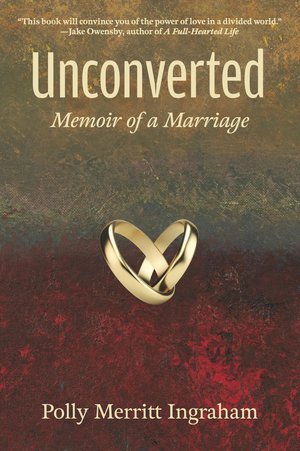
This week, Rootstock Publishing released Polly Merritt Ingraham’s first book, “Unconverted: Memoir of a Marriage” (Rootstock Publishing, June 17, 2025). More than a decade in the making, it’s a story of love, seeking, and commitment—to her husband, her children, her own profession in public education, as well as her quest to live out key beliefs and values. Ingraham, the School-to-Career counselor at Belmont High School, is married to Bishop Rob, and over their almost 35-year marriage she has sought to nurture and sustain their deep bond, while preserving her identity as unaffiliated with any one denomination. Instead of in a church sanctuary, she has found community and purpose on her children’s sports fields and in the various neighborhoods where the family has made their home while Rob was building his career. The book is elegantly constructed, smart, and occasionally quite funny; Ingraham poses thoughtful relatable questions without taking herself too seriously. It’s an eyes-wide-open look at how a loving relationship can survive, and in fact thrive, despite significant differences.
This interview has been edited for length and clarity.
Polly Ingraham: I started feeling inspired to write this back when we lived in Amherst before Rob was called to be bishop, and I was going regularly to church with our children sitting in the pew and essentially thinking, "How did I get here?"
Susan Axelrod: You weren't raised in the church?
PI: No, I was raised with almost no church, except for some experience going to Quaker Meeting with my grandmother. It was a very happy childhood. I had four older brothers, who had a big influence on me. It was a busy life, and we lacked for nothing. Occasionally it would cross my mind, "We don't go to church, but many of our friends do."
After Rob and I fell in love, got married and settled in, I thought, "This is probably a little unusual." Then that was confirmed because I began to glean that a lot of people assumed as soon as they met me, that I must be religious too. And I thought, "That's interesting. Why? They don't even know me."
I don’t need to tell you, I’m sure, there’s something that often feels old-fashioned about certain aspects of church life. Everybody is so nice. Still, for spouses anyway, there’s often this feeling that doesn’t really exist with other professions.
SA: …that you’re expected to be the help meet. I know because my father was a priest, and my mother felt that. Even though she is a pretty religious person, she rebelled a bit against the clergy wife thing because she always wanted to have a career, but she was still in the pew on Sunday mornings with the three of us.
PI: And so was I; I wouldn't do it any differently. It was one question that was important to Rob, “Will our children be raised in the church?” I totally understood, and they were. So, now I'm on the other side of it and I have had some time to muse about this. Rob has been very supportive about my drive to write the book.
I have some skill as a writer, I have some skill observing, I have some skill at trying to find things that are funny in life. And so, I've tried to tell my story of being married to a priest.
Whenever there have been clergy spouse gatherings, it struck me as very interesting that there’s a sense of “we're all in this together.” And besides being in a similar situation, we’re all likely Episcopalians. I mean, that's not even a question, even though wouldn't it be possible that some partners might be from a whole different tradition?
What I hope that I’ve portrayed in this story is that love works in mysterious ways, that you can love someone and still not quite become that person. In fact, a relationship can be enriched by the interplay that goes on when distinct differences are recognized and respected.
SA: To quote author Jay Owensby from the cover notes: “This book will convince you of the power of love in a divided world.” You and Rob are very different in personality type too, you're much more extroverted.
PI: He's more contemplative. But there are shared things that brought us together. We both read all the time. We both care a lot about physical workouts. We both care a lot about being kind to people.
There's one part early in the book—our first date when we went to a restaurant, and I was asking him questions: “What do you believe? How do you believe it?” It’s essential to the rest of my story—Rob trying to answer my questions and trying to be patient with me not knowing.
It's important to me to emphasize that part of why I wanted to write this was to try to display that love is not about being the same as your spouse. It's this kind of cross-fertilization that happens. You are constantly learning from and with one another. When Rob comes back from all his events that he does and he's tired, I will always ask about them because this is how I was raised, and I’m also genuinely interested. And yet sometimes Rob will say, "Oh Polly, that's the last thing I want to talk about. Please just tell me about your day; I need time to process that meeting on my own.”
Being an extrovert, I've learned from him the importance of quiet and that it can be a good thing for me too. For instance, when he says at night, "I'm going upstairs to read," sometimes I'll still have stuff I want to tell him. But I realize that when he goes upstairs it means quiet time. And I say, "You know what? That's a good idea. It can wait."
One of my chapters is about the day of Rob’s consecration. My hope was that this description would speak to other spouses/partners, especially those with spouses/ partners in the public eye, because what it's like for all the people there to celebrate is different from what it's like for the spouse/ partner. Everybody was so happy that day, and I was thinking, "Wait a minute, what is this going to mean for us?"
SA: How did you find time to work on the book?
PI: I started drafting early chapters back when I had what I called my “clergy wife journal”—keeping a lot of impressions about our way of life without knowing what the structure of a full-length book could be. Then, after we’d been in New Hampshire for several years, I enrolled in the Memoir Incubator program at Grub Street, a non-profit creative writing center in Boston. The premise there is “You come to a weekly class here for a year, and you will leave with a first draft.” I finished that in 2018, and thought I’d be really done in another year after absorbing all the feedback I got from my classmates, but then the “querying” process (reaching out to agents and publishers) took several more years. Ridiculous, right?
Now, I'm running the gamut between being proud of the fact that I finished the book, pleased that I have a good publisher, and a little bit exhausted by the no-end-in-sight feeling that has been there for months. And then I combine that sometimes with, "Holy cow, what have I done?" and “What will people think?” But then I realize that I never set out to do anything but tell my own story truthfully and vividly; I hope that it will resonate with people who are both inside and outside the church world.
You can pick up a copy of “Unconverted” at Gibson’s Bookstore in Concord, which will host Ingraham and her friend and fellow author, Ian M. Rogers, for a book launch event on Wednesday, July 9, at 6:30 p.m. Also find the book on Amazon and IngramSpark. Learn more about “Unconverted” and author Polly Merritt Ingraham here.
Iona Collaborative Workshop Affirms 'Small is Beautiful'

Forty-eight leaders from 18 congregations gathered on Saturday, May 10 for “Spiritual Tools for Small Congregations” with Rebecca Hall from the Iona Collaborative. At this all-day workshop, Hall spoke about the “bi-vocational journey” and affirmed that “small is normal” and “small is beautiful.” At the Iona Collaborative, “bi-vocational” is understood to be any congregation that is not a community gathered around a full-time priest. According to data from Virginia Theological Seminary (VTS) and Church Pension Group (CPG) in 2022, 30 percent of congregations in The Episcopal Church are led by a full-time priest and 69 percent of congregations are “bi-vocational”—either lay-led (14 percent and rising) or served by a part-time priest (55 percent and rising). And this trend has very likely continued since 2022.
In the diocese of New Hampshire, we currently have 41 parishes and missions and five gospel-oriented communities. Of those parishes and missions, 20 are served by a full-time priest, 18 are served by a part-time priest, and three are lay-led with supply priests. Of the five gospel-oriented communities, two are led by part-time priests and three are lay-led. This means that in New Hampshire, 43 percent of our congregations are “full-time,” 43 percent are “part-time”; and 14 percent are “lay-led.”
New Hampshire congregations invited to the workshop included all missions and those parishes who have part-time clergy or who are lay-led (with average Sunday attendance of 40 or less). The workshop provided strength and encouragement for the small-church journey as well as relationship building between congregations. The Iona Collaborative’s primary work is to provide tools and training for small congregations to discern what God is doing in their midst. Since small churches can’t “do it all,” they are developing their discernment skills to make Spirit-led ministry decisions with tools that help them ask questions such as: What do we have enthusiasm and energy for? What is both “good work” and “our work” in the community? What do we have the materials resources for?
The Iona Collaborative is made up of 36 dioceses who work in collaboration with the Seminary of the Southwest to develop curriculum, spiritual direction, and discernment tools for local schools of ministry and bi-vocational clergy and congregations. The collaborative hosted a Spring Workshop weekend in April in Baltimore, but so many members of congregations in New Hampshire wanted to attend that it made more sense for Hall to travel to New Hampshire.
Bishop Rob opened the gathering in prayer, reflecting on the resilience of small churches and expressing his gratitude for our partnership with the collaborative. Canon to the Ordinary Tina Pickering, who organized the gathering, said “the whole day affirmed the diverse gifts and strengths of our smaller congregations throughout the granite state, offering small church leaders an opportunity to be seen, respected, and encouraged in their ministry.” The group of small churches gathered at this workshop affirmed their desire to come together through quarterly Zoom meetings and a yearly in-person gathering to continue to celebrate and learn about the important ministry of small churches throughout the diocese.
Finding Solid Rock in a Time of Shifting Sands: Insights from the Spring House of Bishops Meeting

Photo: Bishops at Camp McDowell in Nauvoo, Alabama, for the Spring 2025 House of Bishops meeting. Courtesy of the Bishop of Georgia, Frank Logue.
by Susan Sherrill Axelrod
Director of Communications
To reflect on the recent House of Bishops (HOB) meeting last month at Camp McDowell in Nauvoo, Alabama, New Hampshire Bishop Rob Hirschfeld and Maine Bishop Thomas Brown joined me on Zoom for a Q+A. Our conversation has been edited for clarity and length.
Susan Axelrod: Before the HOB meeting, you gathered with other bishops from Province 1 for a retreat. Is that something you usually do?
Bishop Rob: Normally, Province 1 bishops meet during Advent for the greater part of a week. In Advent of ’24, we had to reschedule because we were called to Minneapolis for a day-long HOB meeting with the new presiding bishop. So, we thought, since we’re all going to be in Alabama anyway, why don’t we just show up a little earlier for that? Thomas arranged for the executive director of Camp McDowell to lead us on a quiet day—a nice container to reflect on our rule of life. As always, the highlight for me is just getting together outside of our usual context, exploring how God is speaking to us, comforting us, holding us, challenging us, and it’s a great time to share our fellowship in this ministry.
Bishop Brown: A big highlight of the retreat for me was that both Julia Whitworth, the new Bishop of Massachusetts, and Nathan Pipho, the new Bishop of the New England Synod of the Evangelical Lutheran Church in America were there. While we’re a tightly knit group, we are also always changing. Most of the times the bishops in New England gather, we have been a different group from the group we were the previous time.
SA: What was the biggest takeaway for each of you from the HOB meeting?
BR: I’ve been ruminating on this. What is that hymn? All else is shifting sand …
BB: My hope is built on nothing less than Jesus Christ and his righteousness. On Christ, the solid rock, I stand. All other ground is sinking sand.
BR: There you go. That brain of his is just amazing. There’s a lot of sinking sand. We are living in a world with a whole new level of chaos and change that is making us uneasy. The church is shifting with the new presiding bishop who has initiated a lot of structural reforms. Even though he promised these things, it still comes as a shock for many, and it’s disruptive. We’re trying to find our footing. Even though this was a meeting, it wasn’t a retreat, and we were dealing with topics that have to do with the institution—Title IV, how the church has partnered with other agencies, both in and outside the government to address the immigration crisis and ministry to our new Americans and refugees—we did not come out with any programmatic statement or a declaration about where the church stands on any one or all of these issues.
It feels that like many nonprofits and political parties—one in particular—we’re in a retreat mode before we make an advance, like we’re taking stock deliberately. There was an insertion of a quiet centering prayer every day that was new. I think there’s a sense of pressure and urgency; how long are you going to be taking stock? But there’s also a sense that we need to find out where is the solid rock that we’re standing on amid the sinking sand.
BB: I think that’s right, Bishop Rob. It’s a risky time to be a follower of Jesus right now. I think that risk is good, and I think the church is made for this moment. If we could get ourselves clear about the fact that for some of us, this is the first time we’ve had to do really hard things. In the Bishops Beyond Borders video, I quoted the Black theologian in Georgia who said, “The problem with a lot of you white people is that you’ve just been entertained for 70 years and now you actually have to do some work.” I think that we need to roll up our sleeves and declare and proclaim to our churches, especially in Maine and New Hampshire, that God has already given us everything we need to be faithful in this moment.

Presiding Bishop Sean Rowe preaching at the Spring 2025 House of Bishops meeting. Photo courtesy of the Bishop of Georgia, Frank Logue
Yes, there is some risk, and the stakes are higher for some of us now than they have been, but that’s okay. One of the things that I hope for the presiding bishop is that as necessary and as much as I support all of the structural work that he’s doing, it coincides with the things that are happening in our nation’s government, and if we continue to only speak about structural reform in our church, it may sound as if we are not responding to the urgent needs of our society. I don’t think we are there right now, but I will want to work with everybody to make sure that we are also addressing issues that impact people’s lives on a day-to-day basis.
I also want to say something about a specific part of the meeting and the presiding bishop’s focus on Title IV disciplinary matters, particularly as they pertain to bishops. When the presiding bishop took office in November, there were over 30 cases pending, and now that’s down to fewer than seven. He is really committed to attending to these issues. In disciplinary work, very often our lack of keeping the process going creates more harm than whatever the alleged behavior is. That’s especially true with disciplinary matters against bishops. Previously it was like molasses to get stuff done, but this presiding bishop doesn’t act at that pace, he acts with alacrity. So, things are getting done and that’s good for the church, that’s good for bishops, that’s good for people who feel wronged. It’s just good all the way around.
But he’s also doing something else. He’s working with people who have expertise in conflict that isn’t about behavioral misconduct. So, I applaud both his getting stuff done and his recognition that when someone has a concern about a bishop, it’s not always a disciplinary matter, it could be a conflict matter, and those can be solved and discussed in different ways.
BR: With this presiding bishop, there seems to be a real commitment to speak directly to issues that we’re facing. I’ve been a bishop for almost 13 years, and I’ve heard after every general convention or HOB meeting, “But we’re not really talking about the things that we need to be talking about, one of which is numerical decline, some of the demographic shifts that are happening in the church in the wider culture.” And the presiding bishop seems to say, “Let’s uncover those rocks and look at those.” So, we spent a morning looking at statistics; they’re sobering and hopeful at the same time. They’re hopeful because we’re dealing with the truth.
There was a lot of truth telling at this HOB about the state of the church, both the bad news and the good news, the challenging news and the promising news. Title IV as Bishop Brown was talking about. Also, our facing or our being caught surprised around the rise of Christian nationalism. Atlanta Bishop Rob Wright gave a presentation on that like the one he gave last year in Maine. It was a dense meeting.

Maine Bishop Thomas Brown, second from left, with other LGB bishops at the Spring 2025 House of Bishops meeting. Photo courtesy of the Bishop of Georgia, Frank Logue.
BB: Bishop Rob, I think you’re absolutely right about the truth being told. And also I heard some senior bishops who felt that trust among us is getting deeper and wider and therefore things felt real. One of the things that I think you know more about than I do, Rob, is that because the presiding bishop has been a bishop for a long time, he knows everybody very well. That matters doesn’t it? The HOB is also more diverse. Frank Logue, the Bishop of Georgia, always takes group photographs, and they reveal a changing community. We’re now nearly 50 percent women. There’s a photograph of the EBAD—Episcopal Bishops of African Descent–as well as one with those of us who are LGB—there’s no T or Q yet. For the first time there’s a Latina bishop. Every time we gather, and we get those group photographs, what I notice is that some of those communities are getting larger, and that is just a beautiful thing to see.
BR: Underscoring that was during the big day of all the graphs and the statistics around the life of the church from the statisticians, the factoid that among those who are priests, deacons and bishops, the HOB is the most diverse in terms of gender, race, and sexual orientation. That’s been the work of deliberate recruiting and supporting those who may feel called to the Episcopate.
SA: I think you’ve just answered my next question, which was, “This was the new presiding Bishop’s first time leading the HOB. What about his message and leadership resonates the most with you?”
BR: I think he’s convinced as I am—and I think Thomas is—that this church is built for times such as these. It’s a church that grounds itself in a sense of community, but not necessarily a community of like-minded or like-looking people. And it’s currently involved in a project of building and strengthening that sense of community for right action, which is going to come. What that looks like, how that might express itself is in God’s mind right now, and we’re discerning it. I remember some years ago, one of Bishop Wright’s first addresses to the HOB. He referred to the crozier as a lever and suggested that we use it wisely. Also, that we need to find out where exactly the fulcrum is for a movement, where the pressure point is that’s going to be most effective.
I’ve carried that with me. I feel like right now we are in a moment where we can’t just stick the crozier in everywhere. I think the evil one is asking us to just diffuse our power and our efficacy by addressing everything that’s happening with such ferocity and frequency that it’ll weaken us. I think we’re in a place of wise discernment of finding out where is our lever that…as Archimedes said, “Give me a lever and a fulcrum and I can move the world.” That’s what we’re about right now. It’s going to be frustrating because I feel the pressure every day. “How come you’re not here, there, everywhere?” God is here, there and everywhere and God is clearly directing us in God’s inscrutable ways.
SA: Was there anything about this HOB meeting that surprised you, that you didn’t expect, either good or bad?
BB: I don’t usually go to the evening social at seven o’clock. But I did go once and there were a lot of bishops there, a lot of fun being had. When I joined the HOB, there was a small group of poker playing bishops, maybe 10 of them. Last year there was a bishop who said, “I’m more of a wine and Uno girl.” So, she started an Uno table. The night that I went this year, there were seven tables of Uno being played, with people of all ages, races, and languages, some people learning to play Uno for the first time, and some playing Uno for the first time in 20 years. A delightful surprise was seeing how much fun they had with each other. And because I’m still relatively new, I’ve of course heard stories of when there were bishops who wouldn’t even speak to each other, going back as recently as the early 1990s, particularly around human sexuality. I just don’t think that’s at all true now. I don’t know what you would say Rob, but there’s not a single bishop that I would not gladly sit down and have a cup of coffee with.
BR: I totally agree. I’ve been part of this little group of self-identified contemplative bishops, and over the past five years, it’s grown from maybe five or six to 35, 40 people. And there’s no mysterious technique. It’s not a gimmick. It’s just like we need to just sit in the presence of God. And that’s been something to witness. I think it has an effect on the whole body, a ripple effect. Early on in this gathering, somebody cited Evelyn Underhill, the great twentieth century mystic and British spiritual writer, who apparently wrote a little note to the gathering of the bishops in Great Britain sometime during World War II, “My lords, I urge you to remember that the most interesting thing about the church is God.” I feel like that’s resonating among us.
BB: That’s so beautifully said. The more that we can make God the subject of our sentences, the more we’ll be able to speak to this moment and live in this moment.
Bishops Without Borders: A Video Conversation
A time of conversation, fellowship, and prayer among the Anglican/Episcopal Bishops of Maine, Montreal, New Hampshire, Quebec, and Vermont, recorded on Friday, March 21, during the spring meeting of the House of Bishops.
An Episcopal Path to Creation Justice 2025 Update
From the Rev. Rachel Field, project manager and Deb Baker, project coordinator
An Episcopal Path to Creation Justice is halfway through its second year. Over the past two years this program has shifted from a small pilot to open enrollment for Province 1. In this time of significant political upheaval and social change, the Path offers a model for grounded community support and activism. Changes within The Episcopal Church and across the United States have created a landscape of uncertainty for many of our environmental ministries. Initiatives protecting wilderness and biodiversity, as well as programs to achieve zero carbon emissions are all threatened. As a friend of mine recently stated, "The work hasn't changed; it's just gotten harder." Through the generosity of the Dioceses of Massachusetts, Western Massachusetts, and Rhode Island, and additional support from Province 1, the Path continues to hold space in our parishes—laying the groundwork in prayer for nurturing lay leadership, building community, and effecting impactful action. In times of uncertainty, these models of connection feel even more essential.
This year, our Companions have been witnessing and supporting goals for ecological justice, deepening commitment within parishes, and helping connect parishes to existing resources and other communities. In Brattleboro Vermont, St Michael's continues to move toward its goal of zero emissions and is incorporating adult education programming around composting, green burials, and divestment from fossil fuels. In Massachusetts, Good Shepherd Acton is using the "Love God, Love God's World" curriculum and incorporating music from the Missa Gaia (Earth Mass) into their worship life. Earlier this year, all our Path parishes received materials from the organization Beyond Plastics, and some are incorporating these into a "plastic free" Lenten practice. In New Hampshire and Maine, we have three parishes working to discern their own unique Paths to creation justice, St. James in Keene is working to write a land acknowledgement that takes into consideration not only whose land the church is on but also the relationship the original inhabitants had with the land.
Enrollment for the Path is now open for the fall of 2025. If you or your community are looking to deepen your engagement around climate justice, have a committed group of at least three people, and are able to commit to monthly meetings between October 2025 and May 2026, then we invite you to reach out and explore how the Path may be able to support you. The program is open to all Episcopal communities in Province 1 (CT, MA, ME, VT, NH, RI). Or if you are eager to offer support to other communities and would like to join our cohort of Companions we also invite you to contact Rachel and Deb at episcopalcreationpath@gmail.com.
An Episcopal Path to Creation Justice is a four-level initiative now available in Province 1 to encourage and support our congregations to deepen and grow in a holistic response to the climate emergency. The Path develops and equips church communities to grow in knowledge and skills as they progress along the four-fold path toward Creation Justice, which includes: Prayer, Learning, Action, and Advocacy. It provides consultation, support, community, and recognition for participating churches through its trained Companions and share their work so that others will be inspired.
New Micah 6 Commission Will Work for Justice, Mercy, and Humility in New Hampshire and Beyond
A new diocesan committee, the Micah 6 Commission, was launched at an organizational meeting on Monday, Feb. 17. Conceived by Bishop Rob in recognition of the fact that so many of the issues we face in the world—racism, environmental degradation, educational, health care and economic inequities—are interwoven, the new commission replaces the former separate commissions dedicated to Reconciliation, Earth Care, and Our Kids.
The Micah 6 Commission prayerfully seeks to discern how the Episcopal Church of New Hampshire can follow the words of Micah 6:8, to “do justice, love kindness, and walk humbly with our God,” as we witness Christ’s love to a world continually in need. “The requirement of God that we work towards justice, mercy, and humility is the aim of lifelong Christian discipleship,” said Bishop Rob. The Micah 6 commission will work ‘at the speed of relationship’ so that spiritual discernment of our role in repair and reconciliation comes through a sense of community call.” The commission will strive to partner wherever it can with agencies, both religious and secular, that are already effectively carrying out God’s mission.
At the meeting, members reflected on Micah 6:8 together and learned more from the Bishop about the “charge” to the commission. They also heard from Chair, the Rev. Derek Scalia of St. James’, Keene, about the background work that led to the commission and from Canon to the Ordinary Tina Pickering, diocesan staff liaison, about organizational logistics, beginning with 1:1 meetings to build common ground and deep relationship. April 11-12, members will go on retreat together at the Barbara C. Harris Camp and Conference Center, during which the commission will set group norms, roles and responsibilities, and talk about community partners and congregational relationships. Members will also begin to develop a map of the work, including looking at the efforts of the Reparations Task Force, budgeting, grant work, and more. The commission will meet monthly on the first Tuesday of the month.
In addition to Scalia and Pickering, the Micah 6 Commission is comprised of: Rev. Jean Beniste, St. Paul’s, Concord; Seth Bonvouloir, Grace Church, Manchester; Kristen Gowdy, St. Thomas’, Dover; Rev. Shawn LaFrance, Grace Church, Concord; Rev. Susan Langle, Epiphany Church, Newport; Rev. William Petersen, All Saints,’ Wolfeboro; John Rowntree, Good Shepherd, Nashua; Robert Siewierski, St. Stephen’s, Colebrook; Deborah Szauter, St. Paul’s Lancaster; and Ashley Wade, St. John’s, Portsmouth.
“At the core of the Christian faith is a commitment to love God and to love neighbor,” said Bishop Rob. “We seek to reflect as best as we can the compassion that Jesus felt to the lost, the least, and the last among us. I am so grateful that the inaugural members of the Micah 6 commission are so eager to discern in deep prayer and courage how we can most effectively share the love of Christ in our communities.”
A Sabbatical Note from Canon for Formation and Vocation, the Rev. Kelly Sundberg Seaman
With gratitude to the Episcopal Church of New Hampshire and the people of Trinity Claremont, I am on sabbatical from Feb. 1 through April 30, 2025. During that time, please connect with the following colleagues:
For the ordination process, vocational discernment, and matters related to the Commission on Ministry, the lead contact is Dean of Clergy, the Rev. Louise Howlett.
Registration and logistics for the March COM retreat are being handled by Operations and Event Administrator Kathy Traynor.
Safe Church, background checks, and youth formation remain in the hands of my associate, Youth Formation and Safe Church Coordinator George Swenson.
For matters where formation meets congregational development, including the diocese’s relationship with the Iona Collaborative, connect with Canon to the Ordinary Tina Pickering.
For the School for Ministry:Currently enrolled students, please contact SFM faculty member and interim SFM lead the Rev. Steve Rugg, or your instructor.
SFM Wednesday community time will be student-led.
For questions about tuition invoices or other financial matters, please connect with Director of Finance and Benefits Lauren Tennett.
For Trinity Claremont:Trinity’s general email is welcome@trinityclaremont.org. The parish administrator will forward your message to the appropriate person at Trinity. For pastoral emergencies, please consult your directory and contact Deacon Geof.
Please note that my kss@nhepiscopal.org email inbox will not be monitored until May 1.
Northern New England Clergy Gather For First-Ever Tri-Dio Conference

Conference participants singing with Music That Makes Community
Episcopal clergy from New Hampshire, Maine, and Vermont gathered at Geneva Point Center in Moultonborough, New Hampshire, Oct. 6-8 to join in worship and fellowship for a first-of-its-kind meeting of church leaders from the three dioceses.
Organized by the Episcopal Church of New Hampshire’s Dean of Clergy, the Rev. Louise Howlett and Events Administrator Kathy Traynor, supported by the Clergy Formation Committee of ECNH, in consultation with the Rev. Canon Susan Ohlidal and the Rev. Rachel Field from the diocese of Vermont and the Rev. Peter Swarr from the diocese of Maine, the clergy retreat focused on communal song sharing inspired by the Brooklyn, New York-based nonprofit, Music That Makes Community (MMC). Clergy were invited by MMC worship leaders, Nancy Willbanks and Jorge Lockward, to sing, compose, and lead others in song sharing by using accessible and easy methods to embrace songs and leadership skills. Experiencing this type of song sharing was a way both to tap the spiritual root of God’s presence in community and to uncover the musical connectivity and capability that is already present in each person through God’s gift of loving creativity.

From left: Vermont bishop Shannon MacVean-Brown, Bishop Rob, Maine Bishop Thomas J. Brown
While taking breaks from singing, the 90-plus participants had the opportunity to catch up with old friends and meet new colleagues for the first time. The rainy, yet beautiful fall days at Geneva Point Center also afforded those interest in physical activities the chance to hike, kayak, play soccer, and take in the photogenic beauty of Lake Winnipesaukee. The center’s bucolic setting and long ecumenical history of serving as a meeting place for the National Council of Churches was not lost on this group.
Bishops Robert Hirschfeld, Shannon MacVean-Brown (Vermont), and Thomas Brown (Maine) also gathered with the group to discuss future collaboration possibilities, reflect on various challenges facing The Episcopal Church, and the importance of clergy leadership. Before departing, the group shared in the celebration of the Eucharist filled with music we had learned throughout the conference. Participants left fulfilled, inspired, and looking forward to more opportunities to get together.
The clergy conference was supported financially by a generous grant from Province I and the Schofield Fund from ECNH. St. Andrew’s Episcopal Church in New London, New Hampshire also hosted an MMC all-day workshop for lay people and other religious and music leaders.
Vote Faithfully This Election Day

Voting is a powerful way to make a positive impact on your community and fulfill the Gospel call to care for one another. It's not just about choosing a president—it’s about deciding on local races like city council, mayor, and school boards, which directly affect daily life. Here’s how you can help get souls to the polls!
Parish Election Challenge: Building Community with Election Engagement
Vote Faithfully Election Engagement
Make Me an Instrument of Peace, A Guide to Civil Discourse
“It is a Christian obligation to vote, and more than that, it is the church’s responsibility to help get souls to the polls. ”
Voting in New Hampshire
Are you registered to vote? Do you need to update your address? Go to vote.gov/register.
Absentee ballots are now available, but you must meet certain criteria to vote absentee. Learn more and request one here no later than noon on Monday, Nov. 4. Ballots must be received in person no later than 5 p.m. on Nov. 4 and by mail no later than 5 p.m. on Election Day.
Pray for Our Nation: Oct. 29 – Nov. 5
Let's come together across the church to offer prayers for discernment in voting and for the well-being of our nation. Starting Oct. 29 and continuing through the day after the election, you are invited to pray for the election of leaders in the U.S. Download the guide for use at home or to share with your congregation. The prayers will also be posted daily on Facebook and Instagram. To download the bulletin insert to share with your congregation, visit Forward Movement.
Election Night Virtual Prayers

Everyone is invited to join Election Night Virtual Prayers hosted by The Episcopal Church Office of Government Relations from 8 to 10 p.m. on Nov. 5. Bishop Sean Rowe, who will become presiding bishop on Nov. 1, will offer an opening reflection and prayer.
Episcopalians from around the church will hold silence and lead participants in prayers together for peace, the nation, and all people and countries. Join the event via Zoom by registering here, or watch a livestream on The Episcopal Public Policy Network’s Facebook page.
New Book Document's St. James Keene's Historic Needlepoint Collection

Similar to today, the early 1970s were times of great societal and religious change. The Anglican religious needlework tradition, which at this period turned to collections of needlepoint kneelers and cushions, produced numerous collections in Britain and the U.S. that reflect their societies' struggle to honor the old while embracing the new. The collection at St. James Episcopal Church in Keene rivals the best of these collections. In over 400 separate needlepoint canvases, requiring 60 volunteers and a decade of work, it explores the ancient symbolism of the church, the stories of the Bible, favorite hymns and prayers, church history, local history and events, and the individual interests and devotions of the needlepoint stitchers. All these diverse subjects of the collection come together in a comprehensive design that continues to inspire hearts and minds of St. James' parishioners. Yet, as the church has continued to change and modernize, parts of the collection have gone out of use and are being elsewhere. More changes will surely follow.
The inevitable dispersal of the St. James needlepoint collection inspired St. James parishioner Ann Carlson to write “The Needlepoint of St. James: Fifty Years of Greater Glory” (ABCarlson Publishing, July 2024, $36.99). With a foreword by the Rev. Elsa F. Worth, rector of St. James, the book provides a complete history and photographic inventory of the project; connects the individual pieces with the record of their makers and of the hundreds of memorial dedications that were given to make the project possible, and tells the story of how this collection has contributed to the life of the community, then and in the ensuing 50 years. It also serves as a companion to a book written by the projects' original director, Mrs. Mary P. Olsen. Mrs. Olsen's book, “For the Greater Glory: A Church Needlepoint Handbook” (Seabury Press, 1980), is a reference book of how this project was completed, with detailed instructions for planning, organizing and directing other large needlepoint projects.

Through the end of 2024, Carlson is offering a special discount for readers of The Vine at her print cost ($22/copy), which can be accessed by ordering the book here or via the QR code.
Dr. Ann Carlson, is a retired aerospace scientist who spent her primary career working for the federal government, mostly at NASA. In retirement, her new career has become that of publishing artists, poets, historians and writers in niche markets, or for local audiences. Occasionally, she publishes a similar project of her own.
“The Needlepoint of St. James” by Ann Carlson
Hardcover, July 2024
ISBN 978-0-9962883-4-7
$36.00; 6 x 9, 134 pages
Resources for the Season of Creation Sept. 1 - Oct. 4

Bishop Rob is one of 42 diocesan bishops to authorize the use of the 2024 edition of "Season of Creation: A Celebration Guide for Episcopal Parishes," during this year's Season of Creation, Sept. 1 - Oct. 4.
According to the Episcopal News Service, "developing this resource has been a grassroots effort inspired by the ecumenical Season of Creation movement, a desire for authentic Episcopal liturgical expression, and the awareness that parish leaders often have limited time and energy to prepare and plan services for every season." The guide includes prayers, readings, and hymns dedicated to honoring the sacredness of God’s Creation.