Praying for our Nation on the 250th Anniversary of the Declaration of Independence — July 4, 2026
Dear People of God in the Granite State:
On this milestone Independence Day, perhaps you have noticed a certain ambivalence about its celebration in others and in yourself. We do indeed have so much to give thanks for—our land’s natural and bounteous beauty, the richness of the many heritages that have contributed to our varied customs and people, and the blessings of community, freedom of faith and speech, the capacity to pursue genuine happiness. At the same time, we acknowledge the fear and suspicions that plague us, the widening inequities of wealth, health care, education, and opportunities that do more to constrain, rather than enhance, the freedoms the Declaration still promises. Our Founders were both heroic and flawed men. They sought the best for a people, and even nations, yet unborn. And they were tragic in their inability to cast the shackles of slavery for all humankind, to allow the right to vote to all, or to settle this nation without the violent eradication and subjection of the native peoples, the first stewards of these lands and waters.
To acknowledge these both/ands is to acknowledge the complex truth on which God always insists. For Christians, in whom all memory is present in the Presence of a righteous God, history is studied and told not for the sake of a paralyzing shame, but to set us toward new horizons of justice, mercy, and grace.
Whether you are conservative or progressive, Republican or Democrat, (or like me, who bristle at being labeled by any party and refuse to be locked into the orthodoxies of any political party), you may resonate with the words of an early student of our nation, Alexis de Tocqueville. Tocqueville spoke of our nation’s promise in this way: “The greatness of America lies not in being more enlightened than any other nation, but rather in her ability to repair her faults.” (Democracy in America, Chapter XIII, 1835.)
I invite us to give thanks, hearty thanks, for this nation. And I invite us to appeal to God’s grace and mercy to grant us the courage, vision, and trust in the God, the Judge of all nations, who is to assist us in repairing our faults. To make this prayer, I turn to the Book of Common Prayer, and the Thanksgiving for National Life, page 838, included below.
Faithfully Yours in the Sovereign Lord Jesus Christ,
+Rob
Thanksgiving for National Life
Almighty God, giver of all good things:
We thank you for the natural majesty and beauty of this land.
They restore us, though we often destroy them.
Heal us.
We thank you for the great resources of this nation. They
make us rich, though we often exploit them.
Forgive us.
We thank you for the men and women who have made this
country strong. They are models for us, though we often fall
short of them.
Inspire us.
We thank you for the torch of liberty which has been lit in
this land. It has drawn people from every nation, though we
have often hidden from its light.
Enlighten us.
We thank you for the faith we have inherited in all its rich
variety. It sustains our life, though we have been faithless
again and again.
Renew us.
Help us, O Lord, to finish the good work here begun.
Strengthen our efforts to blot out ignorance and prejudice,
and to abolish poverty and crime. And hasten the day when
all our people, with many voices in one united chorus, will
glorify your holy Name. Amen.
For Heroic Service
O Judge of the nations, we remember before you with grateful
hearts the men and women of our country who in the day of
decision ventured much for the liberties we now enjoy. Grant
that we may not rest until all the people of this land share the
benefits of true freedom and gladly accept its disciplines. This
we ask in the Name of Jesus Christ our Lord. Amen.
*
Bishop Rob Delivers Final Address at St. Paul's School - April 13, 2026
Good morning. It is a deep and awesome privilege to be with you again. Thank you for your welcome. This passage that we just heard from John's gospel is the first of what are referred to as the resurrection appearances of Jesus. He comes and he meets the disciples the evening after he rises from the dead and he comes with wounds. He comes showing them the evidence of their having abandoned him at the cross. They're locked in a room. They've locked themselves into a room for fear and probably shame. Each of them in that room left Jesus to hang and die.
It's of note that when Jesus comes, he could have just said, "Where were you? You promised to be with me even to the end of time, to the end of this whole journey, and you all took off—each one of you.” Instead, the word Jesus speaks is, “Peace.” Peace. It's a message of forgiveness, a message of healing, a message of restoration, of community in the midst of division, hatred, and fear. Yesterday, most Christian churches that follow what's called the Revised Common Lectionary read that passage of Jesus extending peace, but the same day, we also heard in the news that prospects of peace in the Middle East were becoming more remote.
And it occurred to me, as it often does, that there will be no world peace if there's not first peace among us, peace within our own communities, our own neighborhoods, among us in our own schools and churches and synagogues and mosques, peace within ourselves. And peace is not something that urges us to just forget what we've done with each other, against each other or to each other. Real peace does erase our memory of past hurt, but it holds us accountable without rancor, without hatred, always respecting the dignity of every human being. I can never read this passage of being in a locked room--the disciples in a locked room for fear and shame, and Jesus entering that room --without remembering of a moment in my life when I was very young, 13 years old, that bears some similarity, although in a much less significant way. But for me, it was a pivotal moment.
I grew up in suburban Connecticut, outside of New Haven, and I was a freshman in high school at the time. And I remember one day, it was late fall, and the bus took us home, and I got off the bus and we started to walk. It was about a quarter mile walk from the bus stop to my house, and there were a number of other students. One was Mary, my next door neighbor, with whom we shared homework with our algebra or geometry, whatever that was, which I was never good at. And there were three brothers, Billy, Gary, and David. And we got off the bus and started walking home, and one of the brothers noticed a crab apple tree on another house in that development. Something came over him, and he decided that he would pick up one of the crab apples that had fallen to the ground. There was a whole nest of them. And he picked it up, and he threw it at Mary, hitting her in the back.
He did it again, this time hitting her in her cheek. She began to cry and quickened her pace, and then the other brothers followed, gathering fistfuls of crab apples and hurling them at Mary. And then they asked, "Robbie, how about you? " And so I picked up a crab apple and also hit Mary. It landed in the back of her head, hard enough to sting. We all made it home. After that, I went into my house. Both my parents worked, so I opened my math book and started to try to do my homework. About a half an hour went by and the doorbell rang, and I wondered who could that be. So, I went down the hallway and I could see through the panel of windows on each side of the door that it, of course, was Mary.
I pretended not to hear. I hid away, but she kept ringing the doorbell. Finally, I couldn't pretend anymore, and I had to open the door. And there she was, her face tear-stained, and she said, "Rob, the Miller boys, they always treat me that way. I could expect it from them, something like that. But today, today it was you. I thought we were friends.”
God help me, I just melted at that moment. I don't think I could even say, "I'm sorry." But she knew that even at 13 years old, even though we didn't know the language of forgiveness and grace and all of that, we knew that there was a deep hurt.
We were not at peace. Now, God bless my mother. She always had a cookie jar of those wonderful Toll House cookies. I said, "Mary, come in, please." And I put out some of those cookies out and poured some milk. Maybe that was the beginning of my decision to become a priest. It was like teenage communion, and we just sat there in silence and had cookies. Somehow we got through the next hour or so. We talked about math. We made small talk. Small talk is not to be underestimated in our healing with one another, small talk, lowers temperatures. Small talk begins the tender bonds that build and restores relationships.
The next morning, we went to the bus stop and I knew that I had to stand with Mary and walk alongside her as she faced the cruelty, the senseless, gratuitous, pathetic cruelty of my other neighbors. Sure enough, they picked up crab apples even the next morning and started hurling them this time at both of us. That afternoon when we came back from the bus, I think they realized that it was puny and pathetic what they were doing. They had stopped.
You remember that scene in the Lion King? (This is a transition.) When Simba is called back to the pride, (interestingly called, “the pride”), to come back to community after living a life of Hakuna Matada—where you just look after your own desires and wants and concerns. Rafiki, who holds a staff and has vestments, is a priest but he’s also, of course, a baboon. (Clergy are sometimes thought of that way.) Anyway, Rafiki leads Simba to a pool of water and he, Simba look at the pool of water. The movie superimposes this image of his father, Mufasa. And somewhere Mufasa says, "Simba, you have become less than you are.”
You have become less than you are.
When Mary rang that doorbell and she said, "Rob, today it was you” That was my Mufasa moment. “You have become less than you are.” Jesus doesn't bother to ring the doorbell. He goes through locked doors and when he shares peace to those disciples undeserving and needing to be held into account, he reminds them that you have the power to forgive or to retain the memory of hurt. That's the message of our faith. That's the message of Easter. If we can't reckon with the call to become who God has created us to be, holy, flawed, deeply flawed, wholly beautiful and forgiven, there's no chance for this world. It starts here. It starts in our own hearts.
Thank you.
Easter Message from Bishop Rob — April 2026
Every year, a close reading of the same gospel, even if we’ve read it over a life-time, brings something fresh, something green, and new—something surprising. It may be very familiar and obvious, but the Holy Spirit wants us to notice it as though for the first time because we need to hear it for the first time. This year what springs up as though a new sunrise is the verse in John’s gospel, at the end of the Good Friday reading, when we hear these words:
Now there was a garden in the place where he was crucified, and in the garden, there was a new tomb in which no one had ever been laid.
To this day, in the Holy City of Jerusalem, the Church of the Holy Sepulchre is also known as the site of Calvary, Golgotha, the place of the crucifixion, where tradition tells us that a relic of the cross was uncovered AND it is also the place where Jesus was laid in an unused tomb. It’s from the tomb, of course, where God raised him from the dead. Execution and resurrection happen in the same small piece of real estate: the place of unimaginable suffering by human hands and hearts AND the site of the world changing triumph of life over death, love over fear, forgiveness over hatred. It is the place our savior expresses humankind’s deepest abandonment by God and humankind. And it is the site of recognition: of us recognizing Jesus and then the risen Jesus seeing us as a friend. It is the site of the most holy “both/and” which is our life in the Risen Christ.
Our Calvaries are legions. There are so many, too many, and too heartbreaking to list. We all know what they are. The effects of human sin and cruelty, done by us and to us, are all around. We see them. They burden and grieve us. Those crucifixions lead us to times of both despair and hope. They are the reason for our prayers, our seeking help from God and each other. They are the cause of our thirst for righteousness, our struggles to forgive, and our cries to be forgiven. The desolate Place of the Skull and the Garden of Resurrection are layered on top of each other. The suffering and death of bodies, of communities, of hope itself, occur in the same place, and with even more power where we meet Jesus’ Rising. From out of the depth of the Sepulchre, Jesus calls us each by name just as he called to Mary Magdalene on that first Easter morning.
May your Good Fridays, your scenes of deep loss and sorrow be converted into a glorious resurrection, a rising to life, to a love and a life that is stronger than death. What courageous joy that gives us, to know in our bones that nothing, not even death, or the fear of death, will separate us from the love of God in Jesus. May that love and life rise in our hearts this Easter, and may every day be Easter. Jesus Christ is Risen. Alleluia.
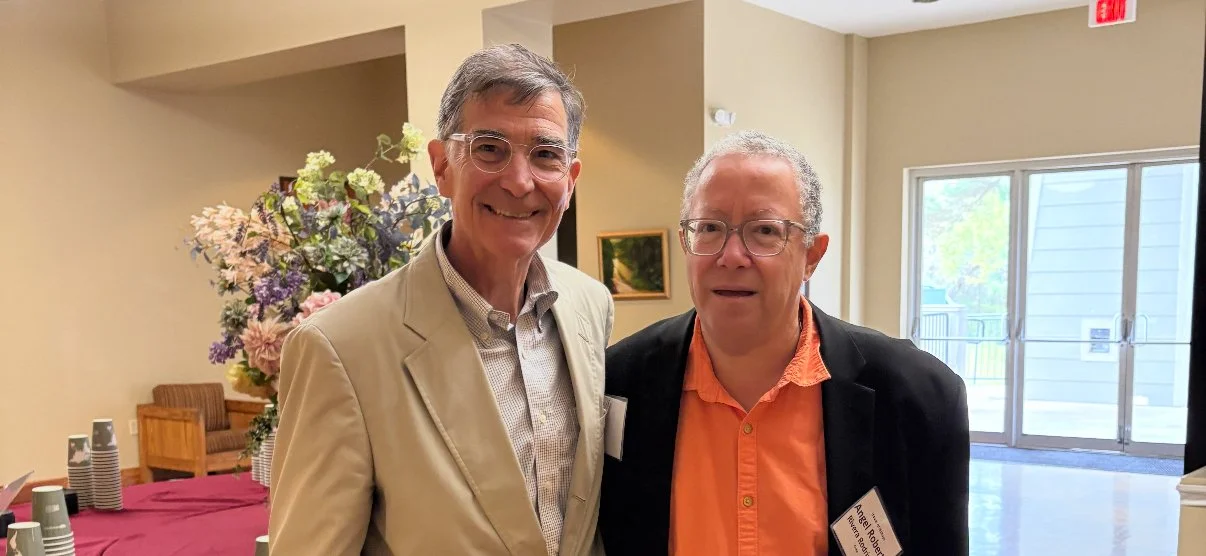
Bishop Rob and Bishop Angel, of Cuba, spend time together.
Report from Bishop Rob - House of Bishops Spring Meeting - March 17-25, 2026
It was a privilege for me to attend the spring gathering of the House of Bishops at Camp Allen in the Diocese of Texas. Though I always hate to leave my beloved Diocese of New Hampshire, I find the time enriching to be with my colleague bishops from the whole Episcopal Church, including from the dioceses in Latin America, Europe, and Taiwan.
By now a Word to the Church has been issued. Its intent is to offer a message of hope, unfailing in the Good News of Jesus Christ, even in times of crisis and discouragement. The new war in Iran—extending to the whole Middle East—the ongoing conflicts in Ukraine, Sudan, and other parts of the world weigh heavily on all of our hearts. Such suffering is a call for us all to pray, fervently, for efforts for a just and lasting peace. I am humbled by the work of my fellow bishops and their churches as they strain to hold together community in Christian fellowship even as forces of inhumanity toward immigrants are rampant and political rages foam.
We always come together in prayer. I have been part of a small but growing number of bishops who devote daily time on contemplation. We do this because as our world experiences such chaos, disorientation, and division, and even war, it is essential that Christians, especially Christian leaders, stay rooted in the awareness of God’s enduring, loving, and life-giving presence in the Incarnate, Crucified and Risen Jesus. Any word or action that is not rooted in prayer is, as Paul says, like a noisy gong to a clanging cymbal. I believe that the tenor of our discussions during the more business-oriented sessions of the House has been more open to deep listening and respect because of the critical mass of bishops who practice contemplative prayer, even those who consider themselves more activist on certain issues.
We spent much of our time discussing the state of theological education, particularly for the raising up of priests in our Church. The landscape of traditional seminary training has shifted significantly in the past 15-20 years. Our denomination has gone from relying on eleven 3-year residential and very expensive seminaries to something like seven, and each of those offering paths that are more accessible to postulants for Holy Orders in local settings, such as rural New England. Much of the changes in education have been driven by economic and demographic forces. The bishops’ discussion of these trends was much overdue. It was so confirming to me to see how our establishment of the School for Ministry, for laity, deacons and priests is something that is becoming more and more accepted and even normative in the wider church. As I spoke with bishops from Ecuador, Columbia, Puerto Rico, the Dominican Republic, Cuba, Massachusetts and Pittsburgh, I was heartened to learn how we are all facing similar challenges in the urgent need to raise up new ministers of the gospel. New Hampshire’s hybrid model is something looked to and admired by such different settings in the Episcopal Church.
We also heard of Presiding Bishop Sean Rowe’s diligent efforts to reform and reshape the organizational structure of the Episcopal Church in a way that supports evangelism, church planting, and redevelopment. There are significant and overdue changes being contemplated, about which we will hear in the coming months. This support for church renewal is of keen interest to us in New Hampshire as we initiate new missions in Manchester, Claremont, Portsmouth, and more in the coming years. This is so important to consider and welcome as demographic models predict a movement northward of the U.S. population in the coming decades. We have been praying for young adults and families for years. I pray that the spiritual and organization work we have done in our Diocese in recent years has helped us prepare for the growth that, God willing, is coming our way.
We discussed proposals in the wider Anglican communion that seek to deepen and further relationships with other provinces of the Church where relationships have been strained and in disrepair for a variety of reasons. The Nairobi-Cairo Proposals are fascinating to read because they imagine a church that is seeking ways to be in communion, and defining what communion means, in an era when the long-term trend for churches, religions, indeed almost every institution in society is toward greater splintering. Though the bishops are, in my view, rightly cautious about the proposals, it is encouraging to think of the many who continue to do the hard and sacred work of true reconciliation across serious differences of practice.
I was so grateful to hear a fulsome presentation from Bishop Ann Ritonia, Bishop Suffragan for the Armed Forces and Federal Ministries. Our church’s work to provide pastoral care and accompaniment to chaplains in the military, federal prisons and hospitals is truly essential, especially when so many of these chaplains encounter tremendous moral, spiritual, and physical trauma. I am grateful for Bishop Ann’s witness to both the gospel of Jesus Christ AND the U.S Constitution’s protection against the incursion of governmental establishment of religion of any kind.
Finally, the return home through a Houston airport stressed with dramatically fewer TSA agents and many more ICE agents felt like being in a country that has changed. As I walked through the labyrinth paths to the security check points, along with thousands of others, I thought of the many pilgrims throughout millennia who have walked the Way of the Cross in Jerusalem, recalling the path the Jesus took from his entry into that City, to his actions in the Temple, to his Trial, his Crucifixion, his burial and his Rising.
I hope that wherever your journey and observances this coming Holy Week takes you, you may know how Jesus Christ walks alongside you, sharing your hopes, your joys, and the depths of your sorrows.
He will raise us all in peace and glory.
Yours in the Risen Christ,
+Rob
Bishop Hirschfeld's Address to the 218th Annual Convention
Behold, I am doing a new thing,
do you not perceive it?
I will make a way in the wilderness
and rivers in the desert. Isaiah 43:19
Delivered via Zoom from All Angel’s Chapel, Diocesan House - November 14, 2020
Behold, I am doing a new thing,
do you not perceive it?
I will make a way in the wilderness
and rivers in the desert. Isaiah 43:19
Usually we see our Annual Convention as a time to tout accomplishments and share our goals for the year ahead. In these addresses, I’ve striven to provide encouragement, a spiritual boost, and clarity of vision that sets a direction for the time ahead. This year is both no different and completely different.
We find ourselves in 2020 in a strange and painful place. Who would have thought after the celebration we shared with the North Country just 12 months ago, we would be here? Gathered by a technology — Zoom — that hardly any of us had even heard of a year ago because of a deadly pandemic — no, a second wave of a pandemic that has infected 12,000 persons and has claimed 500 lives in New Hampshire. We have been pressed to take hard measures, out of loving concern for our neighbors and ourselves, to maintain physical distance and to deprive ourselves of one of our primary outward and visible signs of Christ’s living presence among us: the Holy Eucharist.
I speak to you from an empty altar in the tiny chapel of All Angels’ at Diocesan House in Concord. The emptiness mirrors an empty space in my heart and a hollowness that we all share.
This is grief, and even in a Convention Address that usually rallies and rouses, we have to face the realities right before us. The Hollowness in our hearts can be hallowed, made holy, when we remember that Jesus rising from the dead was first made known to his disciples at an Empty Tomb by the women who came to grieve. So, I ask us to devote some time, even this morning, to our grief and our lament. We grieve for what we enjoyed and even took for granted — I know I did. I never imagined that there would be a day, a month, a year when I wouldn’t be able to share the meal of the Resurrection in person, around the table that, as the 23rd Psalm tell us, God sets in the wilderness, even in the wilderness of the valley of the shadow of death. Christians, standing on the solid truth of the Risen Jesus, need not fear facing the shadows of life, knowing that light rises and that God’s love and presence is sustaining and stronger than death. But in the sure and certain hope of the resurrection, we are called together to walk through this valley of the shadow of death together this year. We do this in faith.
Let me start by naming some dear friends of this diocese who died since our last meeting. As I mention these few names, I invite you to type in names of those who have died in the past year into the chat function, so that I may give voice to our prayers for them as well.
Our dear sister in Christ, Judith Esmay, Vestry member of St. Thomas, Hanover, Canon for Lay Leadership, ardent knitter and weaver of prayer shawls, signs of welcome and protest hats, steward of all things canonical and constitutional, spiritual director to many whose lives have been enriched by her wisdom and council, President of the Standing Committee, universally respected and often-time deputy to this and our General Conventions, above all friend in Christ.
The Rev. John Adams of All Saints’, Peterborough. Companion to Christine Howe, interim pastor at Union, Claremont. As a young curate, John brought me communion when I was in traction for a broken neck as a 13 year-old boy. When I recovered, I served as his acolyte. I continued to be an acolyte (a follower) of John even as I was his bishop.
The Rev. Lew Stone, long-time rector of All Saints’, Peterborough. Devoted spouse to Eve Stone. A priest who, in my mind at least, was as close to the soul of a country rector with the heart of a poet and pastor. Lew was so easily touched to tears by both our sorrows and our joys. Lew made up part of the soul of the Church of New Hampshire.
Susan Sielke, a steady and joyful soul and lay leader from St. James’, Keene. Spouse to Eleanor Vander Hagen, observant to the movement of the spirit in the Church and individuals. Susan was my shepherd, and a good shepherd she was, when I was called to join this Diocese. She was such friend and pastor to many.
I would like to invite the names of others who have died and I will give voice to them in this moment:
(Pausing for submissions and reading of names)
Rest eternal grant unto them, O Christ, and may they rise in glory everlasting with all your saints.
Mourning and lament are Christian meet and right responses when we experience death, violence, trauma. Have we grieved? Have you experienced some of those off-cited stages of grief? Let me remind you of them:
Denial: (This can’t be really happening? They are making too much of this? These results aren’t to be trusted. Let’s keep going as though nothing is happening then maybe it will just go away.)
Anger: (How dare you? What are you afraid of? Don’t tell me what I can and can’t do!)
Bargaining: (I know we can’t do this, but what about this instead? I know everyone else can’t, but maybe you can make an exception for us?)
Depression or Despair: (What’s the point? I give up. It’s hopeless. I’m done. Nothing good will come of my efforts, so why even try?)
Acceptance: (Since it’s not going away soon, there no use fighting it. I might as well get on. We’ll go on.)
A Sixth Stage has been suggested: Finding meaning and purpose. What is this situation teaching us? What new thing is emerging? Do we see a path, or paths, opening up, even as the smooth pavement ends. Where might these trails, faint as they are, be leading to?
I firmly believe God desires more for us than mere acceptance as the final response to the trauma, dislocation, disillusionment, fear and anxiety that beset God’s people in past ages.
God wants more for us than mere stoic resignation, firm upper lip, resolute leaning into our suffering merely for the sake of leading into hardship. That is the New England, one might say granite-like posture, to take. And I know we value that here in the Granite State. The alma mater of one of our colleges extols how deeply set is “the Granite of New Hampshire in our muscles and in our brains.” That may be a hymn for a college, but it’s not a hymn for Christ’s Church, the Body of Christ, which, after all, has a heart of flesh and blood.
When I search for meaning and purpose, I look to scripture. This year, I hear the prophet Isaiah who lived in times that bear some comparison with our own… actually much worse. Isaiah lived through the incomprehensibly traumatic experience of God’s people seeing the collapse of its government, the invasion of an occupying Assyrian empire, and the forced re-location of Judah to Babylon where it was urged to worship gods and kings that were not its own. God’s people have always been led through the wildernesses of denial, rage, bargaining, the despair, then the reluctant acceptance. Just read the Books of First and Second Kings alongside the Prophets Isaiah and Jeremiah, or the Psalms, and you’ll see all those stages of grief laid out so clearly.
Isaiah is led by God to find a new meaning and purpose, a way of seeing what’s happened with the eyes of hope, tenderness, even joy. Judah had been cut off from its past traditions, its most cherished routines and patterns, its deepest sense of itself. Then see, a sprout of new life, something new, fresh, something in spite of everything.
A shoot shall come out from the stump of Jesse,
and a branch shall grow out of his roots. Isaiah 11:1
and later:
Behold, I am doing a new thing,
do you not perceive it?
I will make a way in the wilderness
and rivers in the desert. Isaiah 43:19
So let in the spirit of facing reality, honest and courageous lament, let us bear witness to the stumps — the deep wounds — of our communities.
We are now cut off from the illusion that our nation is united, of one spirit. We have Democrats and Republicans as neighbors, and the toxicity of our national discourse is insinuating itself into our sanctuaries and threatens to harm the Body of Christ.
We are now cut off from the idea that we have already built the City on a Hill that is the flawless and immaculate moral beacon for ourselves and all nations,
We are cut off from the illusion that the social flourishing of our nation is universally fair and impartial: from the delivery of health care, to policing, to housing availability, to the quality of our schools, to unjust wages, to uneven vulnerability to the dire risks of environmental degradation and climate change.
We are cut off from the notion that we in the church are indeed welcoming to “those people” (a phrase we still say and hear as people of good will but referring to black and brown skinned persons) — and yet we remain confused as to why “those people” feel nervous about coming through the doors of our communities, our economy, our churches. Life in the Body of Christ sees “those people” as us.
Out of this stump, God says, I am going to try again, and behold, tender seedlings will spring forth and sprout. Molecule by molecule, cell by cell, I will make it grow. But I need you to care for it, tend it, make sacrifices for it. “Behold I am about to do a new thing. Do you not perceive it?”
To which we first may answer God, “Well. Actually. No. I don’t see it. Show me.”
Exile makes people see things with new eyes. We might see things that we would not have noticed before. We come to appreciate afresh what we missed. Perhaps God sends God’s people into Exile in order to show them who they really are. Perhaps people leave their homes on pilgrimages because even being home they are homesick.
Earlier this fall, I asked for a survey from you to reveal what Communion means for you, now that we cannot receive it. Here is one way we found to display the results of that survey.
You’ll see the most frequently used word that came back was this: LOVE.
I wonder if you can see this image not merely as a display of what we desire most, love, God’s love. But it is also WHO WE ARE. A tree. A Vine. It’s going through a period of pruning — the word in John’s gospel for the pruning is cleansing.
But the life of this vine has not been extinguished. The life of God with us is still, well, life-ing.
Some of us were shocked and almost had our breath knocked out of us when we saw the attendance statistics for New Hampshire published and we saw a deep decline in our Average Sunday Attendance in 2019. Turns out, the data was inaccurate and incomplete. After a closer look at the data, we saw that our weekly attendance actually rose by 3 people last year! Talk about growth that happens cell by cell!
Who are those three people? Can we buy them a cup of coffee? Maybe some new snow tires? God did something with three… the three angels who visited a decrepit and past hope of childbearing Sarah and Abraham. Three. What if the three who showed up for worship, increasing our weekly attendance, represent the metric of Amazing Weekly Encounter (AWE) as signs of a tender, tiny shoot of renewal. What if we focused our attention on those small signs of encounters rather than so much for which we have such marginal influence, at best. Every moment you have with a neighbor or a person with whom you have some different outlook, every cup of coffee (even over zoom) that builds a community, that re-stitches our torn social fabric, every one of these has spiritually cosmic impact. In the coming months I hope we can re-start in earnest having conversations across political and other divisions, even within our churches, so that the Episcopal Church of New Hampshire can be seen as a place of deep trust, honesty, and where healing takes place for the life of the world.
When Jesus sends out the disciples two-by-two, the Bible stories tell us, I’m convinced it’s as much for the powerfully sanctifying effect on those two disciples as it is to anyone they meet on the way. Maybe more.
Other shoots from the stumps: The efforts of Renewal Works, of the School for Ministry, for a new mission in the town in Franklin, the new creation of a church in the Pemigewasset-Baker Valley in Ashland, Plymouth, and Holderness, a renewal of the Episcopal Identity at White Mountain and Holderness Schools (even new attention to restore and refresh the spiritual underpinnings of St. Paul’s School), our calming, contemplative spiritually-grounding presence on social media by our priests and lay leaders: listen to the Red Church Door Podcast produced by Colin Chapman and Dave Deziel or see Linnae Peterson’s educational contributions on Facebook, Aaron Jenkyn’s Messy Church in Newport, not to mention the astonishing revival of the Daily Office services by the laity in several of our congregations. Nightly Compline is offered by deacons Derek Scalia and Maryann Davis… (By the way, the School for Ministry Dean Kelly Sundberg Seaman and I are eager to train others to further that revival of the Daily Office). There are some shoots coming out of the painful clearcutting of the past year.
PHOTO OF STUMP WITH EVERGREEN SHOOT
FOLLOWED BY PHOTO OF STUMP WITH SEVERAL SHOOTS
The conversations, long overdue and put off, about inequities that are driven, whether deliberately or unconsciously, by racial, class, and/or gender prejudices are evidence of the insistent sprouting of God’s kingdom pushing up through the wounds in our society. It does no good to deny these wounds, long festering and slow to repair and mend. The call to justice, as our Presiding Bishop Michael Curry said recently to the House of Bishops, is not an end in itself, but a call to love, as God loves. Justice is what love looks like in public. Our second resolution this morning, encouraging us all to have conversations that lead to the repairing of society, if we are faithful to the spirit in which it is proposed, will foster the tender and fragile beloved community that God urgently seeks to plant and see flourish among us, for the life of the world.
I anticipate we will be hosting conversations that cut across the political divide in our congregations in the coming year. A movement called Braver Angels: With Malice Towards None, equips people of divergent perspectives to find common ground, with the goal of repairing what has been torn, even cell by cell. I know that Kate Siberine, Joe Rose, and others have already laid the groundwork for the movement of such healing.
And speaking of a new shoot from a stump. Here’s a photo worth sharing:
PHOTO OF METAL SIGN IN FRONT OF FRANKLIN MISSION
We don’t perceive all that God is doing, but there is clearly something new happening, even as we come to settle into this time of extended Exile.
To conclude: we are on the cusp of Advent in our calendar. Many congregations sing portions of O, Come, O, Come Emmanuel every week in Advent. All Saints’, Peterborough will offer an Advent Service of Lessons and Carols in the afternoon of the First Sunday of Advent featuring the verses of an ancient chant called the O Antiphons. They are familiar:
O come, O come Emmanuel
O come thou Wisdom from on high
O come thou Dayspring from on high
O come thou Branch of Jesse’s tree
And this verse: O come Desire of nations bind in one the hearts of all humankind;
bid thou our sad divisions cease, and be thyself the King of Peace.
Rejoice! Rejoice! Emmanuel shall come to thee, Israel!
These “O Antiphons” are all about where we are now. In Exile, homesick for our church fellowship in person, longing for a day when we are seen and honored, forgiven, healed, renewed by our weekly coming together, so eagerly hoping to see our nation healed from this long and intense period of bitter division, even hatred. We don’t know when we will return. In fact, it’s more and more clear that when we do return it won’t be the to the same experience of Church as we had a year ago. God loves us too much to want that for us. God wants to give us something even more beautiful, more wonderful, than our imaginations previously allowed for us.
And so for now we are left with this word, a word that sums up this whole address, the word that precedes to many of the most powerful psalms, the word that so often is the only one that comes out of our longing, seeking, yearning hearts to know God with us more deeply and to see God more clearly in our blindnesses. This is the word: O… O.
O Come, O come, God-with-us. Show us the new thing you are doing among us. Show the rose blooming in the desert. And then may the O Antiphons of our yearning be turned into the Alleluia of new Life, the new life that keeps life-ing among us. Amen.
A Prayer from Bishop Rob - How Little I Have Known You
O Jesus of Nazareth in Galilee, I’m just beginning to see how little I have known you.
A Prayer From Bishop Rob: How Little I Have Known You
A Prayer From Bishop Rob: How Little I Have Known You
O Jesus of Nazareth in Galilee, I’m just beginning to see how little I have known you.
You didn’t talk like me, in the accent of a New England prep school or the Ivy League, or with the elegant linguistic economy of the Elizabethan Book of Common Prayer — a book you never held in your calloused hands.
The other day, O Jesus, I heard a black man speak. His brother was murdered when a white officer of the law knelt on his neck, suffocating him.
The brother spoke within marbled halls, in an expensively paneled room on Capitol Hill. And he used language — nothing profane and nothing obscene — but language which didn’t sound at all like the way I talk.
And this is a sample of how I was taught to talk about you, O Jesus of Nazareth,
Just as the postmodern sublime is figured through both the fragmentation of form and a (pseudo) regathering sublime is figured through pastiche or bricolage, so too the Christian sublime involves both the shattering the Christ-form upon the cross, and a regathering of that form through the resurrection, a regathering that has an intrinsic element the regathering of the scattered disciples into an ecclesia...
O Jesus of Nazareth, what does that even mean? Would you even recognize that we were talking about YOU in all that code? More likely, we were just talking about ourselves—to people like ourselves.
The language of George Floyd’s brother contained verbs that didn’t always agree in the number of their subjects. Sometimes he said, “I’m axing you...” instead of how I learned to make a request.
And, like John the Baptist, he took an ax to the root of my supremacy. He spoke Truth. More truth, because it came from your own broken heart, O Jesus of Nazareth in Galilee.
I heard him more than I’ve heard anyone witness in those stately leather-chaired rooms before. Rooms where Laws are made. It was the language you more likely spoke than how I speak. Forgive me, O Jesus of Nazareth, I have dismissed your syntax all these long, empty white-washed years.
O Jesus of Nazareth in Galilee, When you were lynched on that hill by the garbage heaps of Jerusalem, by officers of the Law, you cried, “Into your hands I commend my Spirit.”
The Book of Common Prayer took those words and bleached them into such bloodless concepts: oblation, satisfaction, atonement. But what you were saying then and what you’re saying to me now, right now, from the lynching cross, is “I can’t breathe.”
Jesus, I don’t know Black. In college here in New Hampshire, Black writing, Native American writing, Asian American writing, Gay and Lesbian writing were all electives, not serious, believed to come from a lesser muse and inferior talent. If you need a “gut,” take those, I heard, and for heaven’s sake don’t take them seriously. So, I avoided those classes. Gutless.
O Jesus, I could have met you in the strains of Coltrane’s Love Supreme, or Ellison’s Invisible Man, or Morrison’s Song of Solomon, or in Baldwin, or Erdrich, or Angelou, or Hughes, or the songs of Marvin. But in that old oak empaneled English Department, with its afternoon teas and white-buck shoed croquet on the manicured lawn below Baker Tower, —the Tower with the caricatured Indian and the peace-pipe weathervane on top - we all found ways to dismiss your revealed Truth, Truth we substituted for playful and clever theories about semiotics and metaphorical structure. Nothing that would disrupt how to love and move in this world of unlikeness.
O Jesus of Nazareth, they shot you right out of their Western Canon. With the sublime chords of Handel in the background you were, Despised. Rejected over sherry in crystal stemware.
O Jesus of Nazareth in Galilee. They made fun of the way you talked, of who you hung out with, (or should I say whom?). And when you got too uppity, they hung you, from splintered timber, nothing like the clean silver and brass cross I wear while sitting at my desk, air-conditioned.
O Jesus of Nazareth in Galilee. You didn’t look or talk or dress like me. To be honest, Jesus, your friends usually make me nervous. To be honest, O Jesus, more and more you make me nervous. But I trust you.
How long and how many times do I need to remember that I don’t really know many people who look more like you, O Jesus, than who look like me? And so, my dear Lord, the truth is I have not really known you as much as I’ve thought or as much as I’ve claimed.
And I’m not alone. Help us. O Lord Jesus of Nazareth in Galilee. Help us. Amen.
Make Your Giving a Joyful Act
Dear sisters and brothers in Christ,
About this matter of aid for God’s people, it is superfluous for me to write to you. I know how eager you are to help and I speak of it with pride to the other dioceses and bishops when I visit them. I know that when you hear of appeals to give, you do so out of a sense of bounty and not because you feel spiritually blackmailed.
‘Remember: sow sparingly, and you will reap sparingly; sow bountifully, and you will reap bountifully. Each person should give as each has decided for oneself. Not out of a sense of reluctance, guilt, or compulsion. We are not about arm-twisting or feeling like we are squeezing blood from a rock, right? God loves a cheerful giver… Our giving is not merely a contribution to the needs of God’s people. Much more than that, God can multiply whatever we give in a flood of thanksgiving to God…Thanks be to God for God’s gift which is beyond all praise!’
Do these words sound at all familiar? I hope you’ve heard a version of them before. They come from Chapter 9 of St. Paul’s Second Letter to the church in Corinth. I confess I’ve done a little paraphrasing and editing to underscore his enthusiasm for the opportunity we have to give.
You read that correctly…Paul’s enthusiasm for the opportunity we have to give. In churches that are thriving and growing and full of the Spirit, people love to give. Anybody who has travelled and worshipped in churches of economically stressed or undeveloped communities will tell you how much the Offertory is the most fun part of the service. In these churches it’s not enough to pass the basket around once during the service. Sometimes it comes around several times, sometimes each time to address a different need within or outside of the community. Often it comes because the people just want the chance to give more. In fact, any eucharistic service, including our tiny mid-week services, that doesn’t invite at least a modest opportunity to give- even just a plate at the back of the church that comes up at the Offertory—doesn’t really make sense in the spirit of the hospitality of God’s Table. Do we come empty-handed when invited to a meal at our neighbors? Money is not the only thing you can bring to the Altar. I remember the exuberance of a predominantly Polish congregation in Brooklyn where I served as a seminarian when links of freshly made sausages came up in the brass plates. (I think they went to the local soup kitchen, but I remember some pretty good pancake breakfasts!) Children in another parish I served brought up crayon drawings in the plate with the same glee as any child might present a work of art and saying, “Look, Ma! Look, Dad, what I made!” Those children knew God delighted in the cheerfulness of their giving.
What would it mean if that same kind of joy of giving was widespread in the Church in New Hampshire. What’s preventing that from happening? I suspect it’s partly because we are infected by the contagion of consumerism. We are more focused on what we are getting from Church rather than what we share. We expect to get value from our dollar, goods or services in return for our investment. Or we give whatever is left in our wallets to the church as opposed to the first fruits, the first that comes in the best we have, the cream of the crop, to our community. Where’s the joy in that? Where is the love?
A member of our family tells the story of overhearing a couple walking down a sidewalk in Manhattan. The woman is animated, clearly frustrated as her companion appears somewhat preoccupied, perhaps sullen and annoyed. She turns to him and says in a loud voice, “I am not talking about the pizza! I’m talking about our RELATIONSHIP!”
I think that’s kind of what Paul is saying to the church in Corinth and to us in New Hampshire when it comes to our giving. We are not talking about money or the budget. We are not talking about the bricks and mortar or the cost of clergy or candles. (Though, like pizza, these things are good and necessary!) We are talking about our relationship… the bonds and links that hold us together. Benevolence, kindness, generosity, prayer, justice, mercy, love. These things are in poor supply in our society, a culture that seems to be disintegrating into coarseness, disparity, and violence before our eyes. It’s not a feeling of blind obligation to give to the church that will renew us, either our church or our society. Rather renewal of our Church will come from the sense that we get to give. We get to share in the same flood of thanksgiving that God releases in our hearts. We get to go ever deeper into our relationship with God and each other in Christ when we give from the top, over the top. “Thanks be to God for God’s gift which is beyond all praise!”
Your brother in Christ, +Rob