Praying for our Nation on the 250th Anniversary of the Declaration of Independence — July 4, 2026
Dear People of God in the Granite State:
On this milestone Independence Day, perhaps you have noticed a certain ambivalence about its celebration in others and in yourself. We do indeed have so much to give thanks for—our land’s natural and bounteous beauty, the richness of the many heritages that have contributed to our varied customs and people, and the blessings of community, freedom of faith and speech, the capacity to pursue genuine happiness. At the same time, we acknowledge the fear and suspicions that plague us, the widening inequities of wealth, health care, education, and opportunities that do more to constrain, rather than enhance, the freedoms the Declaration still promises. Our Founders were both heroic and flawed men. They sought the best for a people, and even nations, yet unborn. And they were tragic in their inability to cast the shackles of slavery for all humankind, to allow the right to vote to all, or to settle this nation without the violent eradication and subjection of the native peoples, the first stewards of these lands and waters.
To acknowledge these both/ands is to acknowledge the complex truth on which God always insists. For Christians, in whom all memory is present in the Presence of a righteous God, history is studied and told not for the sake of a paralyzing shame, but to set us toward new horizons of justice, mercy, and grace.
Whether you are conservative or progressive, Republican or Democrat, (or like me, who bristle at being labeled by any party and refuse to be locked into the orthodoxies of any political party), you may resonate with the words of an early student of our nation, Alexis de Tocqueville. Tocqueville spoke of our nation’s promise in this way: “The greatness of America lies not in being more enlightened than any other nation, but rather in her ability to repair her faults.” (Democracy in America, Chapter XIII, 1835.)
I invite us to give thanks, hearty thanks, for this nation. And I invite us to appeal to God’s grace and mercy to grant us the courage, vision, and trust in the God, the Judge of all nations, who is to assist us in repairing our faults. To make this prayer, I turn to the Book of Common Prayer, and the Thanksgiving for National Life, page 838, included below.
Faithfully Yours in the Sovereign Lord Jesus Christ,
+Rob
Thanksgiving for National Life
Almighty God, giver of all good things:
We thank you for the natural majesty and beauty of this land.
They restore us, though we often destroy them.
Heal us.
We thank you for the great resources of this nation. They
make us rich, though we often exploit them.
Forgive us.
We thank you for the men and women who have made this
country strong. They are models for us, though we often fall
short of them.
Inspire us.
We thank you for the torch of liberty which has been lit in
this land. It has drawn people from every nation, though we
have often hidden from its light.
Enlighten us.
We thank you for the faith we have inherited in all its rich
variety. It sustains our life, though we have been faithless
again and again.
Renew us.
Help us, O Lord, to finish the good work here begun.
Strengthen our efforts to blot out ignorance and prejudice,
and to abolish poverty and crime. And hasten the day when
all our people, with many voices in one united chorus, will
glorify your holy Name. Amen.
For Heroic Service
O Judge of the nations, we remember before you with grateful
hearts the men and women of our country who in the day of
decision ventured much for the liberties we now enjoy. Grant
that we may not rest until all the people of this land share the
benefits of true freedom and gladly accept its disciplines. This
we ask in the Name of Jesus Christ our Lord. Amen.
*
Bishop Rob Delivers Final Address at St. Paul's School - April 13, 2026
Good morning. It is a deep and awesome privilege to be with you again. Thank you for your welcome. This passage that we just heard from John's gospel is the first of what are referred to as the resurrection appearances of Jesus. He comes and he meets the disciples the evening after he rises from the dead and he comes with wounds. He comes showing them the evidence of their having abandoned him at the cross. They're locked in a room. They've locked themselves into a room for fear and probably shame. Each of them in that room left Jesus to hang and die.
It's of note that when Jesus comes, he could have just said, "Where were you? You promised to be with me even to the end of time, to the end of this whole journey, and you all took off—each one of you.” Instead, the word Jesus speaks is, “Peace.” Peace. It's a message of forgiveness, a message of healing, a message of restoration, of community in the midst of division, hatred, and fear. Yesterday, most Christian churches that follow what's called the Revised Common Lectionary read that passage of Jesus extending peace, but the same day, we also heard in the news that prospects of peace in the Middle East were becoming more remote.
And it occurred to me, as it often does, that there will be no world peace if there's not first peace among us, peace within our own communities, our own neighborhoods, among us in our own schools and churches and synagogues and mosques, peace within ourselves. And peace is not something that urges us to just forget what we've done with each other, against each other or to each other. Real peace does erase our memory of past hurt, but it holds us accountable without rancor, without hatred, always respecting the dignity of every human being. I can never read this passage of being in a locked room--the disciples in a locked room for fear and shame, and Jesus entering that room --without remembering of a moment in my life when I was very young, 13 years old, that bears some similarity, although in a much less significant way. But for me, it was a pivotal moment.
I grew up in suburban Connecticut, outside of New Haven, and I was a freshman in high school at the time. And I remember one day, it was late fall, and the bus took us home, and I got off the bus and we started to walk. It was about a quarter mile walk from the bus stop to my house, and there were a number of other students. One was Mary, my next door neighbor, with whom we shared homework with our algebra or geometry, whatever that was, which I was never good at. And there were three brothers, Billy, Gary, and David. And we got off the bus and started walking home, and one of the brothers noticed a crab apple tree on another house in that development. Something came over him, and he decided that he would pick up one of the crab apples that had fallen to the ground. There was a whole nest of them. And he picked it up, and he threw it at Mary, hitting her in the back.
He did it again, this time hitting her in her cheek. She began to cry and quickened her pace, and then the other brothers followed, gathering fistfuls of crab apples and hurling them at Mary. And then they asked, "Robbie, how about you? " And so I picked up a crab apple and also hit Mary. It landed in the back of her head, hard enough to sting. We all made it home. After that, I went into my house. Both my parents worked, so I opened my math book and started to try to do my homework. About a half an hour went by and the doorbell rang, and I wondered who could that be. So, I went down the hallway and I could see through the panel of windows on each side of the door that it, of course, was Mary.
I pretended not to hear. I hid away, but she kept ringing the doorbell. Finally, I couldn't pretend anymore, and I had to open the door. And there she was, her face tear-stained, and she said, "Rob, the Miller boys, they always treat me that way. I could expect it from them, something like that. But today, today it was you. I thought we were friends.”
God help me, I just melted at that moment. I don't think I could even say, "I'm sorry." But she knew that even at 13 years old, even though we didn't know the language of forgiveness and grace and all of that, we knew that there was a deep hurt.
We were not at peace. Now, God bless my mother. She always had a cookie jar of those wonderful Toll House cookies. I said, "Mary, come in, please." And I put out some of those cookies out and poured some milk. Maybe that was the beginning of my decision to become a priest. It was like teenage communion, and we just sat there in silence and had cookies. Somehow we got through the next hour or so. We talked about math. We made small talk. Small talk is not to be underestimated in our healing with one another, small talk, lowers temperatures. Small talk begins the tender bonds that build and restores relationships.
The next morning, we went to the bus stop and I knew that I had to stand with Mary and walk alongside her as she faced the cruelty, the senseless, gratuitous, pathetic cruelty of my other neighbors. Sure enough, they picked up crab apples even the next morning and started hurling them this time at both of us. That afternoon when we came back from the bus, I think they realized that it was puny and pathetic what they were doing. They had stopped.
You remember that scene in the Lion King? (This is a transition.) When Simba is called back to the pride, (interestingly called, “the pride”), to come back to community after living a life of Hakuna Matada—where you just look after your own desires and wants and concerns. Rafiki, who holds a staff and has vestments, is a priest but he’s also, of course, a baboon. (Clergy are sometimes thought of that way.) Anyway, Rafiki leads Simba to a pool of water and he, Simba look at the pool of water. The movie superimposes this image of his father, Mufasa. And somewhere Mufasa says, "Simba, you have become less than you are.”
You have become less than you are.
When Mary rang that doorbell and she said, "Rob, today it was you” That was my Mufasa moment. “You have become less than you are.” Jesus doesn't bother to ring the doorbell. He goes through locked doors and when he shares peace to those disciples undeserving and needing to be held into account, he reminds them that you have the power to forgive or to retain the memory of hurt. That's the message of our faith. That's the message of Easter. If we can't reckon with the call to become who God has created us to be, holy, flawed, deeply flawed, wholly beautiful and forgiven, there's no chance for this world. It starts here. It starts in our own hearts.
Thank you.
Easter Message from Bishop Rob — April 2026
Every year, a close reading of the same gospel, even if we’ve read it over a life-time, brings something fresh, something green, and new—something surprising. It may be very familiar and obvious, but the Holy Spirit wants us to notice it as though for the first time because we need to hear it for the first time. This year what springs up as though a new sunrise is the verse in John’s gospel, at the end of the Good Friday reading, when we hear these words:
Now there was a garden in the place where he was crucified, and in the garden, there was a new tomb in which no one had ever been laid.
To this day, in the Holy City of Jerusalem, the Church of the Holy Sepulchre is also known as the site of Calvary, Golgotha, the place of the crucifixion, where tradition tells us that a relic of the cross was uncovered AND it is also the place where Jesus was laid in an unused tomb. It’s from the tomb, of course, where God raised him from the dead. Execution and resurrection happen in the same small piece of real estate: the place of unimaginable suffering by human hands and hearts AND the site of the world changing triumph of life over death, love over fear, forgiveness over hatred. It is the place our savior expresses humankind’s deepest abandonment by God and humankind. And it is the site of recognition: of us recognizing Jesus and then the risen Jesus seeing us as a friend. It is the site of the most holy “both/and” which is our life in the Risen Christ.
Our Calvaries are legions. There are so many, too many, and too heartbreaking to list. We all know what they are. The effects of human sin and cruelty, done by us and to us, are all around. We see them. They burden and grieve us. Those crucifixions lead us to times of both despair and hope. They are the reason for our prayers, our seeking help from God and each other. They are the cause of our thirst for righteousness, our struggles to forgive, and our cries to be forgiven. The desolate Place of the Skull and the Garden of Resurrection are layered on top of each other. The suffering and death of bodies, of communities, of hope itself, occur in the same place, and with even more power where we meet Jesus’ Rising. From out of the depth of the Sepulchre, Jesus calls us each by name just as he called to Mary Magdalene on that first Easter morning.
May your Good Fridays, your scenes of deep loss and sorrow be converted into a glorious resurrection, a rising to life, to a love and a life that is stronger than death. What courageous joy that gives us, to know in our bones that nothing, not even death, or the fear of death, will separate us from the love of God in Jesus. May that love and life rise in our hearts this Easter, and may every day be Easter. Jesus Christ is Risen. Alleluia.
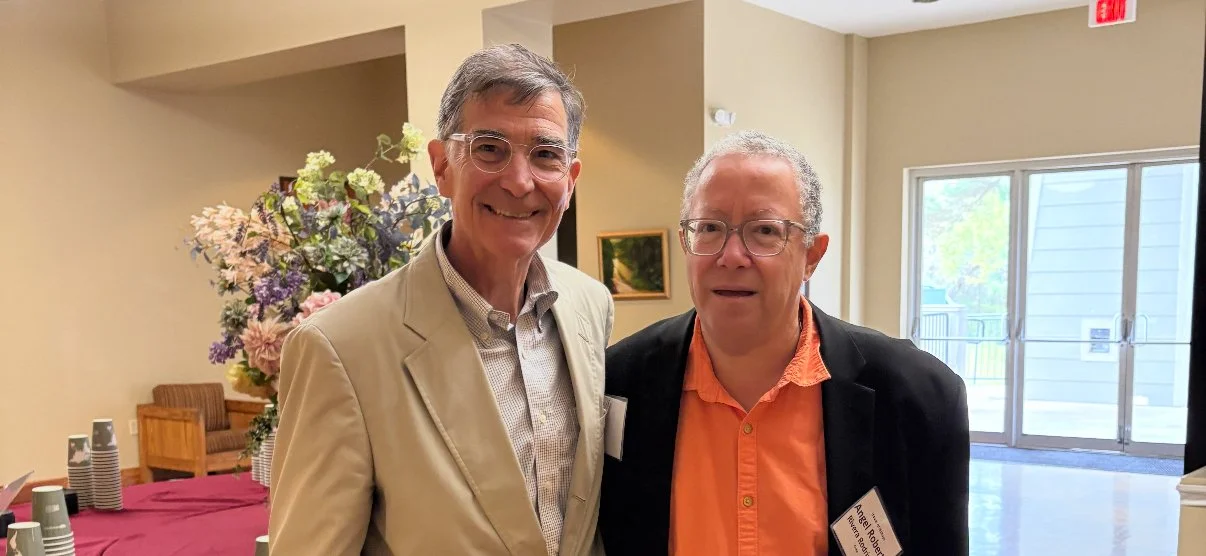
Bishop Rob and Bishop Angel, of Cuba, spend time together.
Report from Bishop Rob - House of Bishops Spring Meeting - March 17-25, 2026
It was a privilege for me to attend the spring gathering of the House of Bishops at Camp Allen in the Diocese of Texas. Though I always hate to leave my beloved Diocese of New Hampshire, I find the time enriching to be with my colleague bishops from the whole Episcopal Church, including from the dioceses in Latin America, Europe, and Taiwan.
By now a Word to the Church has been issued. Its intent is to offer a message of hope, unfailing in the Good News of Jesus Christ, even in times of crisis and discouragement. The new war in Iran—extending to the whole Middle East—the ongoing conflicts in Ukraine, Sudan, and other parts of the world weigh heavily on all of our hearts. Such suffering is a call for us all to pray, fervently, for efforts for a just and lasting peace. I am humbled by the work of my fellow bishops and their churches as they strain to hold together community in Christian fellowship even as forces of inhumanity toward immigrants are rampant and political rages foam.
We always come together in prayer. I have been part of a small but growing number of bishops who devote daily time on contemplation. We do this because as our world experiences such chaos, disorientation, and division, and even war, it is essential that Christians, especially Christian leaders, stay rooted in the awareness of God’s enduring, loving, and life-giving presence in the Incarnate, Crucified and Risen Jesus. Any word or action that is not rooted in prayer is, as Paul says, like a noisy gong to a clanging cymbal. I believe that the tenor of our discussions during the more business-oriented sessions of the House has been more open to deep listening and respect because of the critical mass of bishops who practice contemplative prayer, even those who consider themselves more activist on certain issues.
We spent much of our time discussing the state of theological education, particularly for the raising up of priests in our Church. The landscape of traditional seminary training has shifted significantly in the past 15-20 years. Our denomination has gone from relying on eleven 3-year residential and very expensive seminaries to something like seven, and each of those offering paths that are more accessible to postulants for Holy Orders in local settings, such as rural New England. Much of the changes in education have been driven by economic and demographic forces. The bishops’ discussion of these trends was much overdue. It was so confirming to me to see how our establishment of the School for Ministry, for laity, deacons and priests is something that is becoming more and more accepted and even normative in the wider church. As I spoke with bishops from Ecuador, Columbia, Puerto Rico, the Dominican Republic, Cuba, Massachusetts and Pittsburgh, I was heartened to learn how we are all facing similar challenges in the urgent need to raise up new ministers of the gospel. New Hampshire’s hybrid model is something looked to and admired by such different settings in the Episcopal Church.
We also heard of Presiding Bishop Sean Rowe’s diligent efforts to reform and reshape the organizational structure of the Episcopal Church in a way that supports evangelism, church planting, and redevelopment. There are significant and overdue changes being contemplated, about which we will hear in the coming months. This support for church renewal is of keen interest to us in New Hampshire as we initiate new missions in Manchester, Claremont, Portsmouth, and more in the coming years. This is so important to consider and welcome as demographic models predict a movement northward of the U.S. population in the coming decades. We have been praying for young adults and families for years. I pray that the spiritual and organization work we have done in our Diocese in recent years has helped us prepare for the growth that, God willing, is coming our way.
We discussed proposals in the wider Anglican communion that seek to deepen and further relationships with other provinces of the Church where relationships have been strained and in disrepair for a variety of reasons. The Nairobi-Cairo Proposals are fascinating to read because they imagine a church that is seeking ways to be in communion, and defining what communion means, in an era when the long-term trend for churches, religions, indeed almost every institution in society is toward greater splintering. Though the bishops are, in my view, rightly cautious about the proposals, it is encouraging to think of the many who continue to do the hard and sacred work of true reconciliation across serious differences of practice.
I was so grateful to hear a fulsome presentation from Bishop Ann Ritonia, Bishop Suffragan for the Armed Forces and Federal Ministries. Our church’s work to provide pastoral care and accompaniment to chaplains in the military, federal prisons and hospitals is truly essential, especially when so many of these chaplains encounter tremendous moral, spiritual, and physical trauma. I am grateful for Bishop Ann’s witness to both the gospel of Jesus Christ AND the U.S Constitution’s protection against the incursion of governmental establishment of religion of any kind.
Finally, the return home through a Houston airport stressed with dramatically fewer TSA agents and many more ICE agents felt like being in a country that has changed. As I walked through the labyrinth paths to the security check points, along with thousands of others, I thought of the many pilgrims throughout millennia who have walked the Way of the Cross in Jerusalem, recalling the path the Jesus took from his entry into that City, to his actions in the Temple, to his Trial, his Crucifixion, his burial and his Rising.
I hope that wherever your journey and observances this coming Holy Week takes you, you may know how Jesus Christ walks alongside you, sharing your hopes, your joys, and the depths of your sorrows.
He will raise us all in peace and glory.
Yours in the Risen Christ,
+Rob
Easter Message 2016: Out of Error, Into Truth
Easter 2016
The problem that every preacher has when approaching Easter is that the event it celebrates is simply too big, too meaningful, too life altering, too world-changing for words. Every attempt to condense the meaning of the Resurrection into a 10-15 minute homily always makes us feel so inadequate and futile. To borrow a poet’s phrase, each of our attempts to describe the mystery of Jesus’ rising from the dead is a “raid against the inarticulate.”
But we try anyway. Once more we go, into the breaches of our rationality, our sense making. Once more into the Garden of Joseph of Arimathea, where are face the puzzlement of the Empty Tomb, once more on the road to Emmaeus, once more onto the beach where the risen Jesus has prepared breakfast for us. We try anyway because we need to share the message, the Good News. It’s as though there is a force of hope within the hardness and coldness of hearts that can’t resist sharing hope, even in the face of hopelessness and terror.
We’ve been drowning in terrible news recently. The most recent is the horrific acts of terror in Brussels, the heart of the European Union, in the name of a twisted and hate-filled distortion of Islam. Closer to home, in 2015 over 400 of our neighbors in New Hampshire died to drug overdoses, and its very likely that this year will see even more fall victim to drug deaths. The world where hopelessness, desperation, violence in word and deed seem to be reign, our world, is the same world where God has shown up in Jesus. It’s the same world where Jesus is born and is baptized. Our fractured and frenzied world is the same world where Jesus heals, teaches, is ridiculed by frightened authorities, where he drives out demons and evil spirits from tortured minds, where he talks with outcasts, and makes friends with feared foreigners. It’s this world where Jesus is among us, this world where Jesus is still being crucified, is suffering, longing to hold all human kind, all creation in an embrace of love that can change us by joining us to none other than God.
Jesus is dying along with us, and Jesus is descending into the hell of our world and our histories to rescue us, and grabbing each of us by the wrist so that we won’t get lost. Jesus is taking us out of the tombs of our sins, our fear, even our deaths, to new life.
This is news that I believe, news that I seek to throw my heart into. This is the extravagantly good news that I still believe, despite all evidence to the contrary, will change the world. It starts with you, and it starts with me.
The earliest witnesses to the resurrection were women like Mary Magdalene, who had no standing or legal status in the world of their day. And yet, through their word, the world was turned upside down. As we go into the Episcopal Churches of New Hampshire, this Easter weekend, I hope your vision of the world will also be turned upside down, so that you’ll literally taste and see that God in the Risen Jesus is bringing us “out of error into truth, out of sin into righteousness, out of death into life.”
May the God of Hope fill you will all joy and peace in believing, so that you may abound in hope by the power of the Holy Spirit.
--The Rt. Rev. A. Robert Hirschfeld
Bishop, Episcopal Church of New Hampshire
Watch a Video of Bishop Rob's Easter Message 2016 HERE.
A Pastoral Letter from Bishop Hirschfeld and the House of Bishops
Dear Brothers and Sisters in Christ,
At our spring meeting of the House of Bishops, I joined with several of my fellow bishops in prayers of lament and distress at the increasingly reckless rhetoric, and the violence that it is provoking, in this present political season. A result of our prayers was a statement that the Bishops unanimously endorsed as a statement of the "Mind of the House." This statement, entitled, "A Word to the Church" is below.
This statement should be considered as a Pastoral Letter from the Bishops, and as such, the clergy of the Church of New Hampshire are instructed to make this available to our congregations and people as soon as possible.
The statement, in its content and brevity, would be appropriate to be read from the pulpit on either Palm Sunday or Good Friday as we lead our people in the contemplation of the collision of powers, worldly and divine, that culminates on the Cross, and leads ultimately to the Empty Tomb.
May God lead this nation into the ways of God's truth, justice, and peace.
Yours Faithfully in the Sovereign Lord Jesus Christ,
+Rob
The Rt. Rev. A. Robert Hirschfeld
Bishop
Episcopal Church of New Hampshire
Episcopal Bishops Issue A Word to the Church
"We reject the idolatrous notion that we can ensure the safety of some
by sacrificing the hopes of others."
The House of Bishops of The Episcopal Church, meeting in retreat, unanimously approved the following Word To The Church:
A Word to the Church
Holy Week 2016
"We reject the idolatrous notion that we can ensure the safety of some by sacrificing the hopes of others."
On Good Friday the ruling political forces of the day tortured and executed an innocent man. They sacrificed the weak and the blameless to protect their own status and power. On the third day Jesus was raised from the dead, revealing not only their injustice but also unmasking the lie that might makes right.
In a country still living under the shadow of the lynching tree, we are troubled by the violent forces being released by this season's political rhetoric. Americans are turning against their neighbors, particularly those on the margins of society. They seek to secure their own safety and security at the expense of others. There is legitimate reason to fear where this rhetoric and the actions arising from it might take us.
In this moment, we resemble God's children wandering in the wilderness. We, like they, are struggling to find our way. They turned from following God and worshiped a golden calf constructed from their own wealth. The current rhetoric is leading us to construct a modern false idol out of power and privilege. We reject the idolatrous notion that we can ensure the safety of some by sacrificing the hopes of others. No matter where we fall on the political spectrum, we must respect the dignity of every human being and we must seek the common good above all else.
We call for prayer for our country that a spirit of reconciliation will prevail and we will not betray our true selves.
The Episcopal Church House of Bishops met in retreat March 11 - 15 at Camp Allen Conference Center in Navasota, TX.
To read this on the web or to share a link:
Episcopal Bishops Issue A Word to the Church
Suspend the Death Penalty in NH--The Bishop's Statement
NOTE: Senate Bill 463, in the NH Legislature, proposes to suspend the implementation of the death penalty until it can be ensured that it is not being imposed on innocent people. The NH State Senate will debate and vote on SB 463 on Thursday, March 3, 2016. The following is Bishop Hirschfeld's statement, shared as a Letter to the Editor for NH newspapers:
As the Senate deliberates SB 463, we can reasonably expect its members to consider carefully the strong reasons for the suspension of the Death Penalty in New Hampshire. These reasons range from capital punishment’s limited value as a deterrent to its exorbitant expense to the state in legal appeals to the many moral and religious proscriptions against the state taking human life. All of the arguments against state-sponsored homicide are gaining traction across our nation, indeed, throughout the world, as more and more states and nations are suspending, if not outright eliminating, its practice.
Christians who observe Lent are moving closer to Good Friday, the solemn day when we contemplate, among other things, the futility of a public execution to accomplish its supporters’ intended and short-sighted goals. The Christian convert Simone Weil, studying violence during the one of the most blood-soaked decades of the twentieth century, wrote: “Without room for reflection there is also no room for prudence and justice.”
Put in this context, SB463 is about more than the death penalty, more than a request to ensure ample room for reflection before making the only decision that cannot be revoked. As well, this bill is a call to reclaim eroding civic dignity in a time of rampant and impetuous rage that is infecting and damaging the body of our society. It is a call for civic restraint and increased protection from the rage-fueled impulsiveness that threatens to destroy the soul of this great state and nation.
Three Temptations—Three Lies, A Lenten Reflection
Three Temptations—Three Lies
This First Sunday in Lent we’ll read the passage from the fourth chapter of Luke where Jesus withstands three trials from Satan. The temptations come to Jesus as Three Big Lies.
Here they are:
- You do not have enough.
- You are worthless in the eyes of anyone and everyone.
- Your faith won’t save you or help you.
It might take some explaining to show how we get from the story in Scripture to these Three Big Lies—it’s taken me over fifty years of striving to walk with Jesus through these Lenten Wildernesses to get here-- but I can assure you, these are lies we seem always to contend against.
The lies are vain attempts to divide us (the word devil means “the divider”) from a God who, in Jesus, tells us three Truths.
Here they are:
- God gives us plenty enough. So much that there’s plenty for everybody. Everybody.
- God sees us, made in God’s image, as already full of beauty and glory.
- Worldly fame, power, glory are counterfeit. God, in the Resurrected Jesus, will pluck us from even death.
Jesus, filled with the Spirit, refuses to accept any of the lies and chooses to hold fast to the truths. During his life and ministry he will himself become bread for the life of the world, he will display a power and a glory that make puny the powers of this world, and he will do that by utterly trusting in the protection of God’s love, that is even stronger than death.
This Lent, let’s walk together in the light of God’s truth, encouraging each other when we are tempted to see ourselves as less than God’s children, and abiding in the Spirit that empowers us to walk with Jesus and serve boldly and fearlessly in his name.
Let’s stay close to Jesus this Lent, friends!
+Rob
The Right Reverend A. Robert Hirschfeld, Bishop, Episcopal Church of NH
A Christmas Message from Bishop Hirschfeld
Words matter.
They can create or destroy possibilities. Human beings, perhaps unique in all earthly creation, have access to a linguistic power that can influence, for good or ill, our relationship with each other, with other communities, with ourselves, and with God.
Dear Sisters and Brothers in Christ,
Words matter.
They can create or destroy possibilities. Human beings, perhaps unique in all earthly creation, have access to a linguistic power that can influence, for good or ill, our relationship with each other, with other communities, with ourselves, and with God.
Nowadays, in the digital age, words have a concentrated impact on minds that feel cut off and disenfranchised from healthy, peaceful communities. Our society is now reckoning with the capacity of hate-filled organizations to use social media to attract and “radicalize” vulnerable souls to commit acts of violence in the name of God. The term “radicalize” itself might apply to persons of any faith, including those who claim to follow Jesus.
In the aftermath of the terrorist attacks of San Bernardino and Paris, and the over 350 mass shootings that have occurred in the current calendar year, we might be right to wonder if it matters whether a person was killed as a result of an organized cult of death (such as the hypocritical ISIS which does not live by the word of its professed sacred text), or a deranged person with an assault weapon. Does the choice between the words “terrorist” and “mass murderer” make any difference to the dead or the grieving? It is all sin. That’s the word, rarely used, that our faith teaches about how we deface the image of God in ourselves and in our neighbor.
As we approach Christmas, I urge us to pray words that open and create a new reality that overcomes sin in all its forms. Jesus, The Word-made-flesh has entered into our world in order to usher in possibilities that all people can be reconciled to God and each other, even now, in this time of trial, despair, and fear.
As we gather around the Nativity scenes, Christmas trees, candles, and garlanded tables with family and friends this season, I invite us to pray with renewed urgency. Prayer is how we can hear again the deeper story, the truer news, of God’s tidings of hope and peace. The passage that draws me close to God these days comes from the prophet Isaiah, who lived in times such as ours, full of terror and threat, both domestic and foreign. He dreamed of a time when God would intervene, and his dream came true. It will again. Indeed, it already has in Jesus:
Arise, shine for your light has come,
and the glory of the Lord has dawned upon you.
For behold, darkness covers the land;
deep gloom enshrouds the peoples.
But over you the Lord will rise,
and his glory will appear upon you.
Nations will stream to its light,
and kings to the brightness of your dawning.
Your gates will always be open;
by day or night they will never be shut.
They will call you, The City of the Lord,
The Zion of the Holy One of the Lord.
Violence will no more be heard in your land,
ruin or destruction within your borders.
You will call your walls Salvation,
and all your portals, Praise.
The sun will no more be your light by day;
by night you will not need the brightness of the moon.
The Lord will be your everlasting light,
and your God will be your glory. (Isaiah 60)
There is so much in this song that contradicts the strident words of our times: violence, hatred, terror. As our earthly leaders struggle to come up with domestic and foreign strategies for the security of our nation and for the world, it’s critical for people of faith to be reminded of what God’s vision for humanity is. So I urge my cherished Episcopal Church of New Hampshire to pray this song of Isaiah in our morning, noonday, and nighttime prayers. May we commit it to our hearts; without doubt, Jesus knew it by heart. May this prayer strengthen our faith, enlighten our thoughts, enkindle our love, and direct our actions. May the Word-made-flesh speak in us and transform our words and actions into a shining light in these darkened days.
Words matter. And the Word-made-flesh, our flesh, all flesh, makes all the difference.
May your Advent be holy and your Christmas full of light.
+Rob

Bishop’s Address of the 213th Convention of the Episcopal Church of NH, 2015
I would like to begin my address by introducing the 213th Annual Convention to our new Presiding Bishop, Michael Bruce Curry, by video presentation.
By introducing Presiding Bishop Curry, I am also introducing the Episcopal Church of New Hampshire to ourselves and to our mission as members of the Episcopal branch of the Jesus Movement.
Every time we share communion, we restore our identity as members of the Risen Christ, an identity given to us when we are buried with Christ and raised to new life in him through baptism. It is fitting that, as we recommit ourselves to Christian service as a Church, we renew the promises made at baptism. There’s a prayer that we offer at every baptism, and I now make it a practice not just to pray it myself, but to invite the whole congregation to join in its petition. Please join me.
Heavenly Father, we thank you that by water and the Holy
Spirit you have bestowed upon these your servants the
forgiveness of sin, and have raised them to the new life of
grace. Sustain them, O Lord, in your Holy Spirit. Give them
an inquiring and discerning heart, the courage to will and to
persevere, a spirit to know and to love you, and the gift of joy
and wonder in all your works. Amen.
(Book of Common Prayer, p. 308)
Now, we could pray this only for our own kids, the ones who come into our church, our doors. But I am convinced that Jesus would tell us that that’s not enough. As God spoke to God’s people through the prophet Isaiah, so God urges us:
It is too light a thing that you should be my servant
to raise up the tribes of Jacob
and to restore the survivors of Israel:
I will give you as a light to the nations,
that my salvation may reach to the ends of the earth.
(Isaiah 49:6)
In other words, it’s not enough for us to be fixated on the life of the Church and on those who make up our church directories and membership lists. The Church is here as a light to the world, a light to reach the despairing and hopeless and distressed places right here in New Hampshire.
For decades we have been overly concerned with things too light, too easy: the survival of the local parish church, the institutional stability of the church in the face of the culture wars, sparked by debates about human sexuality and gender. There was a season for this.
In the meantime, more and more of the youth of our communities know nothing of the love of God in Jesus. More of our children are caught up in a culture that is becoming dangerously sexualized, unhealthy, violent, and spiritually deadening.
Visiting our churches on any given Sunday, I see fewer children or teenagers sharing stories with me about where they encountered God in school or on a service trip or on an athletic field or anywhere else. As if this is not enough, the agonizing trial this summer in Concord of a recent St. Paul’s School graduate reminded us all how perilous a world it is for our youth.
The challenges that face children in New Hampshire are of critical concern to me, and it and it pains me deeply to see how God’s children are growing up in an increasingly unsteady and confusing world.
But today we have good news. We have what it takes to bring Gospel light and hope into our communities. As part of the Jesus Movement, we are called to be apostles, which simply means to be sent in Jesus’ name. As apostles, we get to bring the loving concern of Jesus to the youth and at-risk families in our own Galilee, here in the Granite State.
We get to look for those places where God is already at work, showing up to protect, nourish, guide, mentor, teach, and raise youth who are falling off the cliff of a culture that breeds violence, addiction, fear, and hatred toward the neighbor. The call is to GO, to be sent, pushed out of our comfort zone, to wear down the soles of our shoes, to put on our coats and parkas and windbreakers and get out to the playing fields, hockey rinks, dance studios, and classrooms, and cafeterias where all our kids need us.
That’s what it means to be apostolic church, a church that is eager to share in God’s mission rather than waiting for people to come through our intimidating red doors. Our new presiding bishop, Michael Curry, told us at his Installation this week that The Episcopal Church is now committed to two of the hardest things -- not light things or easy things, but essential things.
We are to be about evangelism and reconciliation. We are to be about bearing good news and about bringing together those who have been divided by race, class, nationality, gender, or religion. What the scissor graphs this morning showed as cutting us into divided classes, we can help heal by being apostles.
Let me be blunt. Lamenting over the lost youth in our churches is not apostolic. Stressing over just the right Sunday school curriculum in the hopes that it will be the magic formula to bring in all those kids in town -- along with their pledge-making parents -- is not apostolic. We have for too long bought into the myth that if we had just the right Sunday school teacher, or youth director, the kids would just pour into our churches, like following the Pied Piper of Hamlet.
I’ve seen the annual reports of our churches, and I can tell you it’s a myth. It doesn’t bear up to close scrutiny. And, when we hold on to such myths, such illusions, while expecting different results, we can either be diagnosed as delusional, or be accused of the age-old sin of sloth. Either way, we are not being apostolic. Not being sent.
So here’s what we are called to do: Over the next year, we will establish a new, apostolic Commission for Youth. The Commission’s charter will be to determine the ways our churches are furthering the mission of God to give the children and youth “inquiring and discerning hearts, the courage to will and to persevere, a spirit to know and to love God, and the gift of joy and wonder in all God’s works.”
The Commission will be charged to review ways in which each of our convocations or parishes will partner with others in an effort that will bridge the gap between those kids who come to church and those who don’t; between those who can get supplemental tutoring for their SAT’s and those who don’t; between those who can afford to go to private schools and those who don’t. The question, “Why aren’t kids coming to church anymore?” needs to be transformed by the waters of our baptism to “Why isn’t the Church where Our Kids are?”
To get this party for Our Kids started, I am requesting that this Convention approve the 2016 proposed budget, as Amended, which designates over $46,000 for youth and young adult ministry. Additionally, I am pleased to announce that, thanks to a generous donor who wishes to support the Jesus Movement here in New Hampshire, we will be able to make even more funds available in the near future.
By similar fundraising and budgeting, I want to make $100,000 available in the 2017 budget for after-school programs, mentorships, music and art schools that reach those kids that would otherwise be excluded from such opportunities. (Just to remind us, the total funding in this area of our mission in 2015 was $29,000, only $5,000 of that was for children).
More effective than hiring another staff position in Diocesan House, a Commission will actually go out to see the way that godly people, whether Episcopal or not, are already furthering God’s mission among all our children and then come back to seek the prayers and the support of the Church. That’s the one, holy, apostolic church that we believe in.
We heard of several ways this morning of how we can partner with schools, agencies, and organizations that are already doing the mission of God.
What if we heard Jesus speak to you right now, right here in the Grappone Center in Concord, telling us this: “Your parochial report may tell you that you have less than a dozen kids in your church. But I say unto you, you have several hundreds in your parish, the region that falls within the influence of your church. I am already out there among them,” says, Jesus. “I’m waiting for you. When are you going to go out and meet me out there, in the Galilees of New Hampshire?”
Epiphany Church, Newport heard the voice of Jesus say that. They met with the principal of the Middle School across the street. Many parents have to get to work early in the morning and have to leave their kids at the school, but the school can’t open early enough to in the day. So members of the newly formed team ministry of St. Andrew’s, New London and Epiphany get up way early, just like the first apostles did at the empty tomb on the first Easter. They welcome children before the school hours, keep them safe, get to know who they are and to hear their stories. Apostolic.
St. Paul’s, Lancaster and St. Mark’s, Groveton, Trinity, Claremont, Grace, East Concord, all feed children who would otherwise go hungry during school or during the weekend when school lunch is not available. St.John’s, Portsmouth, and Union, Claremont, St. John’s, Walpole, St. Andrew’s, Hopkinton all seek to strengthen children through the healthy discipline of art or music. St. Andrew’s, Manchester invites students from West Manchester High School to partner with them in feeding the hungry and they offer a scholarship to a college bound senior committed to a life of service.
That’s being apostolic. These are Our Kids, and God’s mission.
The Gospel says, “Go!” and we are going.
Apostolic evangelism is not about “come and see” as much as it is about “go and listen.” Go and be formed and shaped by the people we encounter in the parks where addicts hang out, on the soccer fields where kids are striving, in the homeless shelters and soup kitchens, on the committees for social justice and environmental stewardship, in our prisons where art classes and bible studies are offered, in the halls of the State House when we advocate against the death penalty and work for gun safety.
Wherever we go is a chance to find Jesus and join God’s mission. Go. The model for evangelism that Jesus showed wasn’t one that would have us hunker down in safe church bunkers until we feel adequately prepared for mission. He said, “Go, seek me in Galilee,” which is to say, outside the religious establishment, among the secular, the spiritual but non-religious, and among those whose religion does not look like our own.
The presence of the Resurrected Jesus presence is not weak. It is powerful, stronger than death. It embraces all. We learn about and become like Jesus in the seeking, in the serving, in the listening. So, here are some examples of how the Episcopal Church of New Hampshire is poised for a new age of mission:
Thanks to the dedicated and courageous efforts of Grace Church, East Concord, they have been endorsed as the first Episcopal Service Corps Center in northern New England, choosing the name of Assisi House after St. Francis of Assisi.
Assisi House will host five young adults in an intentional residential community of prayer and service. The interns will be sent to serve in social service agencies that address issues such as poverty, care for the creation, and homelessness as they practice showing up, telling stories, splashing water, sharing food and witnessing how God surprises.
With the ambitious apostolic vision of a little seasonal chapel on the Seacoast, we are actively exploring building a community of women who seek freedom from the shackles of human trafficking, domestic violence, and sexual exploitation. Based on the pioneering work of the Rev. Becca Stevens and her sisters at the Magdalene Project and Thistle Farm in Nashville, we are gathering funds and energy to proclaim, “love heals” and bring release to the captives and good news to the oppressed. That same chapel is also setting aside funds for a new curate position, being envisioned as we speak, to do critical mission work.
Last year, in faith of a promised but unforeseen future, the Convention voted to allow Trinity Church, Tilton to close. This happened in February.
Since then we have established close communication with leaders in that town who are eager and excited for this building to be an economic, social and spiritual center in their community. We will soon be reviewing proposals from town leaders as, together, we envision this property as a centerpiece of the downtown.
Likewise, I am seriously considering the establishment of a new Episcopal worshipping community in Franklin or Tilton. The Spirit of Christ is urging us to go to this suffering part of our State and find Jesus. One of the windows of the former St. Jude’s Church depicts a phoenix rising from the ashes of desolation. The phoenix has become a sign of crucifixion, resurrection and stored hope. We are being guided by the light of Christ to bring hope to those in the grips of despair, addiction, poverty and who feel forgotten by the Church.
To be apostolic means that we will strive to establish up to three new missions a year…that’s right, three new missions every year, where God’s people, expelled from the waters of our baptism, will be sent out in mission to meet the risen Christ. Whether on the streets of Tilton or Manchester, on the ships in the port of Portsmouth, in the schools of the Groveton and Lancaster, in the prisons of Berlin or Goffstown, God’s mission is happening already, we just have to go after it.
Here’s the thing: when we do these apostolic things, I promise you, we will not be siphoning off energy or resources from the congregations. In fact, our churches will be reenergized and renewed. Every church that is involved in its community is enlivened, just like the most robust of the vines that insinuate and push out of the limit of the pot which can both nourish but limit its growth.
The churches that are growing in that way, you know who you are. The parishes that are not actively involved with the community are suffering from a kind of fetid claustrophobic enmeshment. And you know who you are. The good news is that the Jesus Movement seeks to push you out of the tomb and unbind you to show the glory of God.
To paraphrase Jesus:
“Go. Make disciple of all the nations, imbuing them with the water of life in the name of the God whose love draws all into true freedom and life: the Creator, Christ, and Holy Spirit, teaching them to obey everything that I have commanded you. And remember, I will be with you always to the end of the age.” (Matthew 28:19-20)
Thank you.
A Statement from Bishop Hirschfeld following the Oregon shooting
“In the wake of what has now become an endemic part of American life—a mass shooting in a peaceful community of personal growth and learning—I hope the members of the Episcopal Church of New Hampshire are not lulled into a spiritual torpor. In our prayers may the Holy Spirit pierce our numbness with sharp empathy for those who mourn the dead and for those who are wounded in Roseburg, Oregon. In our actions, may God lead us to the courage of Jesus who faced down the powers of dominating violence, not with more violence, but with death-destroying love shown on the Cross.
Baptized members of the risen Body of Christ are called to resist the temptation of allowing the heinous actions of a distorted soul to make us more violent. Christians who advocate to take up more weapons in reaction to these acts of evil betray the meaning of our having already triumphed over death in our baptism. Fear is not a Christian virtue or habit of being, and yet, tragically, we continually cower in the face of those who equate unlimited accessibility to guns with the way of Jesus. May God lead us through the wounds of these horrible events to a place of deeper trust in God and not the proliferation of deadly weapons.”
The Rt. Rev. A. Robert Hirschfeld, Bishop, The Episcopal Church of New Hampshire, 10/2/15
What Would Jesus Do About the Refugee Crisis?
A week ago in Church, we read again of how Jesus travelled outside of his home territory into the Roman province of Syria, more specifically the region of the old cities of Tyre and Sidon. There, He encounters a person of a different ethnicity, religion, gender, and probably even race, than his own.
The story of the “Syrophoenician woman” of Mark’s Gospel provides us a clear and irrefutable response to the provocative question, “What would Jesus do?” When faced with the desperate need and the urgent appeal of a stranger--a person who can claim no cultural or national affinity with Himself--Jesus allows Himself to be moved. Even if he felt initially resistant to helping the Gentile, or “pagan,” he allows his own heart to be opened to feel compassion for the plight of this unnamed foreign woman and her suffering daughter. What would Jesus do? He would allow his own privilege and allegiance to give way to the suffering of the one who humbled herself, asking for mercy.
Also a week ago, we also began to receive the persistent accounts of this woman’s own descendants, Syrians from the same region of the world, who seek to be relieved from the unspeakable violence of the civil war that rends apart that country. We hear of the scores of refugees from the Middle East, including young children, being left for dead in an overheated truck in Austria. We also saw the photograph of the lifeless body of a three-year-old boy, Aylan Kurdi, washed up in a Turkish beach having drowned, along with his mother and five year old brother, as they fled the fighting in their Syrian hometown in the hopes of eventually finding safety with family in Canada.
It’s really not a question of what would Jesus do, as though Jesus were absent now and available to us only as a matter of speculation. It’s a question of what the Risen Body of Jesus Christ, the Church, is doing and is capable of doing, right now, among us. The Bishop of Rome, Pope Francis, has issued a call for every Roman Catholic parish in Europe to provide refuge and sanctuary for at least one refugee household. As I have heard from several congregations now in New Hampshire, I am confident that were we located there, most of our congregations would answer such a call with compassion and hospitality. As the U.S. State Department considers how to bring refugees to communities such as Manchester, Concord and Laconia, we can prepare ourselves to be open as Jesus was, and still is, open to the Syrophoenician woman, who may be coming to New Hampshire.
In the meantime, we pray and work for peace in this and all parts of the world terrorized by violence and war. We pray for those most vulnerable of populations, especially women and girls who are targets of sexual violence perennially used as a weapon of warfare. And, we give of our substance, not just the crumbs that fall from the table, of our own relative abundance.
To learn more about the causes and the extent of this, the worse refugee crisis since World War II, you can go to website for the United Nations High Commissioner on Refugees (UNHCR), which maintains a web portal for aid groups in the region to share information and coordinate response: http://data.unhcr.org/syrianrefugees/regional.php.
“Refugees From Syria, a Cultural Orientation Backgrounder,” offers provides more information about the unique experiences, trauma, and needs of the Syrian refugee population: http://www.culturalorientation.net/learning/backgrounders.
Or, watch The Episcopal Migration Ministries’ video on “Syria’s Refugees: The Episcopal Church’s Response:” https://vimeo.com/114033002.
President Obama announced this week that while the administration was continuing to examine responses to a refugee crisis, the United States will raise the number of Syrian refugees admitted to at least 10,000 in the new fiscal year beginning in October, from fewer than 2,000 in the current fiscal year. Learn more at https://www.whitehouse.gov/the-press-office/2013/09/24/fact-sheet-us-humanitarian-assistance-response-syrian-crisis.
To provide meaningful relief to those affected, I encourage our parishes and people to make contributions or learn more about these partners, who are equipped to help:
Episcopal Migration Ministries
Episcopal Migration Ministries is The Episcopal Church’s foremost response to refugee crises. Working in partnership with offices and groups within the church as well as with governments and non-government organizations (NGOs), Episcopal Migration Ministries assures safe passage and provides vital services for thousands of refugee families upon their arrival in America: English language and cultural orientation classes, employment services, school enrollment, and initial assistance with housing and transportation. For each family, the goal is self-reliance and self-determination. Learn more at: http://www.episcopalchurch.org/page/episcopal-migration-ministries.
Episcopal Relief & Development
Episcopal Relief & Development is the compassionate response to human suffering in the world. Hearing God's call to seek and serve Christ in all persons and to respect the dignity of every human being, Episcopal Relief & Development serves to bring together the generosity of Episcopalians and others with the needs of the world. You can make a gift or learn more at https://www.episcopalrelief.org.
Welcoming America
Welcoming America is a national nonprofit that helps communities achieve prosperity by becoming more welcoming toward immigrants and all residents. National Welcoming Week is celebrated September 12-20. To find events in NH and across the US, visit: http://www.welcomingamerica.org
Ascentria Care Alliance
Ascentria is the local community service organization, which works most closely with the resettlement of refugees, serving their needs socially, spiritually and economically. Inspired by their faith-based heritage, Ascentria “envisions a world in which everyone can realize their fullest potential and share with others in need.” More at
The Missionary Society
The Domestic and Foreign Missionary Society of the Protestant Episcopal Church pools its members together to advocate for solutions to a variety of pressing issues, including domestic poverty, environmental protection and global justice. More at http://www.episcopalchurch.org/page/missionary-society.
Bulletin Insert for August Commemoration of Jonathan Daniels
Please download HERE a message from Bishop Hirschfeld and the Lessons appointed for use on the Feast of Jonathan Myrick Daniels, Seminarian and Witness for Civil Rights, 1965.