Easter Message from Bishop Rob — April 2026
Every year, a close reading of the same gospel, even if we’ve read it over a life-time, brings something fresh, something green, and new—something surprising. It may be very familiar and obvious, but the Holy Spirit wants us to notice it as though for the first time because we need to hear it for the first time. This year what springs up as though a new sunrise is the verse in John’s gospel, at the end of the Good Friday reading, when we hear these words:
Now there was a garden in the place where he was crucified, and in the garden, there was a new tomb in which no one had ever been laid.
To this day, in the Holy City of Jerusalem, the Church of the Holy Sepulchre is also known as the site of Calvary, Golgotha, the place of the crucifixion, where tradition tells us that a relic of the cross was uncovered AND it is also the place where Jesus was laid in an unused tomb. It’s from the tomb, of course, where God raised him from the dead. Execution and resurrection happen in the same small piece of real estate: the place of unimaginable suffering by human hands and hearts AND the site of the world changing triumph of life over death, love over fear, forgiveness over hatred. It is the place our savior expresses humankind’s deepest abandonment by God and humankind. And it is the site of recognition: of us recognizing Jesus and then the risen Jesus seeing us as a friend. It is the site of the most holy “both/and” which is our life in the Risen Christ.
Our Calvaries are legions. There are so many, too many, and too heartbreaking to list. We all know what they are. The effects of human sin and cruelty, done by us and to us, are all around. We see them. They burden and grieve us. Those crucifixions lead us to times of both despair and hope. They are the reason for our prayers, our seeking help from God and each other. They are the cause of our thirst for righteousness, our struggles to forgive, and our cries to be forgiven. The desolate Place of the Skull and the Garden of Resurrection are layered on top of each other. The suffering and death of bodies, of communities, of hope itself, occur in the same place, and with even more power where we meet Jesus’ Rising. From out of the depth of the Sepulchre, Jesus calls us each by name just as he called to Mary Magdalene on that first Easter morning.
May your Good Fridays, your scenes of deep loss and sorrow be converted into a glorious resurrection, a rising to life, to a love and a life that is stronger than death. What courageous joy that gives us, to know in our bones that nothing, not even death, or the fear of death, will separate us from the love of God in Jesus. May that love and life rise in our hearts this Easter, and may every day be Easter. Jesus Christ is Risen. Alleluia.
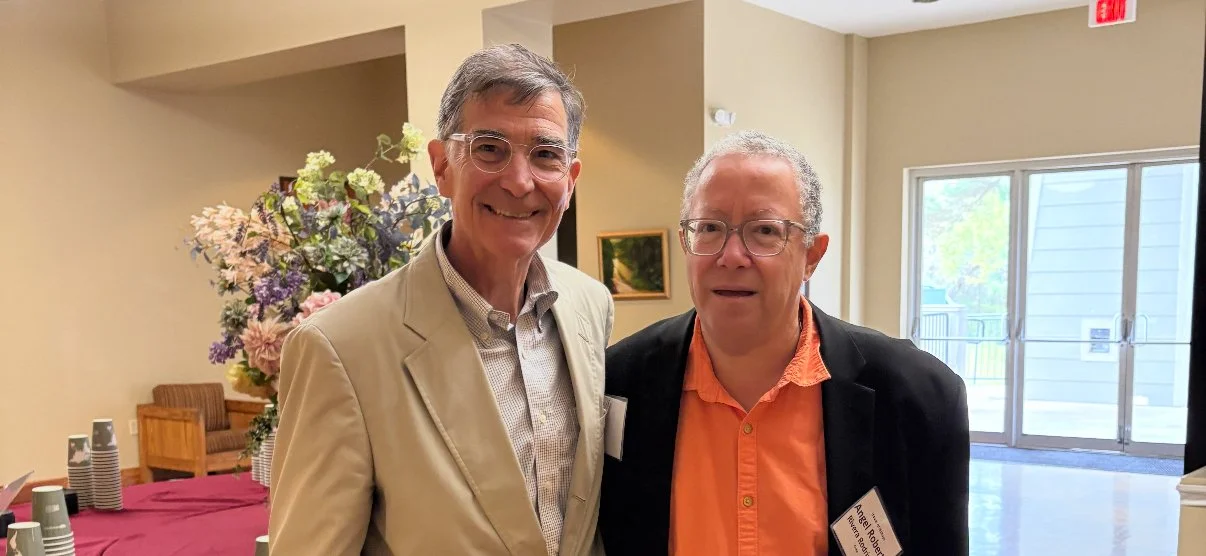
Bishop Rob and Bishop Angel, of Cuba, spend time together.
Report from Bishop Rob - House of Bishops Spring Meeting - March 17-25, 2026
It was a privilege for me to attend the spring gathering of the House of Bishops at Camp Allen in the Diocese of Texas. Though I always hate to leave my beloved Diocese of New Hampshire, I find the time enriching to be with my colleague bishops from the whole Episcopal Church, including from the dioceses in Latin America, Europe, and Taiwan.
By now a Word to the Church has been issued. Its intent is to offer a message of hope, unfailing in the Good News of Jesus Christ, even in times of crisis and discouragement. The new war in Iran—extending to the whole Middle East—the ongoing conflicts in Ukraine, Sudan, and other parts of the world weigh heavily on all of our hearts. Such suffering is a call for us all to pray, fervently, for efforts for a just and lasting peace. I am humbled by the work of my fellow bishops and their churches as they strain to hold together community in Christian fellowship even as forces of inhumanity toward immigrants are rampant and political rages foam.
We always come together in prayer. I have been part of a small but growing number of bishops who devote daily time on contemplation. We do this because as our world experiences such chaos, disorientation, and division, and even war, it is essential that Christians, especially Christian leaders, stay rooted in the awareness of God’s enduring, loving, and life-giving presence in the Incarnate, Crucified and Risen Jesus. Any word or action that is not rooted in prayer is, as Paul says, like a noisy gong to a clanging cymbal. I believe that the tenor of our discussions during the more business-oriented sessions of the House has been more open to deep listening and respect because of the critical mass of bishops who practice contemplative prayer, even those who consider themselves more activist on certain issues.
We spent much of our time discussing the state of theological education, particularly for the raising up of priests in our Church. The landscape of traditional seminary training has shifted significantly in the past 15-20 years. Our denomination has gone from relying on eleven 3-year residential and very expensive seminaries to something like seven, and each of those offering paths that are more accessible to postulants for Holy Orders in local settings, such as rural New England. Much of the changes in education have been driven by economic and demographic forces. The bishops’ discussion of these trends was much overdue. It was so confirming to me to see how our establishment of the School for Ministry, for laity, deacons and priests is something that is becoming more and more accepted and even normative in the wider church. As I spoke with bishops from Ecuador, Columbia, Puerto Rico, the Dominican Republic, Cuba, Massachusetts and Pittsburgh, I was heartened to learn how we are all facing similar challenges in the urgent need to raise up new ministers of the gospel. New Hampshire’s hybrid model is something looked to and admired by such different settings in the Episcopal Church.
We also heard of Presiding Bishop Sean Rowe’s diligent efforts to reform and reshape the organizational structure of the Episcopal Church in a way that supports evangelism, church planting, and redevelopment. There are significant and overdue changes being contemplated, about which we will hear in the coming months. This support for church renewal is of keen interest to us in New Hampshire as we initiate new missions in Manchester, Claremont, Portsmouth, and more in the coming years. This is so important to consider and welcome as demographic models predict a movement northward of the U.S. population in the coming decades. We have been praying for young adults and families for years. I pray that the spiritual and organization work we have done in our Diocese in recent years has helped us prepare for the growth that, God willing, is coming our way.
We discussed proposals in the wider Anglican communion that seek to deepen and further relationships with other provinces of the Church where relationships have been strained and in disrepair for a variety of reasons. The Nairobi-Cairo Proposals are fascinating to read because they imagine a church that is seeking ways to be in communion, and defining what communion means, in an era when the long-term trend for churches, religions, indeed almost every institution in society is toward greater splintering. Though the bishops are, in my view, rightly cautious about the proposals, it is encouraging to think of the many who continue to do the hard and sacred work of true reconciliation across serious differences of practice.
I was so grateful to hear a fulsome presentation from Bishop Ann Ritonia, Bishop Suffragan for the Armed Forces and Federal Ministries. Our church’s work to provide pastoral care and accompaniment to chaplains in the military, federal prisons and hospitals is truly essential, especially when so many of these chaplains encounter tremendous moral, spiritual, and physical trauma. I am grateful for Bishop Ann’s witness to both the gospel of Jesus Christ AND the U.S Constitution’s protection against the incursion of governmental establishment of religion of any kind.
Finally, the return home through a Houston airport stressed with dramatically fewer TSA agents and many more ICE agents felt like being in a country that has changed. As I walked through the labyrinth paths to the security check points, along with thousands of others, I thought of the many pilgrims throughout millennia who have walked the Way of the Cross in Jerusalem, recalling the path the Jesus took from his entry into that City, to his actions in the Temple, to his Trial, his Crucifixion, his burial and his Rising.
I hope that wherever your journey and observances this coming Holy Week takes you, you may know how Jesus Christ walks alongside you, sharing your hopes, your joys, and the depths of your sorrows.
He will raise us all in peace and glory.
Yours in the Risen Christ,
+Rob
A Lenten Message from Bishop Rob Hirschfeld
A message for Lent from Bishop Rob. Click on the video below to watch the message or click here for a transcript.
A Message for the Season of Epiphany from Bishop Rob
Click on the video link below to view an Epiphany season message from Bishop Rob.
To read the message, click here for a transcript.
2021 Advent Letter from Bishop Rob
Dear Friends in Christ,
We have now entered a season of waiting for small things, events that the world doesn’t notice or easily dismisses. An adolescent girl is paid a visit by a mysterious presence. The same woman visits an aging cousin who is also expecting, which causes her child to move inside her. Grown men have dreams and visions that lead them to alter their plans. A child is born in a barn. In the present day we sit in front of tiny replicas of a small family, surrounded by farm animals and shepherds…
Dear Friends in Christ,
We have now entered a season of waiting for small things, events that the world doesn’t notice or easily dismisses. An adolescent girl is paid a visit by a mysterious presence. The same woman visits an aging cousin who is also expecting, which causes her child to move inside her. Grown men have dreams and visions that lead them to alter their plans. A child is born in a barn. In the present day we sit in front of tiny replicas of a small family, surrounded by farm animals and shepherds. These figures, sitting silent on end-tables or mantles, are displayed not doing anything but coming alongside and watching, beholding a kind of wonder in the midst of longing, hope, and awe. All these are small things on the surface, not scenes that would matter much. They would not rate the nightly news, a front page, or a newsfeed. But the world is saved in precisely these seemingly insignificant moments.
Here in New Hampshire, we occupy a tiny corner of God’s realm. We are a small diocese of mostly very modest congregations. Most years, I travel to St. Timothy’s Chapel in Lost Nation before Christmas, a modest star in our diocesan constellation most Granite State Episcopalians are not familiar with. There, warmth radiates from a potbelly stove in the narrow middle aisle. Kerosene lamps fixed to tin shields reflect just enough light from the seasoned pine walls. A sole harpist accompanies the Lessons and Carols. It’s not King’s College, Cambridge, but rather a tiny cathedral. It’s almost as though the chapel is on the layout of the Lionel train set my father would set up around my childhood’s Christmas tree. Miniature. Yet God chooses the humble and the miniature for us to usher the great things of God’s ministry.
The 219th Diocesan Convention
At our recent Diocesan Convention, we heard a homily from the Rev. Katie Nakamura Rengers, who oversees New Episcopal Communities in Presiding Bishop Michael Curry’s office. She reported to us how we — in small, granitic New Hampshire — are developing a reputation for spreading the Good News among those who have not experienced it. We have worked hard to support our established smaller communities with able lay and ordained leadership, and we are a sign in distressed communities of how God chooses to accompany those whom the powers of this world leave behind or neglect. Our Convention explored how our Canons and Constitution might make more room for smaller assemblies of prayer, learning, and service to be established. For now, we call them “missional communities” and they include the Church of the Woods in Canterbury, the Episcopal Mission in Franklin, Epiphany in Newport, Christ the Way at St. Andrew’s in Manchester, and the Episcopal Digital Mission.
The stable in Bethlehem shows us that God chooses to save the world in the humblest of moments. Even our most prosperous churches cherish a closeness among their numbers — they seem to know that in order to be big, they must also practice the presence of God in smallness. I am so grateful to the leaders of our larger congregations who know that in order to nourish congregational vitality, they must attend to the smaller venues where God’s love is made manifest including small groups and foyers, Bible studies, prayer groups, Zoom meetings, and time spent over tables where faith is shared and nothing less than the hospitality of the Holy Trinity is made real.
Another highlight of Diocesan Convention was the video report by our Reconciliation Commission on conversations urged by the 2020 Convention around the ongoing and lingering effects of racism in our society. As has been widely reported, new state legislation deters, if not outright forbids, explicit discussions in our public schools of entrenched racist attitudes, white supremacy, and other modes of intentional and unintentional oppression of God’s children. We can take heart that so many members of our churches have participated in discussions in such programs as Sacred Ground or Be the Bridge. Why is this a matter of Christian faith? Our Risen Lord appeared through locked doors bearing the open wounds inflicted by the world’s hatred. In doing so, and by breathing a spirit of peace and forgiveness upon his fearful disciples — and by extension you and me — he empowers us to own the trauma of the past in order to be healed. I believe God calls us to these difficult yet saving conversations. It’s how we can together know God’s grace for the life of this broken, sin-sick world.
A further example of the small things making a great difference occurred during one of our Convention deliberations: considering changing our Canons to consolidate positions to streamline how the church conducts its business between our Conventions. The deliberation was so thoughtful and respectful, the points pro and con were all so reasonable and caringly stated, even delegates from the same congregation kindly disagreed! We acknowledged that there are some ways to improve our channels of communication and to share our governance. In a small but powerful way, we modeled how people can work through difference and how our bonds in Christ are strengthened. Thanks be to God, and to the delegates of our Convention!
Also at Convention I reported on an another development of the past year. This past summer the Bishop of Vermont, the Rt. Rev. Dr. Shannon MacVean-Brown announced a plan for their diocese to address head-on a dire financial reality. Both Bishop Thomas Brown of Maine and I have pledged our support and eagerness to collaborate in mission and organization. Such diocesan partnerships are already emerging in other parts of the Episcopal Church. There is tremendous opportunity for us to share services with Vermont and Maine. Doing so would strengthen our faith formation and ministry education opportunities, our advocacy for justice, peace and creation care, our communications, our financial services, and facilitate our Safe Church training. The bishops of Vermont and Maine and I now meet every two weeks and are eager to expanding the conversation to include leaders across Northern New England in the coming year. Let me be clear, we are not talking mergers or acquisitions here, each diocese has unique gifts and personalities. It is already exhilarating to see where small reaches across our borders can lead to a furthering of our purpose to live and serve with the love that is in Jesus.
From Deep Roots New Life
We have made some wise and rewarding investments in the past five years. We have made funds available for new missions (mentioned previously), established a School for Ministry that is now in its second year and broadening to include support for lay preaching and students from our neighboring dioceses, enhanced the funding to support newly ordained as curates and missioners so that we are assured of spirit-filled and gifted and competent leaders for the future, and we have made coaching available for clergy and lay leaders as they seek to grow in their capacity to lead in a time of tremendous change. Now is the time to make funding for these and other initiatives more stable and robust for the future.
We have begun to prepare for a new capital campaign: From Deep Roots New Life. The first capital campaign in over 30 years, the funds generated by From Deep Roots New Life will not go to brick-and-mortar endeavors we usually associate with such campaigns. Instead we will enhance the human and spiritual capital that is vital to our flourishing as followers of Jesus Christ. Funds will support the raising up of new leaders, both lay and ordained. It will support new small churches that will change lives and bring Good News to communities thought neglected. It will support more established congregations as they seek to undertake new ventures and experiments in mission.
I heartily invite you to accept the forthcoming invitations to participate in local gatherings to discuss and participate in this exciting project. I deeply believe that we are being guided by the Holy Spirit into this work for the life of the world. And God will work in us, with all our gifts, however large or small. That’s what God does.
Restructuring the Diocesan Staff
This year the diocesan staff team has seen a lot of change. In the last few months, we have said goodbye to my Executive Assistant Lynn Eaton, Office and Communications Coordinator AshleyJane Boots, and Communications Director Dave Deziel. At this time, I give special thanks for the ministry of the Rev. Canon Gail Avery, Canon for Transition and Community Engagement, who retires from diocesan work at the end of December. I am so grateful for all these colleagues with whom I have ministered during my tenure as Bishop.
I am thankful for the following diocesan staff members who have accepted my invitation to minister with me in new or expanded roles. Tina Pickering will serve as Canon to the Ordinary and will work full-time on ministry transitions, accompanying clergy and congregations from saying goodbye to each other, through discernment, to launching new ministry together, including new Episcopal communities. Tina will also serve as “Chief of Staff” at the diocesan office, supporting the employment and development of the diocesan staff. Benge Ambrogi will continue to serve as Chief Financial Officer while reducing his schedule from full time to 32 hours, as Canon Tina picks up the staff support role. Benge will continue to oversee finances, real estate, and mission resources, Trustee investments, and matters of governance and management. Gloria Gallant will continue as Director of Finance, administering our financial records, accounts, payroll and benefits, and offering her support and expertise to church leaders. Gloria plans to retire in 2022 and looks forward to onboarding a new staff accountant.
The Rev. Louise Howlett will expand her role to serve as Dean of Clergy, working in a halftime position to coordinate clergy formation and coaching, offer spiritual and pastoral support to clergy, lead “Fresh Start,” and facilitate communication between clergy, the Bishop and diocesan staff. The Rev. Kelly Sundberg Seaman will expand her role to serve as Dean of Formation, working full time to equip and encourage all the baptized with discernment and formation resources in partnership with the Commission on Ministry. She will continue to serve as Dean of the School for Ministry, and will lead the Safe Church program for the diocese.
The Rev. Alanna Van Antwerpen will serve as Officer for Community Engagement, coordinating the holy work of our commissions on reconciliation, earth care and educational equity. One new feature to this work will be to explore collaborations with our neighboring dioceses. Alanna will also continue to serve as Digital Missioner, offering digital worship, faith formation, and online community for the spiritually curious. The Rev. Kate Harmon Siberine will continue to serve as Missioner to Franklin as she plants a church community in the vibrant “Three Rivers” city.
Katie Clark will join diocesan staff as Director of Communications. Katie currently serves as Director of Communications in the diocese of Maine and will now serve both states. She will evaluate the communications resources of the diocese and direct our communications strategies (website, social media, communications management, media relations), and support the communications needs of our churches. Lisa Laughy has joined the staff as interim archivist. Lisa brings an extensive background in archives and digital content and will be making recommendations for our collection.
Shelli Gay will continue the work she began in April as the Bishop’s Executive Assistant. Shelli will also focus on coordinating the diocesan capital campaign and next year’s convention with Bishop Curry. Kathy Traynor, who joined our staff in August, will continue to serve as our Communications and Program Administrator, coordinating building and office systems, managing our database, and assisting with events and communications.
I began by speaking of the importance of paying attention to small things and find myself concluding with a heart bursting in awe for the powerful ways God multiplies and amplifies blessings among us. I pray that you have a like experience in this season of light and peace.
Gratefully Yours in Christ,
+Rob
A Reflection on the 20th Anniversary of 9/11
September 11, 2021 marks the 20th anniversary of a day that cannot be forgotten in American history. That horrible day has become unlike any other day in our shared history. The neat lines that demarcate days on the calendar dissolve, and the meaning of 9/11 now spill into an era that I believe we are still wrestling to understand fully.
September 11, 2021 marks the 20th anniversary of a day that cannot be forgotten in American history.
That horrible day has become unlike any other day in our shared history. The neat lines that demarcate days on the calendar dissolve, and the meaning of 9/11 now spill into an era that I believe we are still wrestling to understand fully. It was a day of senseless violence committed against citizens in this nation who were simply going about their business and lives, working, running errands, visiting loved ones, growing families, and enjoying the freedom that comes from believing they were safe.
It was also a day of countless acts of courage, compassion, and self-less giving for the sake of others. Hundreds of women and men, first responders, police officers, paramedics, and fire-fighters, threw themselves into harm’s way to save lives — only to have their own lives snuffed out by collapsing towers, falling debris, and then later the inhalation of air filled with toxins.
For a brief period afterward, we experienced a kind of solidarity that we have not since known. We had the empathy and support from peoples around the globe. It seemed that they felt that the deadly assaults were as assaults on the hopes of all humanity. But clearly that center of compassionate solidarity did not hold for long.
It’s hard not to notice how, since 9/11, our outward concern for our neighbors seems to have eroded. Our respect for institutions that sought to guide us, as flawed as they are, has collapsed in many places. We are less kind, more toxic, more callous toward people whose views or backgrounds differ from us. I wonder if the root of this unkindness is fear, fear that we are vulnerable to other acts of violence, fear of defenselessness, fear of weakness, fear of how being in an authentic relationship with those unlike us might change us.
At the heart of our Christian faith is the cross, the place where God chose to be weak in order to unmask the futility of the violent. On the Cross, Jesus Christ chose, quite literally, to open his sacred heart to the evil of this world so that when he rose from the dead, he would make weak all the powers and principalities of this world, those of empire, and even of religious self-righteousness who seek to condemn the children of God. God chose to be tread upon, freely deciding to set aside any privilege, power, worldly claim to use force so that human kind itself, in Jesus Christ, could instead rise out of the tomb. Once risen, Jesus then breathes peace, not revenge, on those who denied and abandoned him at his most needed hour.
For Christians it’s the Cross of Jesus that is an anchor of hope for turbulent times. The 13th century Franciscan theologian Bonaventure, writing in a time racked by political unrest and religious violence, said that the Cross is the medicine of the world. By that he meant to invite us to look not to the counterfeit and corrosive power of human violence, revenge, and hatred for our purpose and identity in this life, but to the life-giving presence of God, gloriously shown by Christ’s self-offering on the cross, for our strength, hope and inspiration in our dealings with one another — even as we seek justice for the victims of cruelty and brutality.
On this 20th anniversary of that horrible day, a day that has tragically become an era, I believe it is in the humility of Jesus that we will ever have hope of freeing this world from the fears that result in cruelty. With God’s help and God’s graces may we seek to bring healing to this beautiful and hurting world.
Faithfully yours,
The Rt. Rev. A. Robert Hirschfeld
Letter to NH House Education Committee against HB20
My name is Robert Hirschfeld. I am Bishop of the Episcopal Church of New Hampshire.
In my role as Bishop, I serve as President, ex officio, of the Boards of both the White Mountain
School and the Holderness School. Each of these are pr ivate schools with a long relationship
with the Episcopal Church. Each school was founded by one of my predecessors to provide
quality education to children of “more modest means” than those who were attending other
independent schools in the Granite State such as Phillips Exeter Academy and St. Paul’s School.
Read more HERE
Bishop Hirschfeld's Christmas Message to the Diocese
Bishop Hirschfeld’s Christmas Message can be found HERE.
Bishop Hirschfeld's Address to the 218th Annual Convention
Behold, I am doing a new thing,
do you not perceive it?
I will make a way in the wilderness
and rivers in the desert. Isaiah 43:19
Delivered via Zoom from All Angel’s Chapel, Diocesan House - November 14, 2020
Behold, I am doing a new thing,
do you not perceive it?
I will make a way in the wilderness
and rivers in the desert. Isaiah 43:19
Usually we see our Annual Convention as a time to tout accomplishments and share our goals for the year ahead. In these addresses, I’ve striven to provide encouragement, a spiritual boost, and clarity of vision that sets a direction for the time ahead. This year is both no different and completely different.
We find ourselves in 2020 in a strange and painful place. Who would have thought after the celebration we shared with the North Country just 12 months ago, we would be here? Gathered by a technology — Zoom — that hardly any of us had even heard of a year ago because of a deadly pandemic — no, a second wave of a pandemic that has infected 12,000 persons and has claimed 500 lives in New Hampshire. We have been pressed to take hard measures, out of loving concern for our neighbors and ourselves, to maintain physical distance and to deprive ourselves of one of our primary outward and visible signs of Christ’s living presence among us: the Holy Eucharist.
I speak to you from an empty altar in the tiny chapel of All Angels’ at Diocesan House in Concord. The emptiness mirrors an empty space in my heart and a hollowness that we all share.
This is grief, and even in a Convention Address that usually rallies and rouses, we have to face the realities right before us. The Hollowness in our hearts can be hallowed, made holy, when we remember that Jesus rising from the dead was first made known to his disciples at an Empty Tomb by the women who came to grieve. So, I ask us to devote some time, even this morning, to our grief and our lament. We grieve for what we enjoyed and even took for granted — I know I did. I never imagined that there would be a day, a month, a year when I wouldn’t be able to share the meal of the Resurrection in person, around the table that, as the 23rd Psalm tell us, God sets in the wilderness, even in the wilderness of the valley of the shadow of death. Christians, standing on the solid truth of the Risen Jesus, need not fear facing the shadows of life, knowing that light rises and that God’s love and presence is sustaining and stronger than death. But in the sure and certain hope of the resurrection, we are called together to walk through this valley of the shadow of death together this year. We do this in faith.
Let me start by naming some dear friends of this diocese who died since our last meeting. As I mention these few names, I invite you to type in names of those who have died in the past year into the chat function, so that I may give voice to our prayers for them as well.
Our dear sister in Christ, Judith Esmay, Vestry member of St. Thomas, Hanover, Canon for Lay Leadership, ardent knitter and weaver of prayer shawls, signs of welcome and protest hats, steward of all things canonical and constitutional, spiritual director to many whose lives have been enriched by her wisdom and council, President of the Standing Committee, universally respected and often-time deputy to this and our General Conventions, above all friend in Christ.
The Rev. John Adams of All Saints’, Peterborough. Companion to Christine Howe, interim pastor at Union, Claremont. As a young curate, John brought me communion when I was in traction for a broken neck as a 13 year-old boy. When I recovered, I served as his acolyte. I continued to be an acolyte (a follower) of John even as I was his bishop.
The Rev. Lew Stone, long-time rector of All Saints’, Peterborough. Devoted spouse to Eve Stone. A priest who, in my mind at least, was as close to the soul of a country rector with the heart of a poet and pastor. Lew was so easily touched to tears by both our sorrows and our joys. Lew made up part of the soul of the Church of New Hampshire.
Susan Sielke, a steady and joyful soul and lay leader from St. James’, Keene. Spouse to Eleanor Vander Hagen, observant to the movement of the spirit in the Church and individuals. Susan was my shepherd, and a good shepherd she was, when I was called to join this Diocese. She was such friend and pastor to many.
I would like to invite the names of others who have died and I will give voice to them in this moment:
(Pausing for submissions and reading of names)
Rest eternal grant unto them, O Christ, and may they rise in glory everlasting with all your saints.
Mourning and lament are Christian meet and right responses when we experience death, violence, trauma. Have we grieved? Have you experienced some of those off-cited stages of grief? Let me remind you of them:
Denial: (This can’t be really happening? They are making too much of this? These results aren’t to be trusted. Let’s keep going as though nothing is happening then maybe it will just go away.)
Anger: (How dare you? What are you afraid of? Don’t tell me what I can and can’t do!)
Bargaining: (I know we can’t do this, but what about this instead? I know everyone else can’t, but maybe you can make an exception for us?)
Depression or Despair: (What’s the point? I give up. It’s hopeless. I’m done. Nothing good will come of my efforts, so why even try?)
Acceptance: (Since it’s not going away soon, there no use fighting it. I might as well get on. We’ll go on.)
A Sixth Stage has been suggested: Finding meaning and purpose. What is this situation teaching us? What new thing is emerging? Do we see a path, or paths, opening up, even as the smooth pavement ends. Where might these trails, faint as they are, be leading to?
I firmly believe God desires more for us than mere acceptance as the final response to the trauma, dislocation, disillusionment, fear and anxiety that beset God’s people in past ages.
God wants more for us than mere stoic resignation, firm upper lip, resolute leaning into our suffering merely for the sake of leading into hardship. That is the New England, one might say granite-like posture, to take. And I know we value that here in the Granite State. The alma mater of one of our colleges extols how deeply set is “the Granite of New Hampshire in our muscles and in our brains.” That may be a hymn for a college, but it’s not a hymn for Christ’s Church, the Body of Christ, which, after all, has a heart of flesh and blood.
When I search for meaning and purpose, I look to scripture. This year, I hear the prophet Isaiah who lived in times that bear some comparison with our own… actually much worse. Isaiah lived through the incomprehensibly traumatic experience of God’s people seeing the collapse of its government, the invasion of an occupying Assyrian empire, and the forced re-location of Judah to Babylon where it was urged to worship gods and kings that were not its own. God’s people have always been led through the wildernesses of denial, rage, bargaining, the despair, then the reluctant acceptance. Just read the Books of First and Second Kings alongside the Prophets Isaiah and Jeremiah, or the Psalms, and you’ll see all those stages of grief laid out so clearly.
Isaiah is led by God to find a new meaning and purpose, a way of seeing what’s happened with the eyes of hope, tenderness, even joy. Judah had been cut off from its past traditions, its most cherished routines and patterns, its deepest sense of itself. Then see, a sprout of new life, something new, fresh, something in spite of everything.
A shoot shall come out from the stump of Jesse,
and a branch shall grow out of his roots. Isaiah 11:1
and later:
Behold, I am doing a new thing,
do you not perceive it?
I will make a way in the wilderness
and rivers in the desert. Isaiah 43:19
So let in the spirit of facing reality, honest and courageous lament, let us bear witness to the stumps — the deep wounds — of our communities.
We are now cut off from the illusion that our nation is united, of one spirit. We have Democrats and Republicans as neighbors, and the toxicity of our national discourse is insinuating itself into our sanctuaries and threatens to harm the Body of Christ.
We are now cut off from the idea that we have already built the City on a Hill that is the flawless and immaculate moral beacon for ourselves and all nations,
We are cut off from the illusion that the social flourishing of our nation is universally fair and impartial: from the delivery of health care, to policing, to housing availability, to the quality of our schools, to unjust wages, to uneven vulnerability to the dire risks of environmental degradation and climate change.
We are cut off from the notion that we in the church are indeed welcoming to “those people” (a phrase we still say and hear as people of good will but referring to black and brown skinned persons) — and yet we remain confused as to why “those people” feel nervous about coming through the doors of our communities, our economy, our churches. Life in the Body of Christ sees “those people” as us.
Out of this stump, God says, I am going to try again, and behold, tender seedlings will spring forth and sprout. Molecule by molecule, cell by cell, I will make it grow. But I need you to care for it, tend it, make sacrifices for it. “Behold I am about to do a new thing. Do you not perceive it?”
To which we first may answer God, “Well. Actually. No. I don’t see it. Show me.”
Exile makes people see things with new eyes. We might see things that we would not have noticed before. We come to appreciate afresh what we missed. Perhaps God sends God’s people into Exile in order to show them who they really are. Perhaps people leave their homes on pilgrimages because even being home they are homesick.
Earlier this fall, I asked for a survey from you to reveal what Communion means for you, now that we cannot receive it. Here is one way we found to display the results of that survey.
You’ll see the most frequently used word that came back was this: LOVE.
I wonder if you can see this image not merely as a display of what we desire most, love, God’s love. But it is also WHO WE ARE. A tree. A Vine. It’s going through a period of pruning — the word in John’s gospel for the pruning is cleansing.
But the life of this vine has not been extinguished. The life of God with us is still, well, life-ing.
Some of us were shocked and almost had our breath knocked out of us when we saw the attendance statistics for New Hampshire published and we saw a deep decline in our Average Sunday Attendance in 2019. Turns out, the data was inaccurate and incomplete. After a closer look at the data, we saw that our weekly attendance actually rose by 3 people last year! Talk about growth that happens cell by cell!
Who are those three people? Can we buy them a cup of coffee? Maybe some new snow tires? God did something with three… the three angels who visited a decrepit and past hope of childbearing Sarah and Abraham. Three. What if the three who showed up for worship, increasing our weekly attendance, represent the metric of Amazing Weekly Encounter (AWE) as signs of a tender, tiny shoot of renewal. What if we focused our attention on those small signs of encounters rather than so much for which we have such marginal influence, at best. Every moment you have with a neighbor or a person with whom you have some different outlook, every cup of coffee (even over zoom) that builds a community, that re-stitches our torn social fabric, every one of these has spiritually cosmic impact. In the coming months I hope we can re-start in earnest having conversations across political and other divisions, even within our churches, so that the Episcopal Church of New Hampshire can be seen as a place of deep trust, honesty, and where healing takes place for the life of the world.
When Jesus sends out the disciples two-by-two, the Bible stories tell us, I’m convinced it’s as much for the powerfully sanctifying effect on those two disciples as it is to anyone they meet on the way. Maybe more.
Other shoots from the stumps: The efforts of Renewal Works, of the School for Ministry, for a new mission in the town in Franklin, the new creation of a church in the Pemigewasset-Baker Valley in Ashland, Plymouth, and Holderness, a renewal of the Episcopal Identity at White Mountain and Holderness Schools (even new attention to restore and refresh the spiritual underpinnings of St. Paul’s School), our calming, contemplative spiritually-grounding presence on social media by our priests and lay leaders: listen to the Red Church Door Podcast produced by Colin Chapman and Dave Deziel or see Linnae Peterson’s educational contributions on Facebook, Aaron Jenkyn’s Messy Church in Newport, not to mention the astonishing revival of the Daily Office services by the laity in several of our congregations. Nightly Compline is offered by deacons Derek Scalia and Maryann Davis… (By the way, the School for Ministry Dean Kelly Sundberg Seaman and I are eager to train others to further that revival of the Daily Office). There are some shoots coming out of the painful clearcutting of the past year.
PHOTO OF STUMP WITH EVERGREEN SHOOT
FOLLOWED BY PHOTO OF STUMP WITH SEVERAL SHOOTS
The conversations, long overdue and put off, about inequities that are driven, whether deliberately or unconsciously, by racial, class, and/or gender prejudices are evidence of the insistent sprouting of God’s kingdom pushing up through the wounds in our society. It does no good to deny these wounds, long festering and slow to repair and mend. The call to justice, as our Presiding Bishop Michael Curry said recently to the House of Bishops, is not an end in itself, but a call to love, as God loves. Justice is what love looks like in public. Our second resolution this morning, encouraging us all to have conversations that lead to the repairing of society, if we are faithful to the spirit in which it is proposed, will foster the tender and fragile beloved community that God urgently seeks to plant and see flourish among us, for the life of the world.
I anticipate we will be hosting conversations that cut across the political divide in our congregations in the coming year. A movement called Braver Angels: With Malice Towards None, equips people of divergent perspectives to find common ground, with the goal of repairing what has been torn, even cell by cell. I know that Kate Siberine, Joe Rose, and others have already laid the groundwork for the movement of such healing.
And speaking of a new shoot from a stump. Here’s a photo worth sharing:
PHOTO OF METAL SIGN IN FRONT OF FRANKLIN MISSION
We don’t perceive all that God is doing, but there is clearly something new happening, even as we come to settle into this time of extended Exile.
To conclude: we are on the cusp of Advent in our calendar. Many congregations sing portions of O, Come, O, Come Emmanuel every week in Advent. All Saints’, Peterborough will offer an Advent Service of Lessons and Carols in the afternoon of the First Sunday of Advent featuring the verses of an ancient chant called the O Antiphons. They are familiar:
O come, O come Emmanuel
O come thou Wisdom from on high
O come thou Dayspring from on high
O come thou Branch of Jesse’s tree
And this verse: O come Desire of nations bind in one the hearts of all humankind;
bid thou our sad divisions cease, and be thyself the King of Peace.
Rejoice! Rejoice! Emmanuel shall come to thee, Israel!
These “O Antiphons” are all about where we are now. In Exile, homesick for our church fellowship in person, longing for a day when we are seen and honored, forgiven, healed, renewed by our weekly coming together, so eagerly hoping to see our nation healed from this long and intense period of bitter division, even hatred. We don’t know when we will return. In fact, it’s more and more clear that when we do return it won’t be the to the same experience of Church as we had a year ago. God loves us too much to want that for us. God wants to give us something even more beautiful, more wonderful, than our imaginations previously allowed for us.
And so for now we are left with this word, a word that sums up this whole address, the word that precedes to many of the most powerful psalms, the word that so often is the only one that comes out of our longing, seeking, yearning hearts to know God with us more deeply and to see God more clearly in our blindnesses. This is the word: O… O.
O Come, O come, God-with-us. Show us the new thing you are doing among us. Show the rose blooming in the desert. And then may the O Antiphons of our yearning be turned into the Alleluia of new Life, the new life that keeps life-ing among us. Amen.
Veterans' Day Statement - November 11, 2020
Recently, Polly and I joined the many in our country who have immediate family members in the military. Our oldest son is now a Captain in the U.S. Army, serving as a doctor at Walter Reed National Military Medical Center in Bethesda, Maryland.. … HERE
Bishop Rob's Covid-19 Statement: November 11 2020
Dear friends,
Grace and Peace be with you in our Lord and Savior Jesus Christ,
I want to speak about the re-emergence of the COVID 19 virus in our state. There are new facts and trends of the coronavirus that now confront us. And there is troubling news in the short-term, even if we have been given real hope of an effective vaccine on its way in the coming months.
Dear friends,
Grace and Peace be with you in our Lord and Savior Jesus Christ,
I want to speak about the re-emergence of the COVID 19 virus in our state. There are new facts and trends of the coronavirus that now confront us. And there is troubling news in the short-term, even if we have been given real hope of an effective vaccine on its way in the coming months.
Over the past two weeks, we have seen a dramatic increase in the numbers of infections among us. Though we had certainly hoped to avoid a second wave this fall, its clear that our country has not yet succeeded in stopping the rate of infections or effectively slowing the way one person can infect even several others. This virus has never fully left us, but it is again knocking at our doors with a new ferocity.
New England case rates have remained lower overall than other parts of the country, but all of our numbers in New England are rising and rising quickly, indicating a potentially exponential spread of the virus in the coming weeks. The chief means by which this virus is skyrocketing is by small group gatherings, including religious and sporting events.
The Diocesan Short Term COVID response team is closely monitoring the spread of the virus county by county in New Hampshire through the COVID Act Now website. They are working on a Frequently Asked Questions guide that will answer questions that have been arising such as; What creative worship alternatives are our churches in this diocese offering?
Now, in New Hampshire, our church has relied on the wise, prudent, compassionate caution that each of our congregations has demonstrated to prevent us being a means of infection. We have sought to be the means of God’s grace and health and not sickness.
I want to express how deeply and utterly thankful I am for the leadership of our clergy and lay leaders who have been straining to do just that, to be means of health, hope, God’s presence, even as we are called into this period of exile. Words cannot convey the depth of gratitude and admiration that your care and collegiality mean to me. It is truly astounding, inspiring and I believe, inspired of God.
Now our approach thus far has been one of what we call "Guided Autonomy." And that principle remains. We need to trust each other to do the right things in the coming months. Medical professionals and scientists expect this to be hard winter, and it is with both sadness and grief and resolve that we will meet the journey ahead. Each of our congregations still has autonomy, but I want to stress, emphasize, counsel us all to slow down our plans to have indoor worship together for the time being. Please. God loves you, God loves your neighbor, and God loves our church too much for us to risk our lives by this virus.
I believe God, and I know your bishop, simply love you too much to ask you to go back to our sanctuaries when they are not sanctuaries from this potentially fatal disease.
Having said that, God does not want you to be comfortless. Nor do I. And so I would like to make a more hopeful announcement.
Before the First Sunday of Advent, on November 29th, we will make available to our church in New Hampshire a service where we can share a sacred meal of bread and wine together via zoom or other means of broadcasting. Known as an Agape or Love Feast, our ancestors in the faith, both Jews and early Christians, celebrated and called forth God’s love and redeeming Presence by sharing a meal where ever they found themselves, whether it was wandering in the desert, or in a prolonged period of exile, or after the destruction of a Temple or sanctuary, in times of disease and distress.
I am not going to say what this meal that we will share together beginning in Advent means or does not mean for us, except to say that it is what God makes available to us now. I hope it will offer us, each of us and our communities, the comfort, the assurance, the blessing, the means of reconciliation, and spiritual endurance and nourishment that our community so needs for the extended road ahead.
I will offer the prayers on the First Sunday of Advent on what is coming to be our Virtual Cathedral on Zoom and YouTube Live. The Liturgy Committee is working hard to prepare an instructional video and a brochure so that you can, at last, “Try this at home!”
Just as many of our Jewish friends worship at home every Friday evening with a Shabbat meal, which is a recitation of the Passover Meal, the simple meal of bread and wine that we envision will be a new source of resilience for our local parishes and diocese for the time ahead.
May our prayers, our actions and our commitment to God and each other in Christ continue to support and even enliven and deepen our faith. May our Lord Jesus Christ come among us in a new and needed way this Advent and Christmas.
We live in God’s re-creative power and presence,
We live in truth that the rising of Jesus Christ from the dead assures us that we have not even death to fear,
We live in the power of the Holy Spirit which sends us new creative blessings every hour and every day.
May God bless you with joy, hope and love, today and always.